


In a market where a single job opening can attract hundreds of applications within hours, manual hiring processes are no longer sustainable. Recruiters who rely on email inboxes, spreadsheets and manual screening spend the majority of their time on administrative tasks that add no strategic value and in doing so, risk missing the strongest candidates to employers who move faster.
An Applicant Tracking System solves this. By automating the most time-consuming elements of recruitment CV parsing, candidate ranking, interview scheduling, job board distribution and compliance tracking an ATS frees hiring teams to spend their time where it actually matters: assessing candidates, building relationships and making better decisions. This guide covers what an ATS is, which features matter most, how it works and why modern recruitment teams cannot afford to operate without one.
TL;DR
- An Applicant Tracking System automates and streamlines the entire recruitment workflow from job posting to offer reducing both hiring time and cost.
- Key features include automated CV parsing, AI-powered candidate matching, multi-job board posting, customisable workflow automation, interview scheduling and compliance management.
- ATS software centralises all candidate data in one place, improving recruiter efficiency, hiring consistency and decision quality.
- A built-in CRM layer extends the ATS beyond active recruitment into long-term talent pipeline management.
- Real-time reporting and analytics give hiring managers the data they need to continuously improve recruitment performance.
In today’s competitive job market, companies receive hundreds, if not thousands, of applications for a single job vacancy. Sorting through these applications manually can be time-consuming and inefficient. This is where an Applicant Tracking System (ATS) comes into play. An ATS is an advanced recruitment software designed to streamline and automate the hiring process, making it easier for recruiters to find the right candidates quickly.
What is an Applicant Tracking System (ATS)?
An Applicant Tracking System (ATS) is a software solution that helps recruiters and hiring managers manage job applications efficiently. With an ATS, organisations can save time, reduce hiring costs, and improve the overall quality of hires.
An Applicant Tracking System (ATS) is a digital hiring platform that manages and automates the entire recruitment process. It collects applications, parses resumes, ranks candidates based on keywords and skills, and tracks each applicant throughout hiring stages. ATS software automates various stages of the hiring process for organisations, including improving efficiency, reducing hiring bias, and making data-driven recruitment decisions.
The applicant tracking system collects and stores a resume in a database for hiring professionals to access. It narrows down the applications by using keywords, and then the selected resumes get transferred from one part of the system to another.
Which Features Should You Look for in an Applicant Tracking System?
When choosing an Applicant Tracking System (ATS), it’s essential to select one with the right and best features of ATS to streamline your hiring process and improve efficiency. Here are the key features to consider:
1. Automated CV Parsing & Screening
The most fundamental ATS capability is the ability to automatically extract structured data from CVs work experience, skills, qualifications, certifications and convert it into comparable, searchable candidate profiles without manual data entry. This eliminates one of the most time-consuming tasks in high-volume recruitment and ensures that candidate information is stored consistently across the database, regardless of how it was originally formatted in the original document.
2. AI-Powered Candidate Matching
Advanced Artificial Intelligence (AI) enable the ATS to match job descriptions with suitable candidates based on skills, qualifications, and experience. This feature reduces human bias and enhances decision-making, allowing recruiters to focus on top-tier applicants while improving overall hiring efficiency.
3. Multi-Job Board Posting
A robust ATS allows recruiters to post job vacancies on multiple job boards, career sites, and social media platforms with a single click. This ensures wider job visibility and attracts a diverse pool of applicants, saving recruiters time and effort in manual posting.
4. Customisable Workflow Automation
Every organisation's hiring process is slightly different different approval chains, different stage sequences, different communication protocols for different role types. A strong ATS is flexible enough to reflect these differences through configurable workflow automation: automating interview invitations, status updates, internal notifications and hiring stage progression according to the rules that fit your specific process, rather than forcing your process to fit a rigid system template.
5. Interview Scheduling & Video Interviews
An ATS with integrated interview scheduling tools allows recruiters to set up interviews without the hassle of back-and-forth emails. The system can send automated reminders, integrate with calendars, and even facilitate video interviews, providing a seamless experience for both candidates and hiring managers.
6. Candidate Relationship Management (CRM)
A built-in CRM layer transforms an ATS from a transactional applicant tracker into a long-term talent management platform. It stores and organises candidate data across multiple hiring cycles, enables recruiters to tag and segment candidates for future opportunities, and supports the personalised outreach that keeps promising candidates engaged even when there is no immediate vacancy. The full potential of a recruiting CRM is realised when it is integrated directly into the ATS rather than managed as a separate system.
7. Reporting & Analytics Dashboard
Data-driven hiring is critical for improving recruitment efficiency. A powerful ATS provides detailed reporting and analytics, offering insights into key hiring metrics such as time-to-hire, cost-per-hire, and source effectiveness. These insights help organisations refine their recruitment strategies and make more informed hiring decisions.
8. Compliance & Data Security
Recruitment involves collecting and processing significant volumes of personal data and that data must be handled in strict accordance with applicable privacy regulations. An ATS must provide GDPR-compliant data handling as a baseline: secure storage, defined retention periods, candidate consent management, audit logging and role-based access controls. For organisations operating across multiple jurisdictions, the ATS must also support compliance with local employment law variations.
How does an Applicant Tracking System (ATS) work?
Applicant Tracking Systems are intended to assist recruiters in managing candidates from initial contact through final interview and (ideally) accepted offer. Depending on the application, it can also help with job postings, headhunting, analysing and evaluating prospects, interviewing, and making offers. These are the main stages of the workflow of any ATS platform:
- Job Posting: The ATS distributes job openings across job boards and career pages.
- Resume Collection: Applications are stored in a central database.
- Resume Parsing: The system extracts skills, education, and experience from CVs.
- Candidate Ranking: AI and keyword filters shortlist relevant applicants.
- Interview Management: Recruiters schedule interviews and track feedback.
- Hiring & Reporting: The system generates recruitment analytics and hiring metrics.
Any recruitment software relies on a database to hold candidate information. The program will process an application, which will then be presented to you in an easy-to-navigate interface. There will be no more spreadsheets.
How Does an Applicant Tracking System Benefit Recruiters?
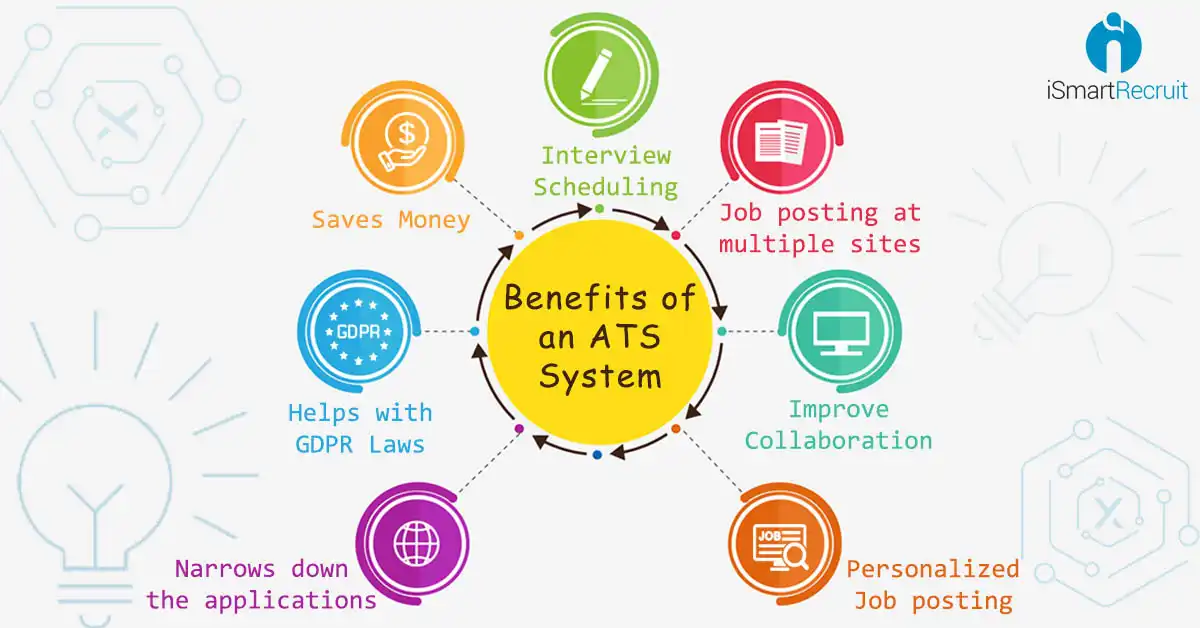
Following Are the Key Benefits of Using an Applicant Tracking System
- Reduces time-to-hire through end-to-end process automation
- Improves candidate quality through AI-powered matching and skills-based filtering
- Centralises all recruitment data in a single, searchable system
- Enhances collaboration between recruiters, hiring managers and interview panels
- Provides real-time analytics for data-driven hiring decisions
- Ensures compliance with data protection and employment law requirements
Beyond these headline benefits, an ATS also:
- Maintains a database of strong candidates from past processes for re-engagement when relevant roles open reducing cost-per-hire on future searches by drawing on an already-qualified talent pool.
- Scores and ranks incoming applicants automatically, allowing recruiters to focus manual review time on the candidates most likely to progress.
- Enables job description templates to be reused across similar roles, reducing time-to-post for recurring vacancies.
- Manages job advertisement distribution across internal career sites, external job boards including Indeed and Monster, and social platforms including LinkedIn.
- Compiles a unified candidate profile including application history, communication logs and interview notes giving every team member the same complete view of each candidate.
- Sends automated interview reminders, status notifications and next-step instructions, improving the candidate experience without adding recruiter workload.
ATS vs Manual Recruitment Process
The key differences between manual recruitment and an ATS can be seen in several important areas:
- Resume Screening: Manual recruitment requires recruiters to review every CV individually, while an ATS can automatically parse, screen, and rank resumes based on job requirements.
- Application Tracking: Manual hiring often relies on emails and spreadsheets, which can make tracking difficult. An ATS centralises candidate information and provides a real-time view of the recruitment pipeline.
- Candidate Assessment: Manual processes may lead to inconsistent evaluations and a higher risk of bias. An ATS supports structured, criteria-based candidate matching and assessment.
- Reporting: Manual recruitment data is often compiled by hand, while an ATS provides real-time recruitment analytics and performance reports.
- Communication: In manual hiring, candidate communication may be scattered across individual emails. An ATS helps automate, organise, and track candidate communications.
- Compliance: Manual recruitment requires records to be maintained manually. An ATS helps organise candidate data and supports GDPR compliance, audit trails, and secure record management.
Final Thoughts on Applicant Tracking Systems
An Applicant Tracking System is no longer a technology advantage reserved for large organisations with dedicated HR technology budgets. In 2026, it is the operational baseline for any recruitment team that wants to hire efficiently, consistently and compliantly regardless of team size or hiring volume.
By automating resume screening, interview scheduling, job board distribution and compliance management, ATS software gives recruiters the capacity to manage significantly more requisitions without proportionally increasing headcount while improving rather than compromising the quality of both the candidate experience and the hiring decisions produced. Organisations that have not yet adopted an ATS are not just operating less efficiently than their competitors; they are making it harder to attract the best candidates at every stage of the process.
If your team is still managing recruitment through spreadsheets and email, now is the right time to change that. The right ATS will immediately return measurable time savings, reduce administrative errors and give your hiring managers the consistent, data-rich process they need to make better decisions every time.
Frequently Asked Questions About ATS
1. What does ATS stand for in recruitment?
ATS stands for Applicant Tracking System, a software tool used to manage job applications and streamline recruitment processes.
2. Do small businesses need an ATS?
Yes. Even small businesses benefit from ATS software by reducing administrative workload and improving hiring efficiency.
3. How does an ATS screen resumes?
An ATS uses keyword matching and AI algorithms to analyse resumes and rank candidates based on job requirements.
4. What is the difference between an ATS and a recruiting CRM?
ATS manages active applicants through open requisitions, while a recruiting CRM manages longer-term relationships with passive candidates and talent pools for future hiring.
5. How long does it take to implement an ATS?
Most ATS platforms can be configured and ready to use within one to four weeks, depending on integration complexity and data migration requirements.
6. Can an ATS integrate with other HR software?
Yes. Most modern ATS platforms integrate with HRIS, payroll systems, job boards, assessment tools and calendar applications through pre-built connectors or open APIs.
About the Author