


A recruiter may write a strong outreach email, choose the right candidate, and send it at the right time. Still, the candidate may never see it. The email might not be ignored because the role is weak or the message is poor. It may simply fail to reach the inbox.
That is where recruitment email deliverability becomes important. If recruiter emails land in spam, promotions, or low-visibility folders, even the best-written message will struggle to get replies. For hiring teams, the issue is not always what the email says. Sometimes, the bigger problem is whether the email reached the right place at all.
This matters because recruiter communication already affects how candidates judge the hiring process. Missed replies, delayed updates, and unclear follow-ups can create frustration. When email deliverability problems are added to that, candidates may feel ignored even when the recruiter is actively trying to reach them.
TL;DR
- Recruiter emails may miss inboxes because of weak sender reputation, poor list quality, missing authentication, or low candidate engagement.
- Recruitment email deliverability depends on how mailbox providers evaluate sender behaviour, email relevance, and engagement signals.
- Falling reply rates, lower open rates, high bounce rates, and spam complaints can show that emails are not reaching the inbox properly.
- Inbox warm-up helps recruiters build trust gradually before sending large outreach campaigns.
- Recruiters also need better communication workflows so candidate follow-ups, replies, and updates do not get missed.
- Personalised messages, clean email lists, proper SPF, DKIM, and DMARC setup, and regular engagement tracking can improve inbox placement.
Common Reasons Recruiter Emails Miss Inboxes
Recruiter emails usually miss inboxes because of a mix of reputation, sending behaviour, engagement, technical setup, and list quality. Here are the main reasons hiring teams should check first.
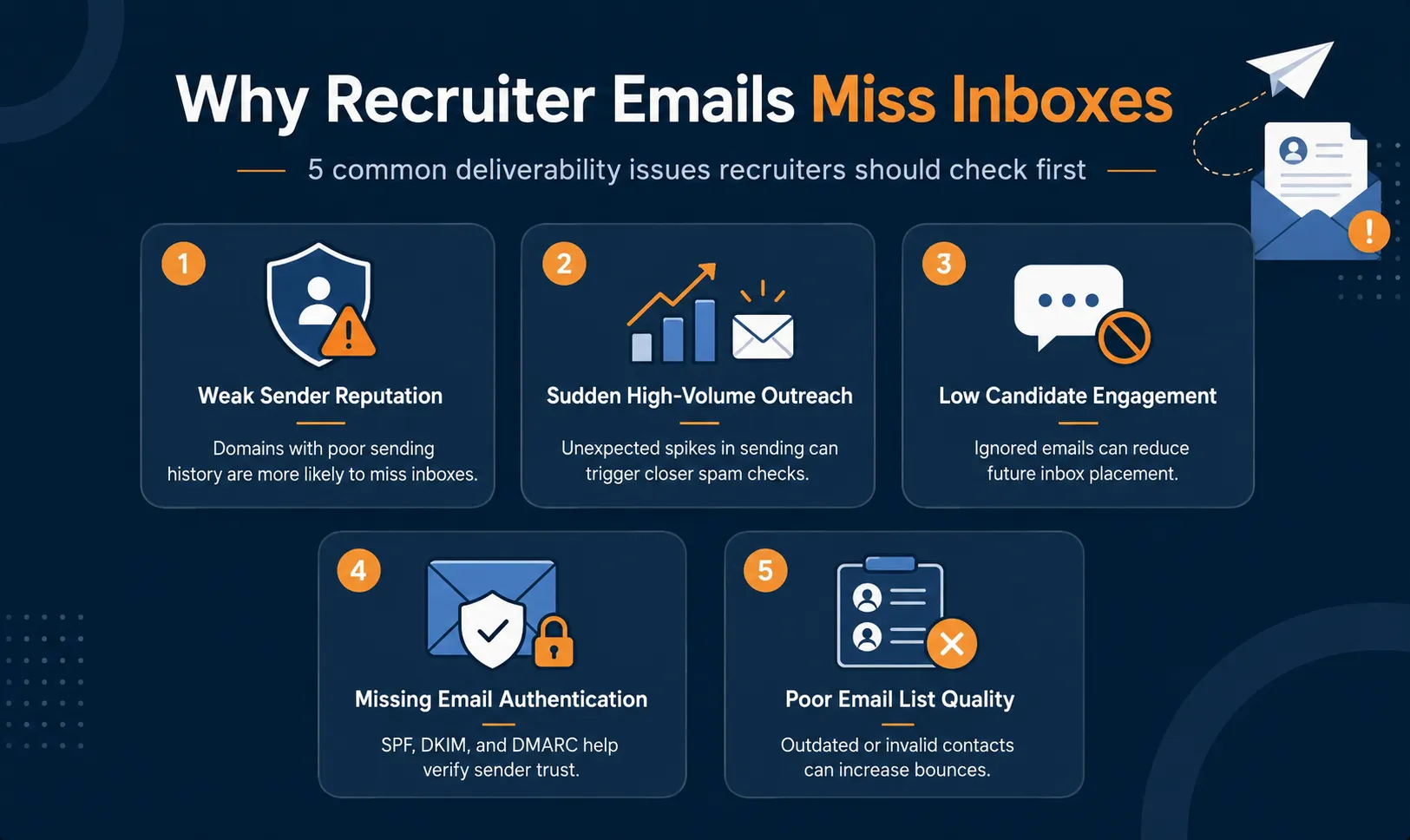
1. Weak Sender Reputation
Most issues start with a weak sender reputation. Providers rate domains and senders based on their sending history. When recruitment emails come from a domain linked to ignored messages, frequent bounces, or spam complaints, future recruitment emails often land out of sight.
2. Sudden High-Volume Outreach
Large outreach campaigns can also create problems. Sending a high volume of emails is not always bad. Many recruiting organisations send large volumes successfully. Many teams rely on outreach platforms such as Snov.io to schedule and manage cold email campaigns more consistently, helping avoid abrupt spikes in sending activity.
What usually causes problems is a sudden jump in activity that looks very different from normal sending behaviour. From the mailbox provider’s perspective, unusual sending patterns often lead to closer inspection.
3. Low Candidate Engagement
Low engagement is another issue. Recruiters naturally care about replies because replies lead to interviews. Email providers care about them, too.
If candidates consistently ignore outreach messages, mailbox providers may start treating future emails from that sender more cautiously. This can make recruitment email deliverability weaker over time.
4. Missing Email Authentication
Authentication problems add to the issue. SPF, DKIM, and DMARC help verify that messages are legitimate and actually originate from the domain they claim to come from.
Without that foundation, inbox placement becomes harder to achieve. This is especially important for recruitment teams sending regular outreach from dedicated hiring or sourcing domains.
5. Poor Email List Quality
Then there is list quality. People leave companies. Email addresses change. Even entire domains are discontinued after acquisitions or rebrands.
A recruiting list that performed well last year may contain a surprising number of invalid contacts today, especially when older candidate databases are not reviewed regularly. If those addresses are not cleaned, they can increase bounces and reduce email deliverability.
How Modern Spam Filters Evaluate Recruiter Emails
Years ago, spam filters were much simpler. Today, they rely on machine learning models and behaviour-based signals to evaluate emails. Patterns now matter more than simple word triggers when AI filters assess email traffic.
Several engagement metrics play a role in these decisions. Reply rates are especially valuable because they reflect real conversation. From a provider’s perspective, a candidate responding to a recruiter is a strong sign that the message served a legitimate purpose.
Open rates can still provide useful direction, although they are no longer as precise as they once were because of privacy protections introduced by some providers. This is why recruiters should avoid relying on open rates alone and should also monitor replies, bounces, complaints, and overall campaign trends.
Relevance now plays a bigger role than many recruiters realise. Most professionals can recognise a mass recruiting email within seconds. But an email that references a candidate’s experience, technical skills, or career path is more likely to get attention. This often creates stronger engagement signals, which can support future recruitment email deliverability.
Warning Signs Your Recruitment Emails May Be Missing the Inbox
Deliverability issues are not always obvious. Usually, recruiters notice symptoms before they identify the cause.
Response rates may begin drifting downward even though nothing in the outreach has changed much. Sometimes teams assume the market has become less responsive. Occasionally, that is true. Other times, inbox placement is quietly contributing to the problem.
Open rates can offer another clue. They are not perfect measurements anymore, but noticeable declines across multiple campaigns deserve investigation. Bounce rates are worth watching closely as well. An increase in bounced emails often points to ageing data or list quality issues that may eventually affect sender reputation.
Spam complaints are also major indicators. Even relatively small increases can influence how providers view future messages from your domain. As a recruiter searching for how to know if emails are going to spam, monitoring engagement trends, inbox placement patterns, and deliverability metrics can help uncover problems before they start affecting hiring performance in a significant way.
How Inbox Warm-Up Helps Recruiters Reach More Candidates
When a new recruiting domain begins sending outreach, mailbox providers have very little historical data to work with. That lack of history creates uncertainty.
Email warm-up helps reduce that uncertainty by gradually establishing trust over time. Instead of moving immediately from little or no activity to large-scale outreach, warm-up allows positive engagement signals to build naturally.
This can be especially useful for recruiting agencies launching new domains, internal recruiting teams creating dedicated outreach infrastructure, or organisations preparing for major hiring campaigns.
In practice, before rolling out large hiring campaigns, some recruitment teams slowly build up email activity using a strong inbox warmup strategy. Reaching the right candidates becomes more likely when emails appear trustworthy. This allows recruiters to build gradual engagement without raising red flags.
Best Practices to Improve Recruitment Email Deliverability
Improving recruitment email deliverability is not about one single fix. Recruiters need a mix of better messaging, cleaner data, stronger technical setup, and more consistent communication habits.
Personalise Outreach for Better Engagement
One reason some hiring firms succeed is personalisation. When job seekers see a clear connection between their experience and the message they receive, engagement is more likely to follow.
A personalised message feels more relevant, less generic, and more worth responding to. This can improve replies and help create stronger engagement signals over time.
Use Clear Communication Workflows
Poor candidate communication is not always intentional. In many cases, recruiters are handling multiple roles, follow-ups, interviews, hiring manager updates, and candidate conversations at the same time. When there is no clear system to manage these moving parts, even important emails can be delayed, missed, or forgotten.
This directly affects the candidate experience. A candidate may not know whether the recruiter is overloaded, waiting for feedback, or simply unable to respond on time. From the candidate’s side, the silence can feel like ghosting, even when the real issue is a lack of structure.
That is why better communication workflows matter. Recruiters need organised reminders, clear follow-up tracking, and a reliable way to manage every candidate conversation. When communication becomes more consistent, candidates are more likely to engage, reply, and trust the hiring process, which can also support stronger recruitment email deliverability.
Keep Email Lists Clean
A well-maintained email list matters just as much. Removing incorrect, unused, or outdated email addresses on a routine basis lowers bounce rates and helps protect sender reputation.
This is especially important for recruitment teams that use older candidate databases or run large outreach campaigns. Clean data helps recruiters avoid unnecessary bounces and improves the chances of reaching active candidates.
Set Up Proper Email Authentication
You should also treat authentication as a core requirement rather than a technical checkbox. Proper SPF, DKIM, and DMARC configuration helps establish trust before a candidate even opens the email. Because these settings often require access to domain and email service credentials, storing them securely with a password manager can help reduce the risk of unauthorized changes or lost access.
Without these records, mailbox providers may struggle to confirm whether the message is legitimate. That can make inbox placement harder, especially for new domains or high-volume outreach campaigns.
Maintain Consistent Sending Behaviour
Consistent sending behaviour also matters. Sudden spikes in outreach can look suspicious, especially when emails are sent from a newer domain.
Recruiters should increase activity gradually, especially before large hiring drives or high-volume outreach campaigns. A steady sending pattern looks more natural and helps reduce the risk of deliverability problems.
Track Engagement Metrics Regularly
Most importantly, keep an eye on engagement metrics. This includes reply rates, open rates, bounces, and complaints.
These numbers reflect what is really happening behind the scenes. A slight dip today might signal a bigger problem tomorrow. Regular tracking helps recruiters identify issues early and adjust their outreach before deliverability starts affecting hiring results. Many teams use an email deliverability tool to monitor these signals automatically rather than checking each metric manually across campaigns.
Improve Candidate Outreach With Smarter Recruitment Tools
Email deliverability is only one part of successful recruitment outreach. Recruiters also need organised candidate data, clear follow-up reminders, and a smoother way to manage communication across the hiring process.
When outreach is scattered, candidates can be left waiting even when the recruiter did not intend to ignore them. A structured system helps hiring teams track conversations, manage follow-ups, and keep candidate communication consistent.

Conclusion
Recruitment emails do not fail only because of weak messaging. Sometimes, they fail because candidates never see them in the first place.
Improving recruitment email deliverability helps recruiters protect sender reputation, reduce missed opportunities, and improve the chances of reaching qualified candidates. Clean data, relevant outreach, proper authentication, steady engagement, and better follow-up systems all work together to support better inbox placement.
When recruiter emails reach the primary inbox, hiring teams have a better chance of starting real conversations. When those conversations are tracked properly, candidates are less likely to feel forgotten. Together, better deliverability and better communication create a smoother recruitment process for both recruiters and candidates.
Frequently Asked Questions
1. Why do recruiter emails miss inboxes?
Recruiter emails may be missed in inboxes because of weak sender reputation, poor list quality, missing authentication, low engagement, or spam complaints. Mailbox providers look at how recipients interact with emails before deciding where future messages should land. If emails are ignored, bounced, or marked as spam, deliverability can become weaker over time.
2. What is recruitment email deliverability?
Recruitment email deliverability refers to how successfully recruiter emails reach a candidate’s inbox instead of landing in spam or low-visibility folders. It depends on sender reputation, authentication, email quality, list health, and candidate engagement. Strong deliverability helps recruiters get better visibility and more responses from outreach campaigns.
3. How can recruiters know if emails are going to spam?
Recruiters can look for signs such as falling reply rates, lower open rates, higher bounce rates, and more spam complaints. Inbox placement testing can also help identify whether emails are reaching the primary inbox or being filtered elsewhere. Monitoring these signals regularly helps teams find deliverability problems before they affect hiring results.
4. Why is inbox warm-up important for recruiters?
Inbox warm-up is important because it helps a new or inactive sending domain build trust gradually. Instead of sending a large number of emails immediately, recruiters increase activity slowly to create positive engagement signals. This reduces the risk of mailbox providers treating the campaign as suspicious.
5. How can recruiters improve recruitment email deliverability?
Recruiters can improve recruitment email deliverability by cleaning email lists, personalising outreach, setting up SPF, DKIM, and DMARC, and avoiding sudden spikes in sending volume. They should also track reply rates, open rates, bounces, and spam complaints. These practices help protect sender reputation and improve inbox placement.
6. Does personalisation improve recruiter email performance?
Yes, personalisation can improve recruiter email performance because candidates are more likely to respond when the message feels relevant to their experience. Referencing skills, career background, or role fit makes outreach feel less generic. Better engagement can also support a stronger sender reputation over time.
7. Why do recruiters sometimes miss candidate follow-ups?
Recruiters may miss candidate follow-ups because they are managing many roles, interviews, hiring manager updates, and outreach tasks at once. In many cases, poor communication is not intentional but comes from a lack of structure or overloaded workflows. Clear reminders, communication tracking, and organised candidate data can help recruiters respond more consistently.
About the Author