

AI executive recruiting is reshaping how organisations identify, evaluate and appoint senior leaders. For talent teams and executive search professionals, the promise is clear: artificial intelligence in executive recruitment can analyse complex networks, predict leadership potential and speed up time-intensive research. Yet practical adoption requires a measured approach that protects fairness, data privacy and the human judgement that matters most at board level.
TL;DR
- AI executive recruiting speeds C-suite searches with data-driven sourcing and predictive matching
- Use machine learning executive search techniques to map networks and uncover passive leaders beyond CVs
- Combine AI assessment with structured interviews to reduce bias and improve fit
- Focus on governance, transparency and vendor validation when deploying AI tools
- Measure time to placement, quality of hire and diversity uplift to demonstrate ROI
- Start with a pilot on a single C-suite role and scale with clear change management
- Human judgement remains critical; treat AI for executive search as augmentation rather than replacement
What all of this points to is a simple truth: in 2026, AI has earned a permanent seat at the executive search table, but it hasn't taken the chair at the head of it. The firms pulling ahead aren't the ones with the flashiest tech stack; they're the ones that know exactly where the algorithm's job ends, and the recruiter's begins, and they've built the governance, metrics, and trust to prove it.
For any organisation watching from the outside, the takeaway is just as simple. The C-suite hire that actually sticks won't come from AI alone, and it won't come from instinct alone either; it'll come from a search built on both, with a human still holding the pen on the offer letter.
Why recruiters should care about AI executive recruiting
Executive hiring is expensive, strategic, and often slow. A single C-suite search can stretch for months, and a wrong hire can cost millions in lost momentum, severance, and reputational damage. AI-powered executive hiring offers a way to compress that risk: it speeds research, sharpens candidate match precision, and reveals passive talent that traditional search misses. Heidrick, Korn Ferry, and Russell Reynolds have already cut C-suite timelines from 18-20 weeks to 14-16 weeks by building this in rather than treating it as optional. Done well, these tools help teams move faster without trading away rigour; the goal isn't a quicker hire, it's a better one that arrives sooner.
-
Cost of Getting It Wrong: A failed C-suite hire is more than a delayed search—it can result in lost strategic momentum, strained board relationships, and long-term reputational damage.
-
Speed Without Compromising Quality: Tools such as iSmartRecruit, HireEZ, and Eightfold can analyse over a billion candidate profiles across 30+ platforms, reducing weeks of manual sourcing to hours of focused research.
-
Improved Match Accuracy: AI helps identify skills, experience patterns, and behavioural indicators beyond what is visible on a résumé, enabling stronger candidate-fit assessments before interviews begin.
-
Access to Passive Talent: Many high-performing executives are not actively seeking new opportunities. AI-powered network and influence mapping helps uncover these candidates, expanding reach beyond job boards and inbound applications.
-
Human Judgment Remains Essential: AI can accelerate sourcing and analysis, but it cannot assess motivation, navigate board dynamics, build trust, or detect nuanced risks. The strongest executive search outcomes come from combining AI-driven insights with experienced recruiter judgment.
How AI transforms executive sourcing
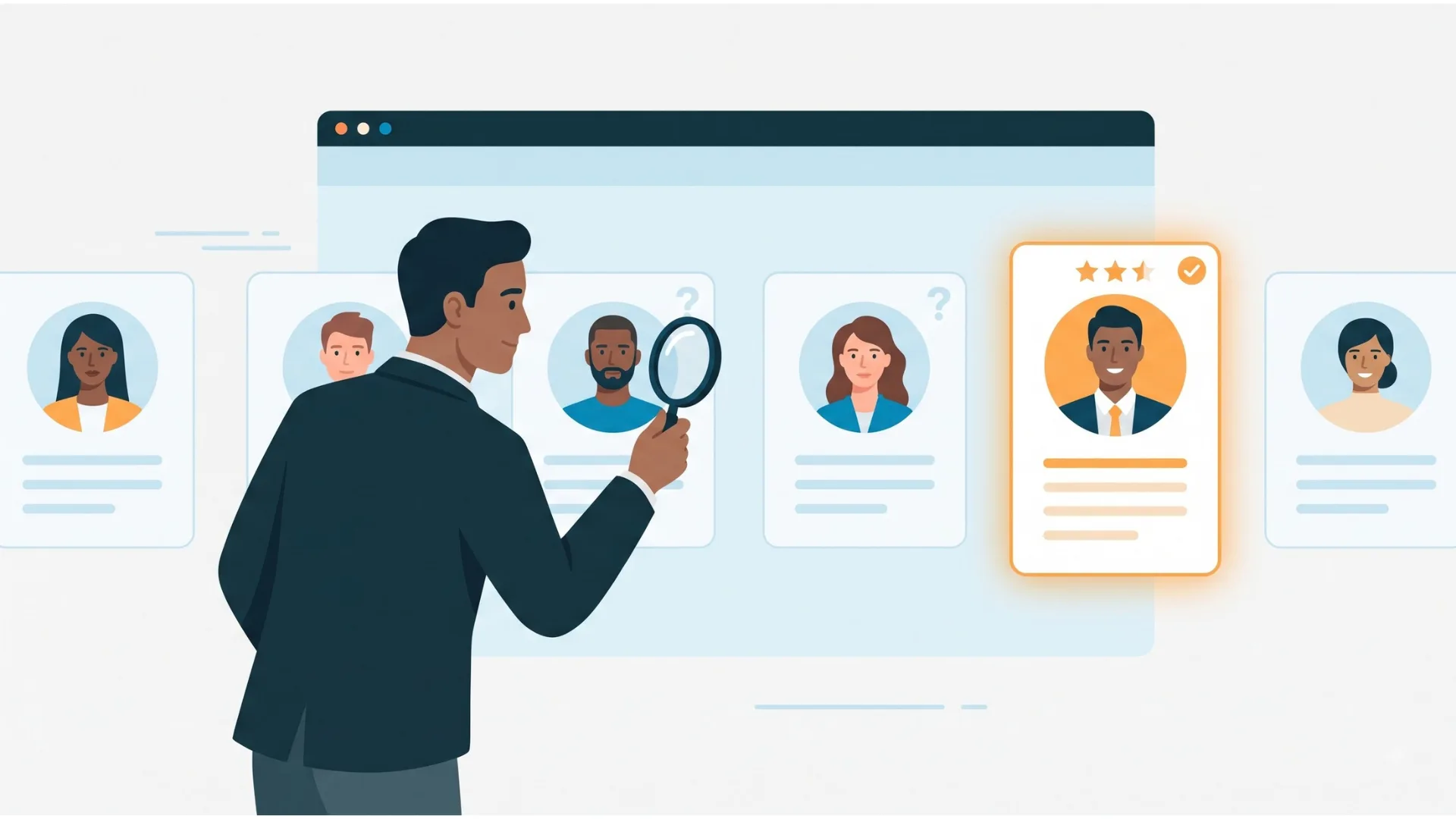
At the heart of AI executive recruiting is smarter sourcing. Instead of scanning CVs and public profiles manually, recruiters can use natural language processing and graph analytics to map real networks of influence. These models read leadership signals from non-standard sources such as patents, public filings and board minutes. They then surface candidates whose profiles align with role needs beyond the usual keyword match the core of what's now called AI candidate sourcing for executives.
Practical techniques
- Network graph analysis to identify cluster leaders and connectors within industries
- Semantic CV parsing that understands responsibilities and outcomes rather than job titles
- Signal enrichment from multiple sources including publications, talk appearances and regulatory records
Real example
A pan-European technology firm used AI executive recruiting to find a CTO candidate with both deep cloud engineering experience and boardroom exposure. The algorithm surfaced three passive candidates who had rarely applied for roles but had authored influential technical standards. One appointment accelerated the company's cloud strategy and reduced vendor spend by over 20 per cent within two years.
Assessing leaders with AI: strengths and safeguards
AI can add objectivity to leadership assessment by scoring competencies from structured datasets and interview transcripts. Predictive models can highlight likely performance indicators while psychometric analysis identifies behavioural tendencies. However, these outputs must be validated and explained during the hiring process.
Combining AI with human assessment
- Use AI to shortlist and provide insights, then apply structured interviews and reference checks to confirm fit
- Prioritise explainability so hiring panels understand which factors influenced a recommendation
- Retain panel decision rights; AI should inform, not decide
AI amplifies assessment, it does not replace the prudent judgement required for C-suite appointments.
Bias, fairness and compliance in executive search
Bias is an important concern in any recruitment process. If training data reflects historical hiring patterns, AI executive recruiting systems can replicate past imbalances. Mitigation requires active steps including data audits, demographic impact testing and the use of counterfactual validation sets.
Steps to reduce bias
- Audit training data for skew and remove proxies that encode protected attributes
- Apply fairness metrics and test recommendations across demographic slices
- Document decisions and maintain a human oversight committee for final approvals
Compliance and privacy
Executive searches often handle sensitive personal data. Ensure your AI suppliers comply with applicable data protection rules and provide clear data provenance. For multinational assignments, check cross-border transfer controls and retention policies before sharing candidate data.
Vendors vary widely in capability and trustworthiness. Before you compare options, this executive search software overview is worth a read for the broader buying criteria. Use the checklist below to compare options.
Designing an AI-enabled executive hiring process
A practical process redesign helps teams adopt artificial intelligence in executive recruitment effectively. Start by mapping the current workflow and identify high-effort steps where AI adds clear value. Typical pilot areas include passive candidate identification, CV screening for leadership outcomes and automated reference synthesis.
Pilot framework
- Choose a representative C-suite role with committed stakeholders
- Define success metrics such as reduction in research hours, candidate quality and diversity uplift
- Run the pilot with parallel human review and capture lessons for wider rollout
Vendor selection checklist for AI executive recruiting tools
Vendors vary widely in capability and trustworthiness. Use a checklist to compare options.
- Data sources and enrichment methods
- Explainability and model documentation
- Bias mitigation protocols and audit reports
- Integration with your ATS and CRM
- Security, compliance certifications and data residence options
- Customer success support and customisation ability
Integration tips
Integrate candidate intelligence into your ATS workflows so sourcers and hiring managers see the same insights, not separate dashboards that drift out of sync. Automate non-sensitive tasks such as outreach scheduling and candidate updates to free senior recruiters for high-value engagement the conversations around motivation and fit that AI still can't read or manage on its own.
Measuring impact and demonstrating ROI
To justify investment, look past time-to-hire alone a fast placement that doesn't stick isn't a win. Track quality of hire, retention of placed leaders over the first 12-18 months, and the business outcomes that trace back to the new appointment, whether that's revenue growth, a key strategic initiative delivered, or team stability under the new leader. These are the numbers that actually prove an executive search worked, not just that it was quick.
Key metrics
- Time to shortlist and time to offer
- Quality of hire as rated at six and twelve months
- Promotion and retention rates of hired executives
- Diversity of final slate and hires
- Hours saved in research per hire
Case studies and credible evidence
Multiple talent leaders report benefits from AI executive recruiting. For example, a multinational financial services group used predictive models to prioritise 50 high-potential leaders for a succession programme. The cohort delivered a higher promotion rate and faster readiness for key roles compared with a control group.
Industry research supports adoption. For large-scale evidence and perspectives, see resources such as McKinsey and LinkedIn, which discuss AI's influence on talent decisions and sourcing efficiency. These analyses show AI is not a silver bullet but a powerful augment when governed responsibly.
Implementation roadmap for HR and search firms
Execution matters. Follow a staged approach that combines quick wins with longer-term change.
- Assessment: Identify business needs, target roles, and evaluate data readiness for AI-powered recruitment.
- Pilot: Select a specific role and run AI-assisted candidate searches alongside traditional sourcing methods.
- Validate: Compare outcomes, measure effectiveness, gather feedback, and refine AI models and search prompts.
- Scale: Expand AI-assisted recruitment to additional roles and teams, supported by standardised operating procedures (SOPs).
- Govern: Establish ongoing audits, human oversight, compliance checks, and regular vendor performance reviews to ensure responsible AI adoption.
People and change
Success depends on stakeholder buy-in. Train hiring panels to interpret AI insights, not just receive them a score or ranking means little if the board or hiring committee doesn't understand what's behind it or where it falls short. Communicate clearly, and early, that AI supports better decision-making and does not eliminate human accountability for appointments. Companies evaluating AI tools should prioritise transparency, compliance, and balance, and that same standard applies internally: the people making the final call need to feel ownership of it, not deference to an algorithm.
Practical tools and feature set to prioritise
When evaluating platforms, prioritise capabilities that matter for executive search.
- Deep profile enrichment combining public records and signals: look for platforms that pull from career history, public filings, and behavioural signals rather than relying on a single data source, since the strongest tools in 2026 like iSmartRecruit, HireEZ and Eightfold now map well over a billion candidate profiles across 30+ platforms.
- Network and influence mapping to find non-obvious leaders: This is what surfaces passive candidates who've never applied anywhere or updated a profile, by tracing who they're connected to and who actually defers to them internally.
- Explainable scoring and evidence trails: Every match needs a "why," not just a rank; a score with no audit trail behind it is a liability the moment a client or regulator asks how a shortlist was built.
- Integration with interview kits and reference workflows: This only adds value if assessment results flow directly into the structured interview and reference-check process instead of sitting in a separate report.
- Flexible data governance and on-prem or private-cloud options: confidential C-suite searches often can't sit on public cloud infrastructure, so the platform needs to support private deployment alongside the bias-audit and candidate-notification requirements now in effect across several states.
Conclusion
AI executive recruiting has moved past the experimental stage and is now reshaping the C-suite hiring playbook in practice, not just in theory. What's changed from 2024 to 2026 is the shift from experimentation to integration: firms are no longer testing AI tools; they're embedding them into daily workflows. Used thoughtfully, AI compresses research timelines, sharpens match quality through skills-based mapping rather than keyword matching, and surfaces passive leadership talent that traditional sourcing would never reach, including candidates who strengthen diversity outcomes.
The path forward is the same one that's always worked with new technology: start with a single pilot search, measure what actually moves time-to-placement, quality of hire, diversity uplift and scale only once the controls are proven. The most successful firms in 2026 aren't choosing between AI and human expertise; they're combining both, and that combination, built on the right guardrails, is what turns AI from a sourcing shortcut into a genuine strategic partner for better leadership decisions.

FAQs - Frequently Asked Questions
1. What exactly is AI executive recruiting?
AI executive recruiting refers to the use of artificial intelligence and machine learning to support senior-level search activities. This includes sourcing passive candidates, enriching profiles, predicting role fit and synthesising references. It is aimed at improving speed and accuracy in C-suite hiring.
2. Will AI replace executive recruiters?
No. AI is best understood as augmentation. It handles data-heavy tasks and uncovers candidates that would otherwise be missed. Human recruiters still lead engagement, cultural assessment and final decision-making, which are critical for leadership hires.
3. How do I prevent bias in AI executive recruiting?
Prevent bias by auditing training data, running demographic fairness tests, removing proxies for protected attributes and keeping humans in the loop for final selection. Choose vendors that publish model documentation and fairness validation results.
4. Which metrics should I track to evaluate success?
Track time to shortlist, time to offer, quality of hire at six and twelve months, retention and diversity uplift. Also monitor hours saved in research and stakeholder satisfaction with candidate quality.
5. Can AI find passive C-suite candidates?
Yes. Modern AI tools analyse non-conventional signals and network relationships. They can surface leaders who rarely apply for roles but whose public contributions and network position indicate suitability for senior appointments.
6. How do I start a pilot for AI executive recruiting?
Begin with a single C-suite role, define clear success metrics, run the AI-enabled process in parallel with your existing approach and compare outcomes. Use results to refine model inputs and build stakeholder confidence before wider rollout.
7. Does AI help with leadership assessment beyond CVs?
Yes. AI can analyse interview transcripts, performance signals and leadership outcomes to support assessment. These insights should supplement structured interviews and reference checks rather than replace them.
About the Author