


The interview is a crucial stage of the hiring process because it helps recruiters understand candidates beyond their resumes. There are three main types of interviews: unstructured, semi-structured, and structured interviews. Among these, structured interviews are often the most effective for reducing hiring bias.
TL;DR
- Structured interviews use a standardised set of questions ensuring consistency and reducing hiring bias.
- They can include open-ended, close-ended, or a combination of questions to assess candidates thoroughly.
- Preparation involves job analysis, defining requirements, creating questions, setting a grading scale, and conducting the interview systematically.
- Structured interviews are more credible, reliable, and promote diversity compared to unstructured interviews.
- Using technology like Applicant Tracking Systems can streamline scheduling and evaluation processes.
Structured interviews from among the different types of interviews are traditional and widely used by many organisations. It requires the recruitment team to develop a clearly defined purpose for each interview being conducted. So, every candidate asked the same set of questions, and responses will be assessed using the same criteria. This blog talk about everything you need to know about structured interviews. So, let’s start!
.webp.dat)
What is a Structured InterviewNULL
A structured interview is defined as a form of candidate interview with a series of standardised questions used for interviewing all the interviewees. The meaning of a structured interview can also be taken as a standardised interview.
The questions asked are in a sequence, and no other question is added to the interview except the ones listed. The meaning of a structured interview lies in its name. It means that the interview questions are organised and structured. With a list of questions, you, as an interviewer, would not lose track of the purpose of the interview and will remain consistent with your queries.
Pro Tip: Structured interview framework is an imperative asset for recruiters to streamline the interviewing process. For instance, Google found that structured interview saves their hiring managers an average of 40 minutes per interview.
Types of a Structured Interview
The types of structured interviews depend on your job roles, position, and the type of knowledge, skills, attitudes, behaviours, and other attributes required for the job. Structured interview examples include behavioural and situational interviews. A structured interview contains two types of questions in itself. These types are as follows.
1. Open-Ended questions
In this form of an interview, the questions remain sequential. However, the answers need to be elaborative. The candidate can continue answering until they believe it is all that they want to say for the question asked. The interview allows the candidate to carry on and get to the depth of their answers. If you are looking for a detailed answer, you can ask open-ended questions during the process.
Example: "Tell me about a time you managed a project with competing deadlines. How did you prioritise your work?"
2. Close-Ended questions
In this form of a structured interview, you ask ‘yes or no’ questions to the candidates. These are point-to-point questions where you do not require elaborative answers from your candidates.
For instance, if you want to ask them if they are UK nationals, the answer you expect is either a yes or no. For such questions, the complete answer lies in a single word. This saves time, and you can move to the next question to complete your interview in due time.
Example: "Do you hold a valid project management certification?" or "Are you authorised to work in this country?"
These questions save time and keep early-stage screening focused. However, they reveal little about capability or fit on their own.
3. Combination of the two types of structured interviews
Your structured interview is a combination of both open and close-ended questions. An interview is not based on only close-ended questions but rather requires more insight about the candidate. Interviewers do not only ask questions but also observe the candidates when they answer the questions.
Things that they notice include their tone, body language, and confidence. You need to prepare a suitable questionnaire for a structured interview with the right proportions of open and close-ended questions.
How to Conduct a Structured Interview: Step-by-Step
A structured interview needs preparation for you to carry it out. It is not only a list of questions but is backed by many other processes. Next, we will tell you about the steps that will prepare you for carrying out a structured interview.
Tip: Make a list of predetermined questions that you can upload or paste into your Applicant Tracking System. It will eventually help you track the questions you ask.
Step 1: Conduct a Job Analysis
A job analysis consists of a job description and a job specification. In a job analysis, you need to thoroughly study the job post, its requirements, and its processes. You also need to identify the type of candidates suitable for the job. This should include the candidate's knowledge, skills, abilities, and other attributes required to perform the job. Once you know who and for what you are looking for, go to the next step.
Step 2: Define Your Requirements
Once you know the qualifications and skills of the candidates, along with the job duties they need to perform, jot them down. It will help you match the job and candidate to one another, and it will help you design your interview questions. Moreover, if you get clarity of your requirements, you can prepare job ads accordingly. By writing down the requirements, you can also analyse the behaviours, emotional intelligence, and attitudes required for the job.
Step 3: Create Interview Questions
Design questions while keeping in mind the situational and behavioural assessments of the candidates, too along with assessing their knowledge and smartness. This will help you add the right amount of probing and competency questions. If you want to test different competencies in the interview, add questions for each competency.
You can add as many or as few questions as you like. It depends on your requirements and the duration of your interviews, and the number of questions that you would want to add that fulfil your criteria for the structured interview.
Make sure to get an expert on board that has the knowledge, experience, and skills related to the field of the job. This will help you analyse and evaluate the candidates with greater specifications.
Step 4: Prepare a grading scale
A grading scale is very important for your structured interview. It helps you analyse your candidates according to the set criteria. For instance, your 5-7 points grading scale can include three levels named low, middle, or high. The person scoring lowest can be categorised as a poor qualifier with low confidence and behavioural requirements. This helps reduce bias in hiring, and you can easily figure out the best candidates based on their scores.
Step 5: Conduct the structured interview
Recruiters need to use online talent acquisition tools such as Applicant Tracking System, which comes with automated features like interview scheduling that automates the manual scheduling process and sending emails to the candidates and save valuable time for recruiters.
Once you're done with the scheduling, carry out the interview and grade the candidates. It is difficult to resist asking random questions but train yourself. Also, get an expert on board to help you understand the answers better. Also, take notes of the main pointers to remember the candidate's answers for later reference.
Make sure that you do not hurry the process and provide a warm welcome to the candidate so they feel at ease. Train yourself on the attributes you need to possess to carry out an effective interview process.
Structured Interview Example
The following incident illustrates how the structured interview process is executed and the type of questions that might be asked during the interview process:
Rachel is the hiring manager in an IT startup, and she is looking for the most suitable candidates to fill the marketing position within the organisation. So, prior to conducting the interview forum with the interviewees, Rachel decided to ask specific questions to candidates.
She decided on the meeting location and scheduled the interviews. Basically, Rachel prepared both kinds of questions, open-ended questions and close-ended questions, to obtain knowledge about the candidate’s technical skills, past experience, and personality. The questions she prepared followed a certain order:
- "How did you first learn about this opportunity, and what about the role made you want to apply?"
- "Tell me about a marketing campaign you led from brief to launch. What was your process, and what were the results?"
- "How do you use data to inform your marketing decisions? Give me a specific example."
- "Describe a time you had to adapt a campaign strategy mid-execution. What triggered the change and what did you do?"
- "If you discovered that a planned campaign was unlikely to hit its objectives three weeks before launch, what steps would you take?"
Once Rachel was done interviewing the candidates with the same standardised format, she analysed and compared the candidates’ responses to find out the most suitable applicant for the open role. Eventually, she can choose and hire the right-fit candidate and place the job offer.
Benefits of a Structured Interview
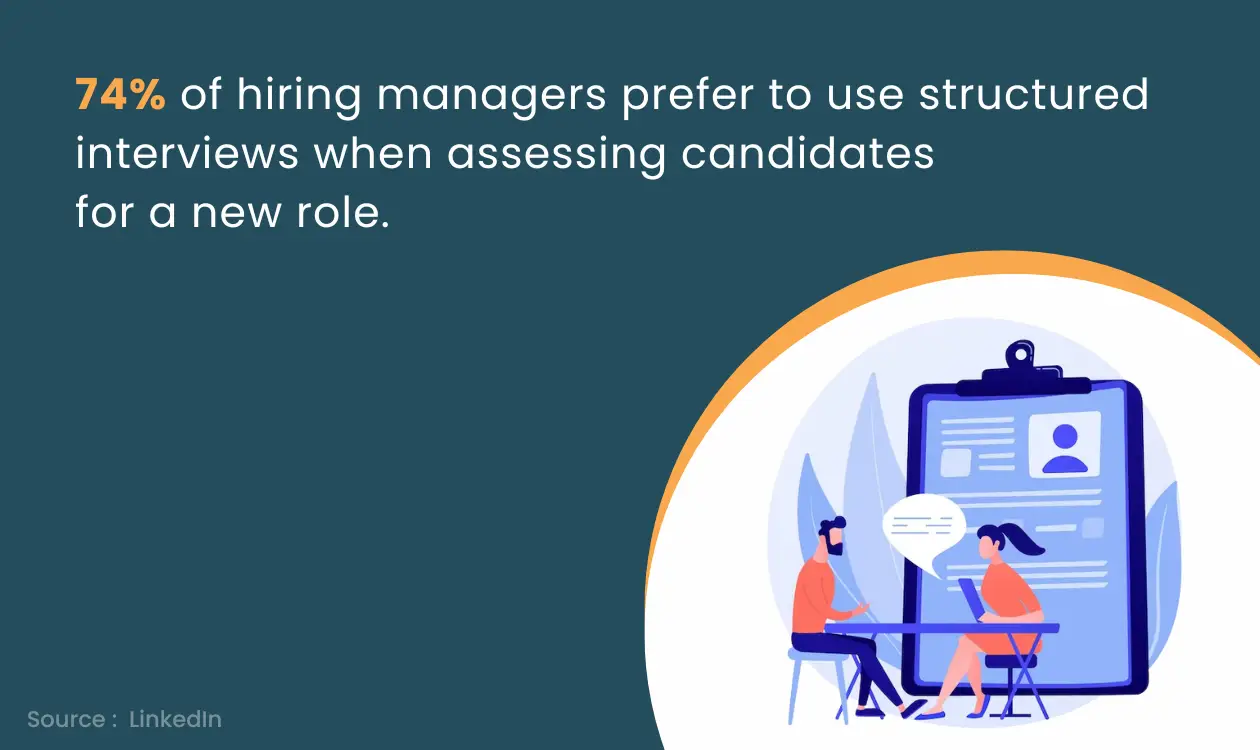
Structured interviews are more reliable compared to unstructured interviews. There are many benefits of carrying out a structured interview. These benefits are as follows.
1. Reduce bias
A structured interview is a great way to reduce bias during an interview. Oftentimes, a candidate is a great speaker or looks good. It fascinates the interviewer, and irrespective of many red flags, they hire them. A structured interview provides a direction and specifies the questions and their answers. It is easier to choose a candidate based on relevant questions than getting off-track and bringing bad hires on board.
2. Higher Credibility
Structured interviews are more credible and reliable than unstructured interviews. Oftentimes the purpose of the interview is lost during an unstructured interview, and the interviewers can have a random conversation.
Think, for example, if a candidate you interview has a similar interest in swimming as you do. During the interview, you read out his swimming interview from his resume and then discuss his coach, the club that he goes to, etc. till now, you have gone in the wrong direction, and on the bases of that discussion, you make a hiring decision.
This not only creates bias but is also less credible. You may not be analysing or evaluating the candidates correctly, but with structured interviews, you have a scoring guide, and you can easily evaluate the candidate's performance by referring to their scores.
3. Encourages diversity
As we discussed, structured interviews are less biased. This means when you interview candidates from different backgrounds, you can easily pick any candidate with the help of structured interviews. So, if you plan to perform better, a structured interview is your building block.
4. Scales Efficiently with Technology
In 2026, 87% of employers use skills-based practices at the interview stage, according to NACE data. Structured interviews are the natural evaluation method for skills-based hiring, because they allow you to assess demonstrated ability consistently across a large candidate pool. Combined with ATS platforms and AI-assisted scoring tools, structured interviews scale without sacrificing quality.
Structured VS Unstructured Interviews
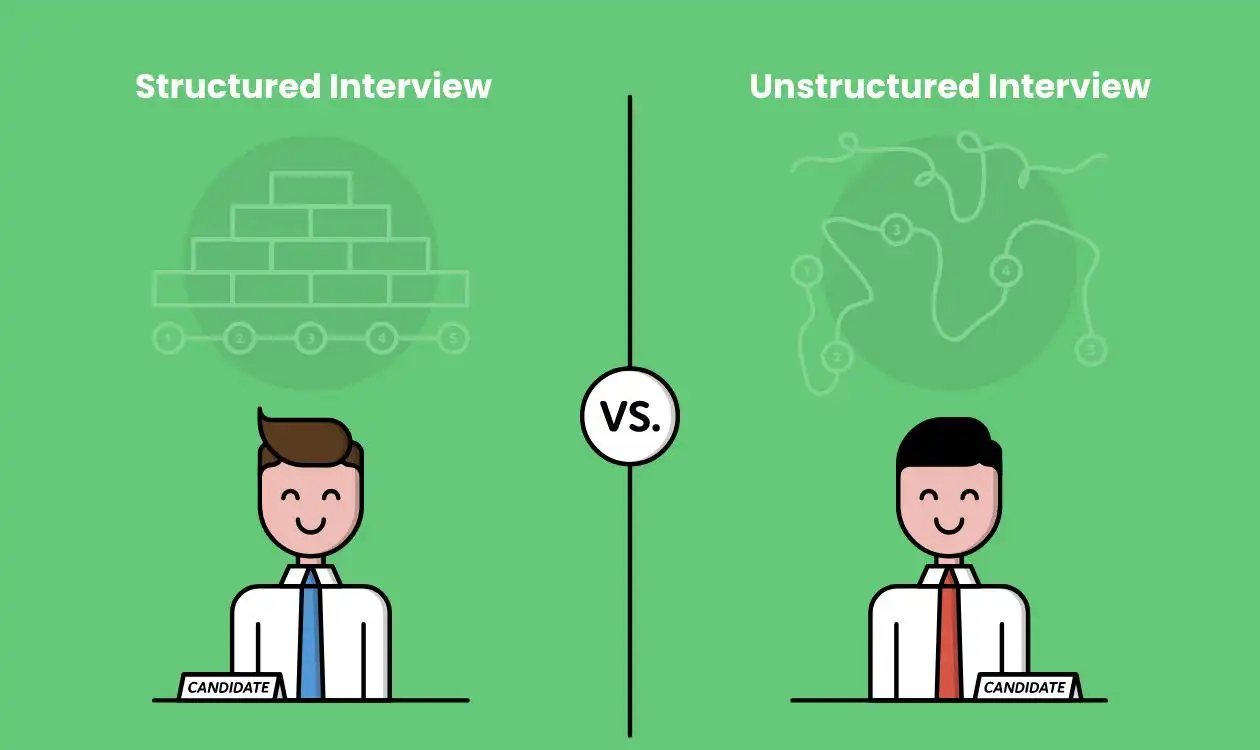
Unstructured interviews are not without value. They can reveal a candidate's conversational intelligence and create a more relaxed dynamic. But as a primary hiring tool, the data is clear: they are less reliable, more biased, and harder to defend. Research from Shortlist found that unstructured interviews have less than a 25% probability of accurately predicting candidate performance.
The best practice in 2026 is to use structured interviews as the core evaluation method, with unstructured conversation reserved for employer branding moments, like giving candidates a genuine sense of team culture and what the role looks like day to day.
Structured Interviews and Technology in 2026
Technology has made it significantly easier to implement and scale structured interviews without increasing recruiter workload.
Applicant Tracking Systems allow recruiters to upload standardised question sets, automate interview scheduling, assign scorecards digitally, and track evaluation data across multiple interviewers. This removes the administrative friction that historically made structured interviews feel labour-intensive.
AI-assisted tools now add another layer, summarising candidate responses, flagging scoring inconsistencies across panellists, and generating interview guides based on role competency frameworks. As of 2025-2026, 24% of companies use AI tools in some part of their interview process. Used well, these tools strengthen the structured process. Used poorly, they can introduce new forms of bias if not properly audited.
The principle remains the same: technology should reduce manual effort and support consistency. Human judgement, guided by a strong rubric, remains at the centre of every good hiring decision.
Conclusion
Structured interviews are not a bureaucratic formality. They are one of the most effective, evidence-backed tools available to recruiters and hiring managers who want to make smarter, fairer, and more defensible hiring decisions.
The process is straightforward: analyse the job, define what success looks like, build questions that test the right competencies, create a scoring rubric, and run every interview consistently. Done well, structured interviews reduce bias, improve predictive accuracy by up to 34%, and provide the documented evidence organisations need to support fair hiring at scale.
In a market where 80% of employers struggle to fill roles easily and the cost of a bad hire can exceed $?,000, investing in a structured interview process is not optional. It is one of the highest-return improvements any hiring team can make.

Frequently Asked Questions (FAQs)
1. What is a structured interview?
A structured interview is a standardized interview method where every candidate is asked the same job-related questions in the same order and evaluated using the same scoring criteria. It helps recruiters compare candidates fairly and reduce hiring bias.
2. What is the difference between structured and unstructured interviews?
Structured interviews reduce hiring bias by using predetermined questions, consistent evaluation criteria, and grading scales. This prevents interviewers from relying on personal impressions, irrelevant questions, or informal conversations.
3. Why are structured interviews more effective?
Structured interviews are more effective because they reduce bias, improve consistency, support fair candidate evaluation, and help recruiters make more accurate hiring decisions based on role-specific criteria.
4. How can iSmartRecruit help with structured interviews?
iSmartRecruit offers Applicant Tracking Systems that support uploading standardised questions, automating scheduling, and grading candidates, making your structured interview process smoother and more effective.
5. What are examples of structured interview questions?
Examples of structured interview questions include: “Describe a time you solved a workplace problem,” “How do you prioritise tasks under pressure?” and “What steps would you take to handle a difficult client?”
About the Author