


Candidate sourcing techniques are the methods recruiters use to identify and engage potential job candidates. These techniques have evolved significantly from manual CV searches and basic job adverts to modern strategies that combine Boolean search, niche platform targeting and artificial intelligence to surface the right talent faster and with greater precision than any single method can achieve alone.
For recruitment teams, understanding this evolution is not optional. The organisations winning the talent competition in 2026 are those that blend traditional sourcing rigour with AI-assisted tools finding and engaging the right candidates more efficiently while maintaining the personalised outreach that drives response rates. This guide covers the full spectrum of candidate sourcing techniques available today, from the foundational mechanics of Boolean search to the advanced AI capabilities reshaping how passive talent is identified and engaged.
TL;DR
- The most effective candidate sourcing strategies blend classic Boolean search with AI tools precision from the former, scale and pattern recognition from the latter.
- Use ATS and Recruiting CRM together to centralise talent pools, track outreach and prevent promising candidates from falling through the cracks between hiring cycles.
- Combine X-ray search, GitHub, LinkedIn and specialist industry forums for niche skill sets that standard job board searches consistently miss.
- Apply AI resume parsers and AI-job matching for smarter, faster shortlisting that surfaces candidates based on skills and potential, not just keyword matches.
- Measure time-to-hire, source quality and pipeline conversion consistently without these metrics you cannot know which sourcing channels are worth your investment.
- Automate the volume and scheduling parts of outreach, but keep personalised, specific messaging for the first contact especially with passive candidates.
The Evolution of Candidate Sourcing Techniques
Early sourcing relied on newspaper ads and CV books. Then came job boards and LinkedIn, followed by boolean search on search engines and social platforms. Today, candidate sourcing techniques include AI-driven search, predictive matching, and integrated Applicant Tracking Software that combines sourcing with hiring workflows.
Boolean remains foundational. It is precise and portable across platforms. But modern tools augment boolean with natural language search, semantic matching and AI-job matching that surface candidates who may not use the exact keywords you expect.
Real example: Merging Old and New
Imagine you are hiring a Python data engineer. A boolean search finds active profiles with relevant keywords. An Applicant Tracking System equipped with an AI resume parser reads CVs and scores candidates. AI-job matching then suggests passive candidates from your Recruiting CRM who match the role but have not explicitly listed the job title.
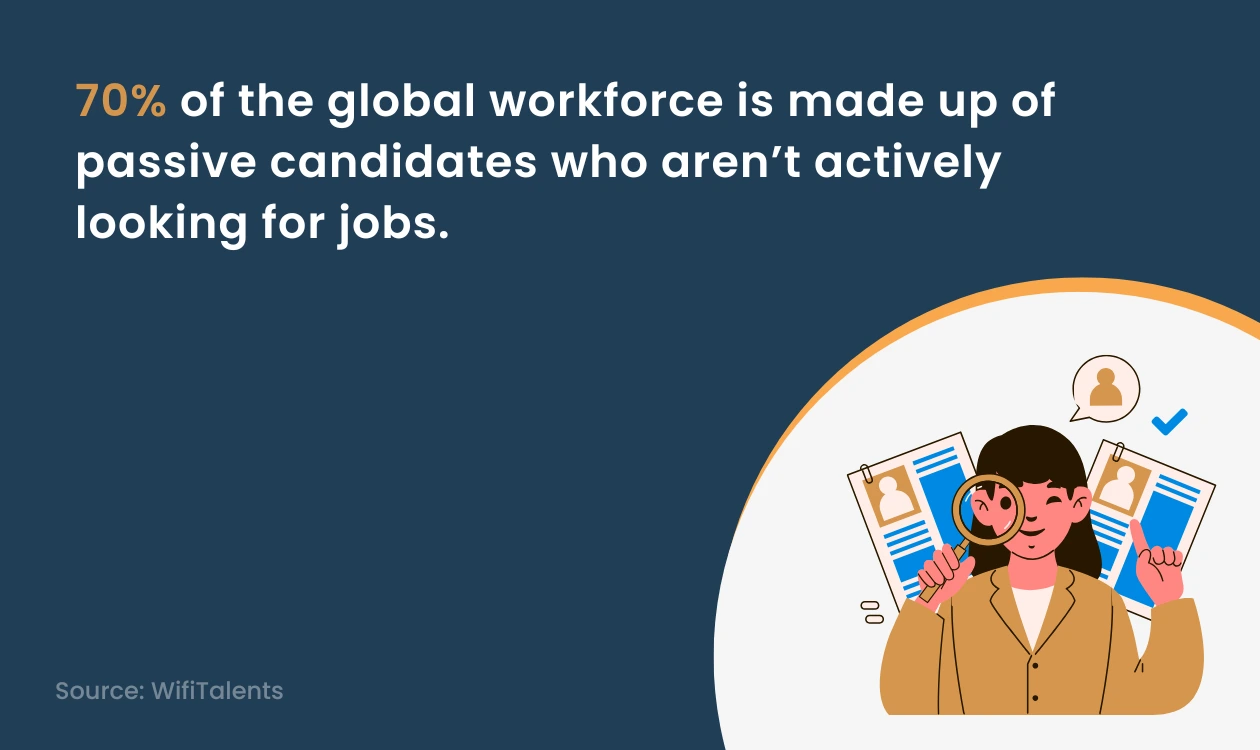
According to WifiTalents, around 70% of the global workforce consists of passive candidates, making proactive sourcing techniques essential for modern recruiters.
Core Candidate Sourcing Techniques
1. Boolean Search and X-Ray Search
Boolean search is the skill every recruiter should master before any other. Using AND, OR, NOT and parentheses, recruiters can construct precise queries that surface exactly the profiles they need filtering out noise and reducing the manual review burden at the top of the funnel. X-ray search extends this further by using Google's site: operator to search specific domains directly LinkedIn, GitHub, Stack Overflow, academic research portals and company websites finding profiles that platform-native searches would never surface.
Example boolean for a senior Java developer: ("Java" OR "J2EE") AND ("Spring" OR "Spring Boot") AND ("microservices") NOT ("intern" OR "junior")
2. Platform-Based Sourcing
Different platforms serve different talent pools, and the most effective sourcing strategies use the right platform for the right role type rather than defaulting to the same two or three channels for every search. LinkedIn is the dominant network for senior professional, commercial and leadership roles. GitHub is indispensable for finding software engineers whose work is visible through their open-source contributions. Dribbble and Behance serve design talent. Stack Overflow and specialist developer communities surface deep technical expertise. Academic research portals and ResearchGate connect recruiters with scientific and R&D talent.
When combined with Boolean strings and X-ray search, platform-based sourcing can identify rare or highly specialised talent that would never appear in a standard job board search which is precisely why investing time in platform diversity pays disproportionate dividends for niche or senior roles. For a comparison of the best job boards by role type and geography, understanding where your specific candidate audience actually spends time is the critical first step.
3. Applicant Tracking System and Recruiting CRM integration
Modern platforms such as iSmartRecruit combine Applicant Tracking System functionality with Recruiting CRM features, enabling recruiters to manage sourcing, outreach and candidate pipelines from one platform.
The CRM manages the broader relationship layer passive talent, silver medalists from previous searches, candidates who engaged with employer brand content and people referred informally who are not yet formally in a process.
Modern platforms like iSmartRecruit combine both capabilities in a single system, enabling recruiters to manage sourcing, outreach, pipeline tracking and talent pool nurturing from one place eliminating the data silos and manual handoffs that cause promising candidates to fall between the cracks. When your ATS and CRM are genuinely integrated, every candidate interaction is captured, every follow-up is scheduled and every talent pool is searchable the next time a relevant role opens.
4. Sourcing via Talent Pools and Communities
Building a talent community in your Recruiting CRM or Applicant Tracking System pays dividends. Regular nurture emails, events and content keep passive candidates engaged. Candidate sourcing techniques that prioritise relationships reduce time-to-hire when roles open.
Building that pool requires consistent investment: nurturing passive candidates with relevant content, keeping in touch at meaningful intervals rather than only when there is an immediate vacancy, and organising talent into segments by skill set, seniority and role type so that the right profiles can be retrieved quickly. A well-maintained Recruiting CRM is what makes this sustainable at scale automating the nurture cadence while preserving the personalisation that keeps passive candidates genuinely engaged rather than feeling like names on a mailing list.
5. AI-Assisted Search and Screening
AI-job matching and AI resume parser tools help surface candidates who match on skills, not just keywords. This reduces false negatives and improves diversity in shortlists. Use AI to rank candidates but retain human judgment for final decisions.
This has two significant practical benefits. First, it dramatically reduces false negatives qualified candidates who are filtered out because they used different terminology than the search string required. Second, it improves diversity in shortlists by reducing the keyword-based filtering that disproportionately disadvantages candidates from non-traditional backgrounds. AI recruitment agents operating as always-on sourcing tools extend this further continuously scanning databases, professional networks and talent pools to surface relevant profiles as soon as a new requirement is defined, rather than starting each search from scratch.
6. Boolean Plus Automation for Outreach
Identifying the right candidates is only half of effective sourcing the other half is engaging them in a way that generates a response. This is where Boolean sourcing and outreach automation work in combination: Boolean and AI find the candidates, automation scales the outreach, and personalisation drives the replies.
Effective automated outreach sequences for sourcing typically include an initial contact message, one or two thoughtful follow-ups and a final close each spaced to allow a reasonable response window without becoming intrusive. The critical success factor is the personalisation layer: automated templates that reference a specific project, publication, GitHub repository or career milestone in the first sentence consistently outperform generic outreach by a significant margin. The volume is automated; the first line is human.
Step-by-Step Candidate Sourcing Workflow
Step 1: Define Role Requirements
Start with a clear skills matrix. Distinguish must-haves from nice-to-haves. This makes your boolean strings and AI-job matching prompts more effective and ensures your Applicant Tracking System returns higher quality matches. For example, when hiring an Administrative Assistant, must-have skills often include calendar management, communication, and organizational abilities. Clearly defining these requirements upfront helps recruiters target the right candidates more efficiently.
Step 2: Build Boolean and Semantic Searches
Create a set of boolean strings for different platforms and a semantic search query for any AI tools you use. Save these searches within your Recruiting CRM or Applicant Tracking System for reuse.
Step 3: Source Candidates Across Platforms
Run searches on LinkedIn, job boards, GitHub, Stack Overflow and niche sites. Use X-ray search to find profiles not visible via platform search. Add promising candidates to your Applicant Tracking System for tracking.
Step 4: Use AI Screening and Shortlisting
Run CVs through an AI resume parser and use AI-job matching to score candidates against your role. Review the top matches manually to catch context that AI might miss.
Step 5: Personalised Candidate Outreach
Send a tailored message referencing a recent project or post. Use your Recruiting CRM to manage sequences and track responses. Prioritise human touch for senior roles such as those using Executive Search Software or C-level Recruitment Software.
Step 6: Nurture Talent Pools and Measure Results
Add non-selected but promising candidates to talent pools in your Applicant Tracking System. Measure source quality, time-to-hire and conversion rates to refine your candidate sourcing techniques. For candidates who are successfully hired, many HR departments also adopt a mobile-friendly, automated payroll system that lets them run payroll from their phone, ensuring operations stay efficient even outside the office.
Advanced Sourcing: Where AI truly adds value
AI adds the most distinctive value in sourcing when it is used for capabilities that human search genuinely cannot replicate at scale: identifying candidates with transferable skills across industry boundaries, surfacing passive candidates whose profiles suggest high engagement likelihood based on recent activity patterns, and reducing the systematic blind spots that keyword-based Boolean search creates.
Predictive analytics ranking passive candidates in your talent pool by the probability that they are currently open to a conversation, based on signals like job changes, profile updates and content engagement is one of the most commercially valuable AI sourcing applications available in 2026. Combined with an AI resume parser that extracts structured skills data and an AI talent acquisition platform that connects sourcing with screening, outreach and pipeline management, these capabilities create a sourcing operation that is genuinely faster and more accurate than any purely manual approach can match.
The most effective implementations pair AI-generated candidate rankings with human review of the top results ensuring that the contextual nuance and cultural fit assessment that AI consistently misses is caught before outreach is sent.
Ethical Sourcing and Bias Reduction
When you adopt AI, audit models for bias. Use anonymised screening where possible and ensure your AI-job matching emphasises skills and experience rather than demographic signals. Candidate sourcing techniques should improve fairness and transparency.
Tools That Support Modern Candidate Sourcing
The right combination of tools depends on your hiring volume, role complexity and team size but the most effective modern sourcing stacks share a common architecture:
- Applicant Tracking System — centralises all candidate data, integrates sourcing workflows and provides the pipeline visibility that keeps searches on track.
- Recruiting CRM Software — manages talent pools, outreach sequences and long-term candidate relationships that extend well beyond individual requisitions.
- AI resume parser — extracts structured, comparable data from CVs to dramatically accelerate the screening stage.
- AI-job matching — ranks candidates against role requirements based on semantic skills matching rather than keyword coincidence.
- Executive Search Software — supports confidential senior and C-suite searches with the discretion and candidate management depth those searches require.
- Head-hunting software — identifies, tracks and manages passive candidates across long-horizon sourcing campaigns.
For high-volume hiring, prioritise automation depth and strong job board integrations. For niche or senior searches, prioritise platform sourcing capability, outreach personalisation and the CRM functionality that supports long-term relationship management.
Measuring the Success of Candidate Sourcing Techniques
Measurement is what transforms sourcing from activity into strategy. Without consistent tracking of the right metrics, there is no reliable way to know which sourcing techniques are producing the best candidates, which channels deserve more investment and where the pipeline is leaking qualified candidates before they reach the interview stage.
The most important sourcing metrics to track are source quality (the proportion of candidates from each channel who reach interview and offer stages), response rate to outreach by channel and message type, time-to-fill broken down by sourcing method, cost-per-hire by source, and passive-to-hire conversion rate from talent pool outreach. Use the reporting available in your ATS and Recruiting CRM to review these metrics monthly and make channel allocation decisions based on what the data shows rather than habit or assumption.
Single stat to guide focus
Approximately 70% of the global workforce consists of passive candidates. Every sourcing strategy that focuses exclusively on active applicants is, by definition, missing the majority of the available talent market. Track passive-to-hire conversion as a primary strategic metric it measures how effectively your sourcing is reaching the candidates your competitors are not.
Common Candidate Sourcing Mistakes
- Relying only on keyword matching — Boolean strings and ATS filters based on exact terms systematically miss candidates with the right skills expressed in a different language. Combine Boolean with semantic AI for broader, more accurate results.
- Over-automating outreach — mass-templated messages sent to passive candidates produce very low response rates. Keep personalised, specific first-contact messages even when the follow-up sequence is automated.
- Not tracking sources — without consistent source attribution in your ATS, you cannot know which channels deserve more budget and which are producing poor-quality candidates despite high volume.
- Using siloed tools — disconnected ATS and CRM systems create data gaps that cause promising candidates to be missed, duplicated or lost between hiring cycles.
Quick fix checklist
- Save boolean strings and reuse them.
- Integrate AI resume parser into your Applicant Tracking Software.
- Create a nurturing cadence in your Recruiting CRM.
- Monitor a small set of KPIs monthly and act on trends.
Case Study: Combining Boolean and AI Sourcing
A mid-size technology company combined boolean X-ray search with an Applicant Tracking System that offered AI-job matching. They built a small Recruiting CRM talent pool for backend engineers. Within three months their time-to-fill for senior engineering roles dropped by almost half and first interview rates increased. The key was combining human sourcing expertise with automation, not replacing humans with AI.
Action Plan for Recruitment Teams
- Audit your current candidate sourcing techniques and tools — identify which channels are actually producing your best hires versus which are producing volume without quality. A recruitment audit against your current sourcing data is the most reliable starting point.
- Train your team in Boolean and X-ray searching — even in an AI-augmented sourcing environment, Boolean precision remains the most reliable way to find specific, niche talent on any platform that supports text search.
- Implement or upgrade your ATS and CRM — if your Applicant Tracking System does not include AI resume parser and AI-job matching capabilities, or if your ATS and CRM operate as separate, unconnected systems, this is the highest-leverage infrastructure investment available to most sourcing teams in 2026.
- Build a Recruiting CRM-backed talent community — start with the candidates sourced but not placed in your last three to six months of searches, segment them by skill set and seniority, and establish a regular nurture cadence. Measure passive-to-hire conversion at each quarterly review.
Conclusion
Candidate sourcing techniques are most effective when they combine the precision of Boolean search with the pattern recognition and scale of AI. No single method covers the full talent market the 30% of active candidates visible through standard job board search and the 70% of passive candidates who require proactive, relationship-driven outreach need fundamentally different approaches to reach.
Use an Applicant Tracking System and Recruiting CRM as the operational backbone of your sourcing workflow. Apply AI resume parser and AI-job matching for faster, fairer shortlisting. Maintain personalised outreach for the first contact with passive candidates it is what converts discovery into conversation. Measure source quality and pipeline conversion consistently and reallocate effort based on what the data tells you, not what it has always been.
The recruitment teams that build this integrated, measurement-driven sourcing capability in 2026 will compound its advantages over time because every search that generates strong candidates, every talent pool that is properly maintained, and every Boolean string that is refined and saved makes the next search faster, cheaper and more likely to produce the right hire.
Frequently Asked Questions (FAQs)
1. What are the most effective candidate sourcing techniques for niche roles?
Combine boolean X-ray search on niche platforms, GitHub for engineers and specialist forums for domain experts. Use Executive Search Software or head-hunting software for confidential senior searches and store prospects in a Recruiting CRM for nurture.
2. Should I trust AI-job matching over manual screening?
Use AI-job matching to surface candidates and reduce initial volume, but keep human review for context, culture fit and final selection. AI excels at speed and pattern detection but humans assess nuance.
3. How can an Applicant Tracking System improve sourcing?
A: An Applicant Tracking System centralises candidate data, stores saved searches and integrates with sourcing channels. It streamlines pipelines, provides reporting and often includes AI resume parser features for faster screening.
4. How do I measure the ROI of new sourcing techniques?
A: Track changes in time-to-fill, cost-per-hire, source quality and pipeline conversion after introducing new techniques. Use your Recruiting CRM and Applicant Tracking Software reports to compare periods.
5. What is the future of candidate sourcing techniques?
A: Expect greater use of semantic and predictive AI, deeper integrations between ATS and external platforms, and continued emphasis on candidate experience. Human judgement will remain essential for final selection.
About the Author