

Hiring the right candidate starts with choosing the right types of interviews for each role. Different interview formats help recruiters assess skills, experience, communication style, culture fit, problem-solving ability, and long-term potential.
Instead of relying on the same interview method for every candidate, hiring teams can use structured interviews, behavioral interviews, panel interviews, video interviews, group interviews, and other formats based on the hiring goal.
In this guide, we’ll explain the main types of interviews, their purpose, benefits, and when to use each one so you can build a more effective interview process and identify the best talent with confidence.
TL;DR
- Choosing the right interview type is crucial for effective hiring, tailored to skills, cultural fit, and potential.
- The blog covers five main interview types: group, video/virtual, behavioural, virtual practical, and structured interviews.
- Group interviews assess teamwork and communication, while video and virtual interviews offer flexibility and reach.
- Behavioural interviews focus on past experiences to predict future performance, supported by structured questioning methods.
- Structured interviews provide fairness and consistency through uniform questions, ideal for entry-level roles.
- Numerous tools are recommended to facilitate each interview type for smooth and effective hiring.
- Combining various interview methods helps capture a comprehensive candidate profile, increasing hiring success.
What Is the Purpose of an Interview?
A job interview serves three core objectives: assessing skills, evaluating cultural fit, and identifying long-term potential.
Skills assessment goes beyond confirming what is on a resume. The best interview questions explore how candidates apply their skills to real-world scenarios and how they perform under conditions similar to the actual role.
Cultural fit evaluation examines whether a candidate's values, communication style, and working approach align with the team and organisation they would be joining. Situational and behavioural questions are particularly effective for surfacing these qualities.
Potential assessment looks beyond current capability to identify candidates with the growth mindset, adaptability, and strategic thinking that a role may require in six months or two years.
The key principle is that interview format should be tailored to the role. A structured format works well for entry-level positions where direct comparison of candidates matters. A more conversational, exploratory format often reveals greater depth when evaluating leadership candidates. A single, one-size-fits-all interview approach consistently underperforms compared to a deliberately matched one.
Basic Types of Interviews Recruiters Should Know
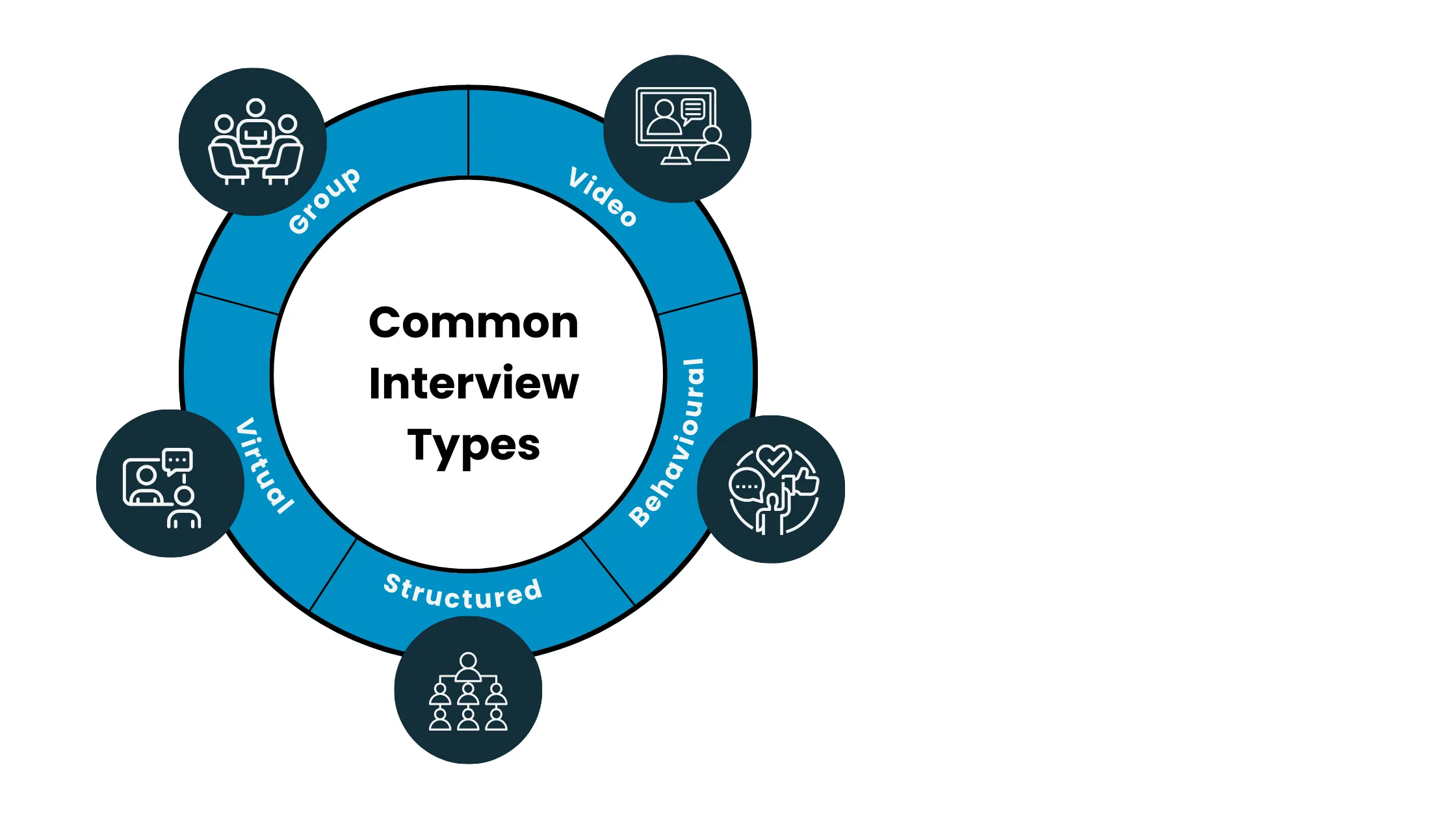
Interviews can vary in many ways, and understanding the right type can help make your hiring process easier and more successful. Here are five basic types of interviews that every recruiter should know to find the best fit for your team.
1. Group Interviews
Group interviews involve evaluating several candidates simultaneously, which is great for jobs requiring teamwork, such as sales or customer service. They save time and provide helpful information about how people work together, communicate, and handle stress.
But having a good structure is important. Activities like group problem-solving show how well people can collaborate, but creating a welcoming atmosphere is essential so quieter candidates don't get overlooked. Look for meaningful contributions, not just the loudest voices—good leaders often show their skills in subtle ways. With the right setup, group interviews can quickly identify strong team players.
Group Interview Tools:
- Zoom or Microsoft Teams: Perfect for online group interviews, especially with breakout rooms.
- Miro or MURAL: Best for teamwork tasks.
- Scorebuddy: Assists in scoring candidates fairly.
2. Video Interviews
Video interviews are online interviews conducted through video communication tools. They can be either live video interviews or one-way video interviews.
Live Video Interviews
A live video interview happens in real time, where the recruiter and candidate speak face-to-face online.
One-Way Video Interviews
A one-way video interview is a recorded interview where candidates answer pre-set questions on video. Recruiters can review the responses later.
Tools for Video Interviews:
- Zoom: Flexible with group features.
- Microsoft Teams: Good for businesses with teamwork options.
- Google Meet: Easy to use and works in a web browser.
- ScreeningHive: Useful for one-way video interviews where candidates record answers to pre-set questions.
- Skype: Trustworthy for talking to people in other countries.
3. Behavioural Interviews
Behavioural interviews types are a great way to see how candidates have dealt with real-life situations in the past.
The idea is simple: what someone has done before can show what they will do in the future. Instead of asking about what they might do, you ask about what they have actually done in their jobs.
For example, if you're looking for a leader, you might ask, "Can you tell me about a time when you had to guide a team through a tough change?" This helps you see not just their skills but also how they think, solve problems, and work with others. To get a deeper understanding, it's important to ask follow-up questions like "What happened as a result?" or "What would you change?". Behavioural interviews have always helped me find top performers by giving a clear and predictable picture of how candidates handle challenges.
Tools for Behavioral Interviews:
- Loom: This is for recording remote interviews so you can review them later.
- Scorebuddy: To make sure you consistently score skills and abilities.
- Jobvite: Offers a database of structured, competency-based questions.
4. Virtual Interviews
Virtual interviews are conducted via video tools like screen sharing, whiteboard sessions, and real-time document collaboration. They are perfect for hiring remotely, recruiting worldwide, and for jobs that need to show skills in action.
These interviews are beneficial for checking practical skills. For example, screen sharing lets candidates display their work, and whiteboarding is excellent for testing problem-solving during coding exercises.
Make sure to test the platform beforehand and that both sides have a quiet place to avoid technical issues.
Tools for Online Interviews:
- Microsoft Teams: Works well with Office tools for team-based roles.
- Google Meet: Easy to use for first interviews.
- Miro or MURAL: Good for whiteboard sessions and brainstorming.
- CoderPad: Perfect for live coding tests.
Online interviews are quick and flexible, allowing candidates to show their skills well, no matter where they are.
5. Structured Interviews
In Structured interviews, every candidate is asked the same set of predetermined questions to ensure fairness and consistency. This method is very useful for entry-level positions where objectivity is important, as it allows you to directly compare each candidate's answers against a standard set of expectations.
Structured interviews are most effective when you need clear and measurable information about a candidate's qualifications and skills. They are perfect for roles like customer service or junior analyst positions, where specific job skills are more critical than personal impressions.
Tools for Structured Interviews:
- Google Forms: Helps organise questions and track responses easily.
- Scorebuddy: Used for standardised scoring and analysing responses.
- HireVue: Allows for structured video interviews with AI-based assessments.
- Greenhouse: Helps keep the interview process consistent and organised.
Structured interviews are efficient, fair, and based on data, making them a crucial tool for recruiters who want to confidently hire the right person for the job.
How to Choose the Right Interview Type
No single interview format captures everything a recruiter needs to know about a candidate. The most effective hiring processes combine multiple types, each chosen to assess a specific dimension of fit.
A practical framework for choosing:
- Use structured interviews when fairness, consistency, and direct comparison matter most
- Use behavioural interviews when predicting how a candidate will handle the specific challenges of the role
- Use group interviews when collaboration, communication, and team dynamics are central to the position
- Use video or virtual interviews for geographic flexibility, remote roles, or efficient early-stage screening
- Use virtual practical interviews when demonstrated skill is more important than self-reported capability
For most roles, a combination of two or three formats produces the most accurate, well-rounded candidate assessment.
Conclusion
To sum up, the key to finding excellent talent is using a balanced interview approach. You can get a full picture of each candidate using various interview techniques & methods, increasing your chances of making a good hire. Whether you're checking skills, understanding past behaviour, or assessing cultural fit, each interview type is important in showing what a candidate can offer your team.
Feel free to combine these interview types to fit the job and your company's needs. The time and effort you put into hiring will be worth it, as a well-matched hire can greatly improve your team's productivity and morale. So, be creative, be thorough, and enjoy the hiring process!

Frequently Asked Questions (FAQs)
1. What is the main purpose of a job interview?
A job interview assesses a candidate's skills, cultural fit, and growth potential in ways that a resume cannot. The format should be deliberately matched to what the role requires, as different interview types reveal different qualities and capabilities.
2. How do I choose the right type of interview for a role?
Match the format to what you need to assess. Structured interviews suit entry-level roles requiring consistent comparison; behavioural interviews work best for evaluating past performance and decision-making; practical interviews are most effective when demonstrated technical skill matters most.
3. What tools are commonly used for virtual or video interviews?
Zoom, Microsoft Teams, Google Meet, and HireVue are the most widely used platforms. Each supports features such as recording, screen sharing, and live collaboration, making them suitable for a range of remote and virtual interview formats.
4. Why are behavioural interviews more effective than hypothetical questions?
Behavioural questions require candidates to draw on real past experiences rather than construct ideal-sounding answers to hypothetical scenarios. Past behaviour is a significantly more reliable predictor of future performance than theoretical responses.
5. What is a structured interview and why does it reduce bias?
A structured interview asks every candidate the same questions in the same order, with responses scored against pre-defined criteria. This consistency reduces the influence of unconscious bias and personal rapport on hiring decisions, producing more objective and legally defensible outcomes.
About the Author