
Hiring teams in 2026 are finding it harder to identify candidates who are truly ready to contribute from day one. Many applicants may look qualified on paper but still lack the practical workplace skills needed for communication, collaboration, ownership, and faster productivity. This widening job-ready gap increases onboarding pressure, slows hiring outcomes, and makes workforce planning more difficult. Structured international internship programmes can help employers access global talent, assess real performance, and build a lower-risk pipeline of future job-ready hires.
TL;DR
- Hiring teams are seeing more applicants, but fewer candidates are truly job-ready from day one.
- The job-ready gap is growing in 2026 because academic learning does not always match modern workplace expectations.
- Experienced talent is becoming harder, slower, and more expensive to hire.
- International internships give employers a lower-risk way to access and assess early-stage talent.
- Structured internship programmes help recruiters evaluate skills, communication, accountability, and long-term potential.
- Global internship providers such as Capital Placement can support sourcing, screening, matching, and onboarding coordination.
- Recruitment software such as iSmartRecruit can help teams track intern candidates, manage communication, collect feedback, and monitor intern-to-hire potential.
What We Mean by the Job-Ready Gap
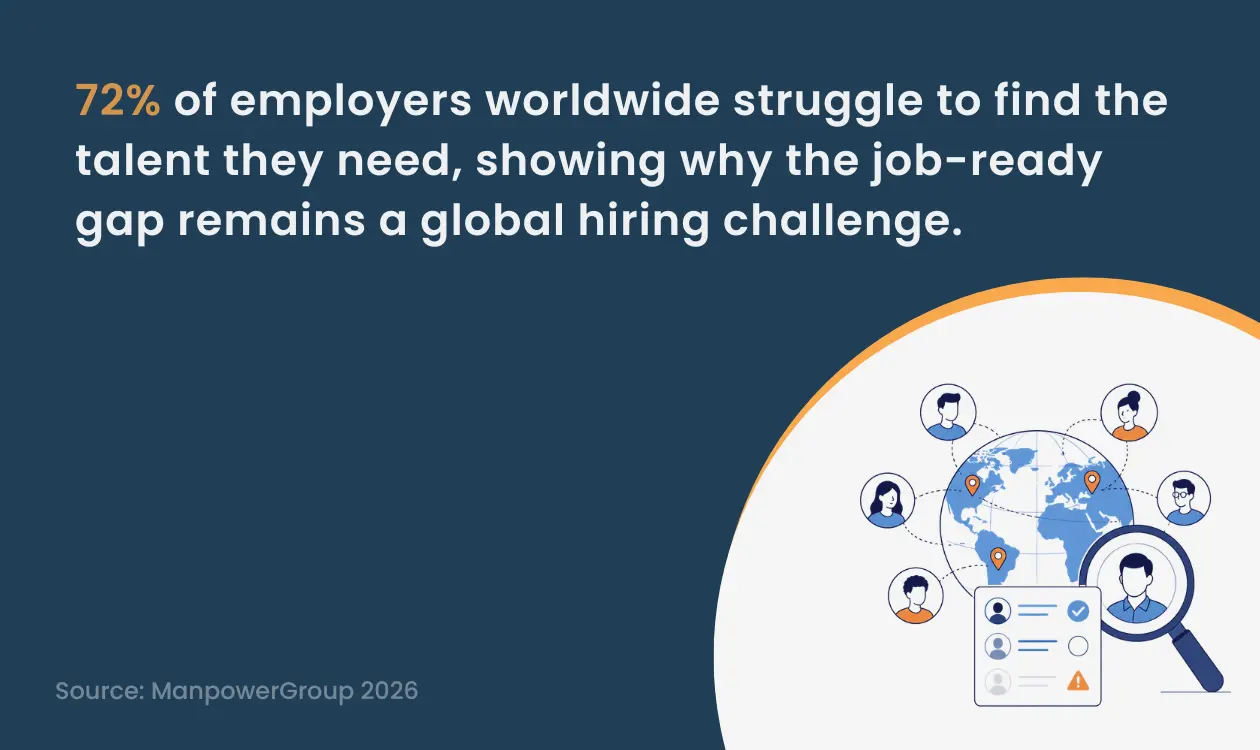
The job-ready gap is already visible in global hiring data. According to ManpowerGroup’s 2026 Global Talent Shortage report, more than seven in ten employers worldwide report difficulty finding the talent they need. This shows that the issue is not simply a lack of applicants. For many hiring teams, the real challenge is finding candidates with the right practical skills, workplace readiness, and role-specific capabilities.
How It Shows Up in Recruitment
For hiring teams, the gap often becomes visible after joining. A candidate may understand the theory behind a role but still struggle to apply it in daily work.
Common signs include:
- Slow ramp-up after joining
- Difficulty managing deadlines
- Limited workplace communication confidence
- Lack of familiarity with business tools
- Heavy dependence on managers
- Difficulty connecting tasks to outcomes
This creates a mismatch between hiring expectations and actual productivity.
Why Traditional Hiring Pipelines Are Falling Short
Traditional hiring pipelines assume that education, interviews, and assessments are enough to identify candidates who can perform well. That assumption is becoming less reliable.
Many entry-level candidates enter the job market with theoretical knowledge but limited workplace experience. At the same time, employers expect faster contribution, better communication, and stronger adaptability.
The Limits of Academic Readiness
Academic learning builds knowledge, but workplace performance requires practical application. Some graduates offset heavy coursework by turning to paper writing services along the way, but that shortcut doesn't build the hands-on skills employers are actually looking for candidates need to manage priorities, communicate with stakeholders, receive feedback, work in teams, and deliver outcomes.
These skills are usually developed through real projects, not only classroom learning. Without that exposure, new hires may need longer onboarding and closer supervision.
The Rising Cost of Experienced Talent
Hiring experienced talent may seem like the easiest solution, but it is not always practical. Skilled candidates are in high demand, and competition often increases salary expectations and time-to-hire.
For growing organisations, this creates pressure on recruitment budgets and delays important business work. Teams may spend weeks searching for experienced candidates while critical roles remain open.
How International Internships Help Hiring Teams Build Future Talent
International interns give companies a practical way to engage early-stage talent before permanent hiring decisions are made.
Instead of waiting for fully experienced candidates, employers can bring in motivated interns, assign structured work, and evaluate performance in a real business context.
Access to a Wider Global Talent Pool
International internship hiring allows companies to reach candidates beyond their local market. This can be useful when local talent is limited, expensive, or highly competitive.
International interns can support areas such as:
- Research and market mapping
- Marketing operations
- Data analysis
- Content support
- Business development
- Customer success
- Operations and administration
For recruitment teams, this expands the talent pipeline and creates more options for future hiring.
Lower-Risk Candidate Evaluation
Internships allow employers to assess candidates through real work instead of relying only on CVs and interviews. Over a defined period, hiring teams can evaluate communication, reliability, learning speed, quality of output, and cultural fit.
This makes internships a useful extension of the recruitment process. If an intern performs well, the company already has evidence of their potential before considering a long-term role.
Why International Internships Support Cost-Effective Talent Development
International internships can help companies develop future talent without immediately committing to full-time hiring costs. This is useful for teams that need support but are not ready to hire permanently for every function.
Reducing Hiring Risk Before Permanent Roles
A poor full-time hiring decision can affect productivity, manager time, team morale, and replacement costs.
Internship programmes reduce this risk by giving hiring teams time to observe how someone works before making a permanent decision. This is especially useful for junior roles, where potential and learning ability are often more important than years of experience.
Building Talent Around Company Processes
Interns can learn the company’s tools, workflows, standards, and communication style from the beginning.
This can make future conversion easier because the intern already understands how the organisation works. For HR teams, this creates a stronger path from early-stage talent to future employee.
Where Internship Programmes Break Down
Internship programmes do not succeed automatically. Many companies struggle because they treat internships as informal support rather than a structured hiring and development process.
When structure is missing, both employers and interns can face confusion, low engagement, and weak outcomes.
1. Vague Role Definitions
Interns need clarity. If the role is too broad, they may not know what to focus on, and managers may not know how to evaluate performance.
A strong internship role should define:
- Role purpose
- Key responsibilities
- Expected deliverables
- Reporting manager
- Timeline
- Review process
- Success measures
Clear role definition helps recruiters match the right candidates and helps managers assess performance fairly.
2. Insufficient Onboarding
Onboarding is critical, especially for international or remote interns. Without a clear onboarding process, interns may struggle to understand tools, communication norms, reporting lines, and expectations.
A structured onboarding process should explain how the team works, what the intern is responsible for, how progress will be reviewed, and who they should contact for support.
3. Lack of Performance Tracking
If companies do not track performance, it becomes difficult to know whether an intern has future hiring potential.
Useful performance indicators include:
- Quality of work
- Reliability
- Communication
- Ability to learn
- Response to feedback
- Initiative
- Future role suitability
This helps HR teams connect internships with long-term workforce planning.
How Global Internship Providers Support Hiring Teams
Most companies don’t struggle with the idea of hiring international interns, they struggle with the execution. Sourcing, vetting, onboarding, and managing interns across geographies requires time, infrastructure, and internal bandwidth that many teams simply don’t have.
This is where internship providers become operationally valuable. Global talent partners like Capital Placement enable companies to access international talent without building the entire hiring pipeline internally. Instead of spending weeks sourcing candidates, screening resumes, and coordinating onboarding, hiring teams can tap into a pre-vetted global talent pool across various industries, significantly reducing time-to-hire. This model removes recruitment fees entirely, allowing companies to access qualified intern talent without incurring any agency costs.
More importantly, the process is streamlined end-to-end. From candidate matching and screening to onboarding coordination and ongoing support, global internship partners handle the operational complexity. This allows hiring teams to focus on role definition, output, and performance, rather than administrative overhead.
Best Practises for Building an Intern-to-Hire Pipeline
A strong internship programme should be designed like a recruitment strategy, not a temporary arrangement.
The goal is to create a repeatable process for identifying, developing, and evaluating future talent.
1. Define Project-Based Roles
Project-based roles are easier to manage and evaluate. Instead of giving interns random tasks, companies should assign clear projects with defined outcomes.
For example, an intern may support market research, data cleaning, campaign reporting, content planning, documentation, or customer research.
2. Set Clear Success Measures
Every internship should have simple success criteria. These criteria help interns understand expectations and help managers evaluate performance.
Success measures may include project completion, quality of output, communication consistency, ability to follow instructions, and readiness for future roles.
3. Schedule Regular Feedback
Weekly or bi-weekly check-ins give interns a chance to ask questions, improve their work, and understand how they are performing.
For managers, these reviews help identify strong performers early and address issues before they become bigger problems.
4. Plan for Future Conversion
Internship programmes become more valuable when companies think beyond the internship period. High-performing interns may become suitable candidates for future full-time roles.
Recruiters should maintain records of performance, feedback, skills, and role suitability so that promising interns can be considered when new positions open.
How Recruitment Software Supports Internship Hiring
As internship programmes grow, manual tracking can become difficult. Spreadsheets, scattered emails, and informal updates can lead to missed follow-ups and unclear hiring status.
Recruitment software helps bring structure and visibility to the intern hiring process.
Centralised Candidate Tracking
A platform such as iSmartRecruit can help HR teams manage intern applications, track candidate stages, organise communication, schedule interviews, and collaborate with hiring managers.
This is especially useful when multiple departments, hiring managers, or intern roles are involved.
Better Hiring Manager Collaboration
Recruitment software keeps candidate details, interview feedback, notes, and hiring status in one place. This helps recruiters and managers work from the same information and make faster decisions.
Tracking Intern-to-Hire Potential
Structured records help companies identify interns who may be suitable for future full-time roles. Recruiters can review performance notes, communication history, manager feedback, and role suitability before making conversion decisions.
How to Measure Internship Hiring Success
To understand whether internship programmes are working, HR teams need to measure both short-term and long-term outcomes.
Key Metrics to Track
Useful internship hiring metrics include:
- Time-to-fill intern roles
- Internship completion rate
- Manager satisfaction
- Quality of intern output
- Intern-to-hire conversion rate
- Retention of converted interns
- Candidate experience feedback
These metrics help teams improve the programme over time and prove its value to the wider business.
Conclusion
The job-ready gap is widening in 2026 because traditional hiring pipelines do not always prepare candidates for real workplace expectations. For hiring teams, this creates longer ramp-up times, higher training needs, and greater pressure to find candidates who can contribute quickly.
International internship programmes offer a practical way to build talent earlier. They help companies access global candidates, assess practical skills, reduce hiring risk, and create a future talent pipeline.
However, success depends on structure. Clear roles, proper onboarding, regular feedback, performance tracking, and organised recruitment workflows are essential.
With support from global internship providers and recruitment software such as iSmartRecruit, companies can turn internship hiring into a scalable talent acquisition strategy.
For hiring teams looking to close the gap between qualified candidates and truly job-ready talent, building talent early is becoming a smarter way to plan for the future workforce.

Frequently Asked Questions (FAQs)
1. Can international interns help companies build job-ready talent?
Yes. International interns can help companies build job-ready talent when they are given structured roles, practical projects, proper onboarding, and regular feedback.
2. Are international internships suitable for recruitment teams?
Yes. International internships are relevant for recruitment teams because they support early-stage talent evaluation, workforce planning, and future hiring pipelines.
3. How can companies manage international interns effectively?
Companies can manage international interns effectively by defining clear roles, setting expectations, scheduling regular check-ins, tracking performance, and using organised recruitment workflows. This helps HR teams create a consistent internship process and evaluate whether interns are suitable for future full-time roles.
4. What is the role of recruitment software in internship hiring?
Recruitment software helps teams track intern applications, manage communication, collect feedback, schedule interviews, and identify interns who may be suitable for future roles. It also helps recruiters and hiring managers keep candidate information, performance notes, and hiring status in one place.
5. Is hiring international interns a replacement for full-time recruitment?
No. International internships should support full-time recruitment by helping companies build a pipeline of early-stage talent and reduce hiring risk before permanent decisions.
6. How can iSmartRecruit support internship hiring?
iSmartRecruit can help HR and recruitment teams manage intern candidate records, track hiring stages, collaborate with hiring managers, and monitor intern-to-hire potential in one organised system. This makes it easier to manage internship hiring as part of a wider recruitment and workforce planning strategy.
About the Author