


Finding qualified candidates takes more than posting job adverts and waiting for applications. Candidate sourcing strategies help recruiters proactively identify, attract and engage people who match their hiring needs, including professionals who are not actively looking for a new role.
From employee referrals and social sourcing to AI-assisted search and talent communities, the right approach helps recruiters reach relevant candidates and build stronger talent pipelines. The key is to choose channels based on the role, personalise outreach and measure which methods deliver qualified candidates.
This guide covers ten practical candidate sourcing strategies, how to implement them and how to build a sourcing plan that supports your recruitment goals.
TL;DR
- Combine employee referrals, professional networks, candidate databases and niche platforms instead of relying on one source.
- Use AI-assisted search and Boolean techniques to identify relevant candidates, with recruiters reviewing the results.
- Build talent pools and communities to maintain relationships with candidates for future vacancies.
- Personalise outreach and communicate clearly to encourage meaningful candidate responses.
- Track source quality, response rates and hiring outcomes to understand which channels work for different roles.
- Review sourcing practices regularly to support inclusive, responsible and data-informed recruitment.
What Makes a Candidate Sourcing Strategy Effective?
A candidate sourcing strategy is a planned approach to identifying and engaging potential candidates for current or future vacancies. It combines a clear candidate profile, suitable sourcing channels, targeted outreach and a method for measuring results.
An effective strategy focuses on candidate relevance rather than the number of profiles collected. Recruiters should understand the skills required for a role, where suitable candidates are likely to be found and what might encourage them to consider an opportunity.
For example, a specialist software engineering vacancy may require technical communities, GitHub profiles and targeted Boolean searches. A senior leadership search may benefit more from professional networks, referrals, industry research and confidential outreach.
The most suitable approach depends on the vacancy, the available talent pool, the recruitment budget and the team's capacity.
10 Candidate Sourcing Strategies to Find Qualified Talent
Finding top talent often requires thinking outside the box and exploring unconventional methods. Here are 10 creative candidate sourcing strategies to help you uncover hidden talent and stay ahead in a competitive job market.
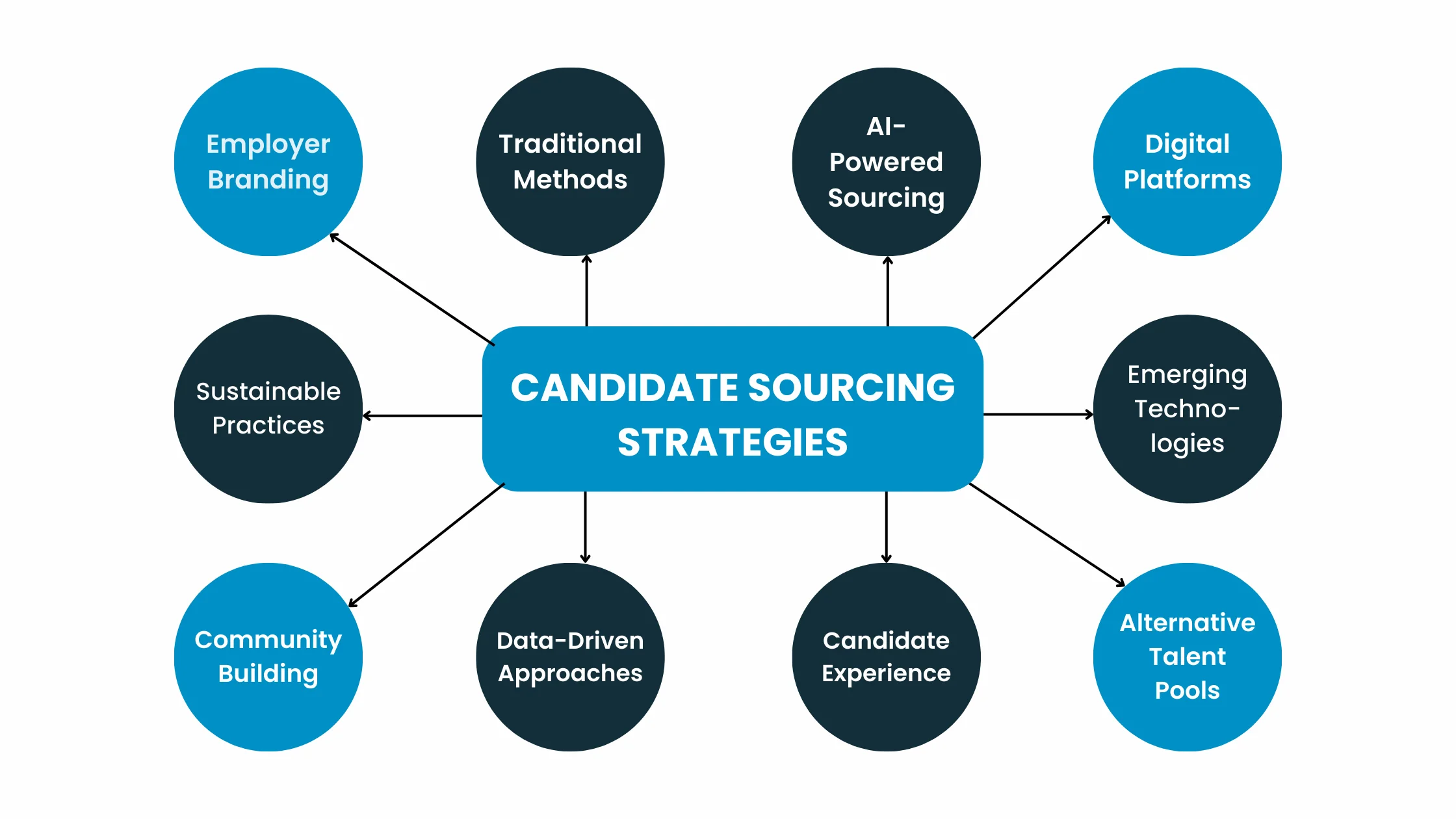
1. Enhance Your Traditional Sourcing Methods
Traditional applicant sourcing methods are like the strong base of a recruitment strategy, but by 2026, they need a fresh approach to stay effective. These different methods of sourcing candidates now use smarter tools, better ways to reach out, and more interesting tactics to get quicker and higher-quality results. The goal isn’t to reinvent the wheel but to make it spin faster and smoother with innovation.
For instance, employee referrals, which used to be a straightforward process, now offer fun rewards to encourage employees to get involved. Similarly, professional networking events, which used to be just physical meetups, have expanded into virtual spaces, making them available globally. Boolean search techniques, a recruiter’s go-to tool, have been updated to work with new platforms like Reddit or Discord. Applicant Tracking Systems (ATS), often not used to their full potential, now work better with advanced filters and AI suggestions to quickly find qualified candidates.
With these improvements, traditional methods are no longer simple, they are now more powerful, making sourcing both dynamic and efficient.
How to apply this strategy:
- Encourage employees to refer people with relevant skills and experience.
- Revisit previous applicants who may be suitable for a different vacancy.
- Search your recruitment database for candidates whose experience matches the role.
- Use Boolean search to combine job titles, skills, qualifications and related terms.
- Attend relevant professional events and maintain relationships after the event.
- Review job adverts to ensure the requirements and responsibilities are clear.
For example, if you are hiring a business analyst, search previous applicants for related experience in business analysis, requirements gathering and stakeholder management before beginning a completely new search.
The aim is to make better use of existing networks and candidate information while continuing to discover new talent.

2. Use AI-Powered Sourcing Tools
AI-powered candidate sourcing strategies transform recruitment by leveraging advanced algorithms and data insights to identify and engage top talent efficiently. This approach handles routine tasks like screening and ranking resumes. So, recruiters can concentrate on more important work. AI tools examine candidate information, predict how well they'll fit the job, and even tailor their communication, speeding up and improving the hiring process. It also provides valuable insights, such as behavioural predictions and skills assessments, ensuring a higher quality of hire.
By adopting AI in candidate sourcing, recruiters can work smarter and make more accurate, data-based decisions about hiring.
Practical ways to use AI in candidate sourcing:
-
Identify candidates whose skills and experience align with a vacancy.
-
Search existing candidate records for relevant profiles.
-
Organise information extracted from resumes.
-
Expand searches to include related job titles and transferable skills.
-
Draft personalised outreach messages for recruiter review.
-
Reduce repetitive administrative work where the software supports it.
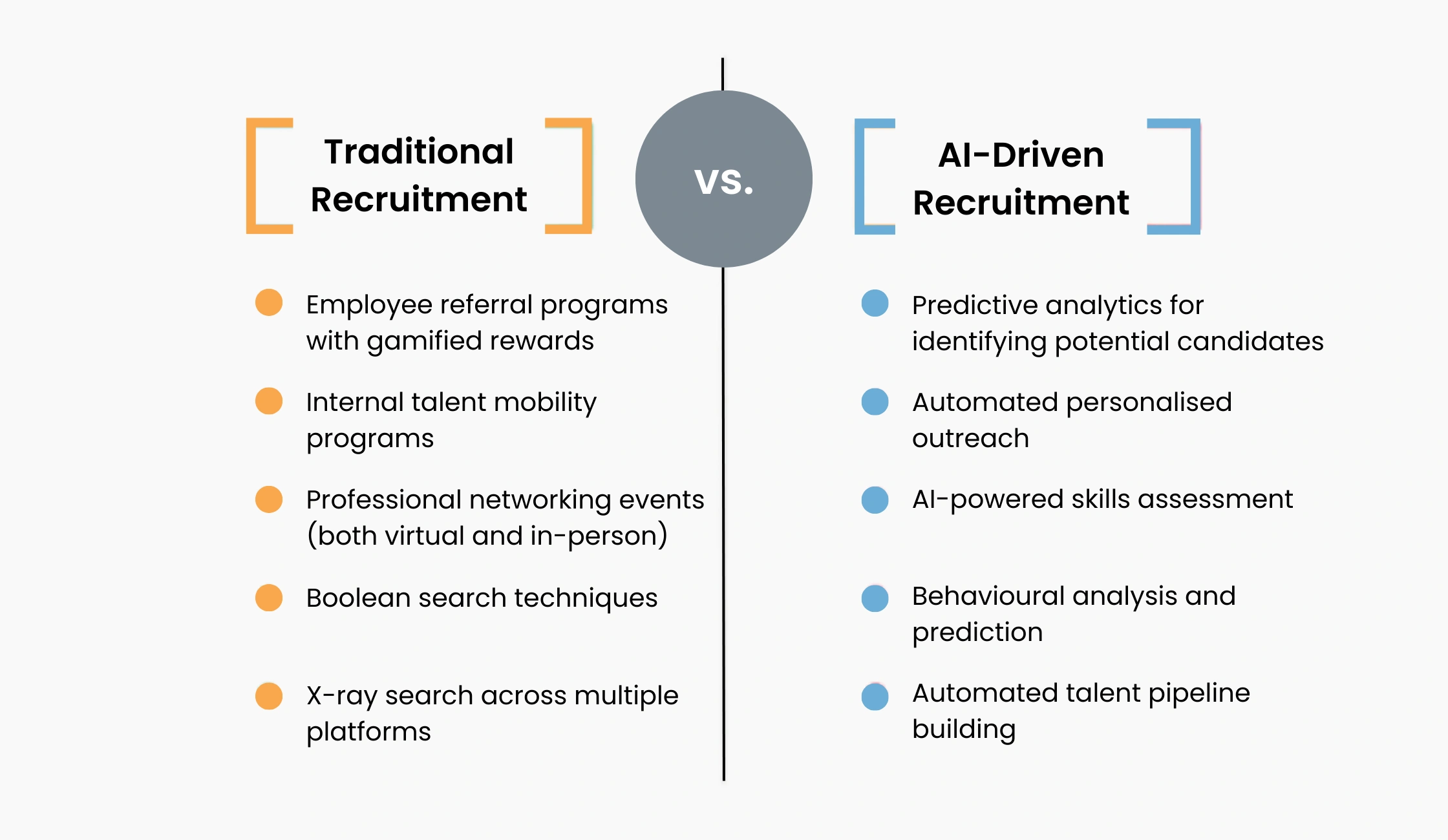
Traditional vs AI-driven Recruitment Process
AI capabilities vary by platform. Review the available features, data sources, privacy controls and human oversight before introducing a new tool.
| Area | Traditional approach | AI-assisted approach |
| Candidate discovery | Manual searches across profiles and databases | Search assistance and matching based on available candidate data |
| Search refinement | Recruiters manually adjust keywords and filters | Some tools can help identify related terms or potential matches |
| Candidate review | Recruiters review profiles individually | Tools may organise or prioritise profiles for human review |
| Outreach | Messages are drafted and sent manually | Some tools assist with drafting or workflow automation |
| Human judgement | Recruiters assess suitability | Recruiters remain responsible for checking relevance, fairness and context |
3. Expand Your Digital and Social Sourcing Channels
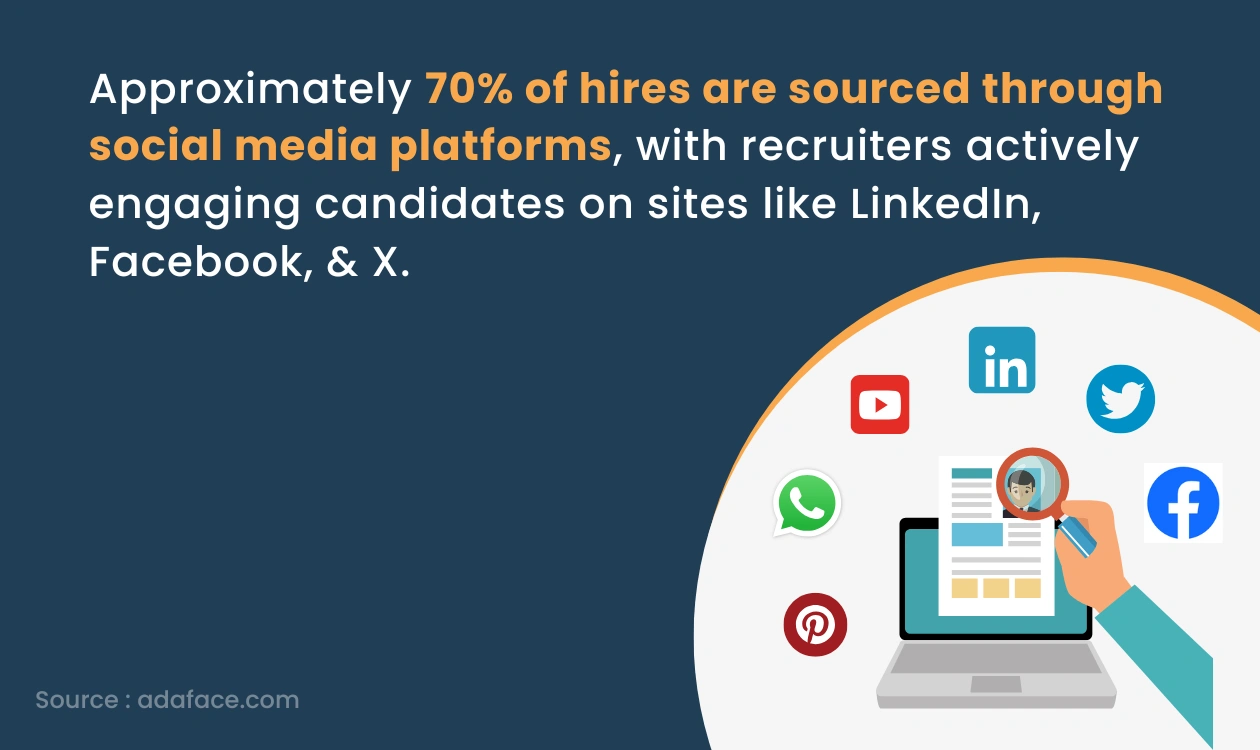
Digital sourcing helps recruiters reach professionals beyond traditional job boards. The most suitable platform depends on the occupation, industry, skills and location of the candidates you want to reach.
LinkedIn can support professional networking and targeted searches. GitHub may help identify developers through publicly available projects. Industry forums, specialist communities and professional groups can provide additional ways to discover people with relevant expertise.
How to make digital sourcing more effective:
- Identify platforms where professionals in the target field actively participate.
- Search for skills, project experience and relevant professional contributions.
- Join appropriate communities and contribute useful information before approaching members.
- Use public professional information responsibly and respect platform rules.
- Personalise outreach by explaining why a person's background is relevant.
- Record the source and outcome of each sourcing activity.
For instance, a recruiter looking for a Python developer could search for relevant technical skills, review publicly available project information and use professional networks to identify potential candidates. The recruiter's next step is to verify experience and assess interest, not assume that a public profile proves suitability.
Avoid relying on one platform for every vacancy. Different roles require different sourcing channels, and a wider search can help identify candidates whose experience is not visible in the most common databases.

4.Use Search Techniques and Recruitment Technology Together
Effective sourcing depends on more than choosing a platform. Recruiters also need a repeatable way to find relevant profiles within the information available to them.
Boolean search uses operators such as AND, OR and NOT to combine or exclude search terms. It can help narrow a search or expand it to include alternative job titles and skill variations.
For example, a recruiter searching for a software engineer with Python experience could start with:
( "Software Engineer" or Developer ) AND Python
This is a starting point rather than a complete search query. The exact syntax and available search fields depend on the platform.
Other useful techniques include:
-
X-ray search: using search engines to locate publicly accessible profiles or pages on selected websites.
-
Skills-based search: including related skills and transferable experience rather than relying on one job title.
-
Candidate rediscovery: revisiting suitable candidates already stored in a recruitment database.
-
Search refinement: reviewing initial results and adjusting terms when too many irrelevant or too few relevant profiles appear.
Recruitment technology can support these techniques by organising candidate records, searching available information and helping recruiters compare profiles with role requirements.
For detailed examples, read the Boolean search guide for talent acquisition.
5. Expand Into Alternative Talent Pools
A narrow sourcing strategy can overlook people with the required skills. Expanding the search to alternative talent pools can help recruiters identify qualified candidates with different career paths, employment histories or professional backgrounds.
Potential talent pools include:
- Career returners who are re-entering the workforce.
- Career changers with relevant transferable skills.
- Veterans with experience applicable to the vacancy.
- Freelancers and contract professionals.
- Former employees who left on good terms.
- Early-career candidates and graduates.
- Professionals in adjacent industries.
- Remote candidates where the role permits remote work.
- People who have developed relevant skills through independent projects or alternative training routes.
The important consideration is whether the person meets the role's requirements, not whether they follow a conventional career path.
How to implement this strategy:
-
Separate essential requirements from skills that can be learned on the job.
-
Identify adjacent roles and industries where relevant skills may exist.
-
Adapt search terms to reflect alternative job titles and experience.
-
Ensure job descriptions and application processes are accessible.
-
Assess candidates consistently against job-related criteria.
For example, a company seeking a customer success specialist may find relevant candidates among account managers, implementation consultants or customer support professionals, depending on the responsibilities of the role.
6. Prioritise Candidate Experience During Sourcing
Candidate experience begins before someone submits an application. The way recruiters approach, inform and follow up with potential candidates can influence whether they choose to engage.
This matters particularly when contacting passive candidates, who may be satisfied in their current roles and need a clear reason to consider a change.
Ways to improve candidate experience:
- Personalise the first message using relevant professional information.
- Explain why the opportunity may be worth considering.
- Keep initial outreach concise and easy to respond to.
- Be transparent about the role, location and important requirements.
- Follow up at reasonable intervals without overwhelming candidates.
- Respect candidates who decline or ask not to be contacted again.
- Keep interested candidates informed about the next step.
For example, rather than sending a generic message about an exciting opportunity, mention a relevant project or area of experience and explain how it connects to the position.
Candidate engagement is not simply about sending more messages. It is about starting relevant conversations and respecting each candidate's time and preferences.
7. Use Data to Improve Your Sourcing Strategy
A data-driven talent sourcing strategy helps recruiters understand which channels produce relevant candidates and where sourcing efforts need improvement.
Instead of judging success by the number of profiles collected, track whether those profiles meet the role requirements, respond to outreach and progress through the hiring process.
Important candidate sourcing metrics include:
| Metric | What it measures | How recruiters can use it |
| Qualified-candidate rate | The proportion of sourced candidates who meet the defined qualification criteria | Compare the relevance of candidates found through different channels |
| Outreach response rate | The proportion of contacted candidates who respond | Review message relevance, targeting and follow-up practices |
| Positive response rate | The proportion of contacted candidates who express interest | Understand whether outreach attracts suitable, interested candidates |
| Source-to-interview conversion | The proportion of sourced candidates who progress to interview | Identify channels that generate candidates who meet the hiring team's requirements |
| Source-to-hire conversion | The proportion of sourced candidates who are eventually hired | Evaluate the contribution of each source to hiring outcomes |
| Time to first qualified candidate | The time taken to identify the first candidate who meets the agreed criteria | Understand how quickly each channel supports a search |
| Cost per hire by source | Recruitment costs attributed to a source divided by the relevant hires | Compare costs using a consistent attribution method |
Define each metric consistently before comparing channels. For example, do not compare one source's response rate based on all messages sent with another source's rate based only on messages successfully delivered.
Results should also be interpreted in context. A specialist search may produce fewer candidates but still be valuable if those candidates are well qualified.
Review the data regularly and use it to adjust your channel mix, search terms and outreach approach.
8. Build and Maintain Talent Communities
Talent communities help recruiters maintain relationships with professionals who may be suitable for future opportunities. Unlike a database that simply stores candidate records, a community aims to create ongoing engagement around relevant information, professional interests or career opportunities.
This approach is particularly useful when recruitment needs recur or when the search for specialist talent takes time.
Ways to build a useful talent community:
- Group candidates by relevant skills, occupation or industry.
- Share useful career resources and professional insights.
- Organise suitable networking events or knowledge-sharing sessions.
- Maintain relationships with alumni and previous applicants.
- Send relevant job updates to candidates who have agreed to receive them.
- Review candidate information periodically and update records appropriately.
For example, a recruitment agency that frequently hires cybersecurity professionals could maintain a talent pool organised by specialism, experience and location. When a new vacancy arises, recruiters can revisit relevant candidates before launching a completely new search.
Talent communities require consistent, useful engagement. Sending frequent generic job messages is unlikely to build meaningful relationships.
9. Make Sourcing Inclusive and Responsible
Inclusive sourcing involves using relevant channels and fair, job-related criteria to reach and assess a broad range of potential candidates. It helps recruiters avoid unnecessarily narrow search practices that may exclude qualified people.
Responsible sourcing also requires care when handling candidate information and using automated tools.
Practical steps include:
- Use clear, job-related requirements in candidate searches.
- Consider transferable skills and alternative career paths.
- Review job descriptions for unnecessary barriers.
- Use more than one sourcing channel where appropriate.
- Make recruitment communications and processes accessible.
- Check AI-assisted recommendations for errors and potentially unfair patterns.
- Follow applicable privacy requirements and platform rules.
- Collect and retain candidate information only as appropriate for the recruitment purpose.
AI tools should assist recruiters, not make unchecked decisions about a person's suitability. Human review, appropriate access controls and regular evaluation are important when technology influences sourcing decisions.
Inclusive sourcing is an ongoing process. Review both the channels used and the outcomes of the sourcing strategy to identify where qualified candidates may be overlooked.
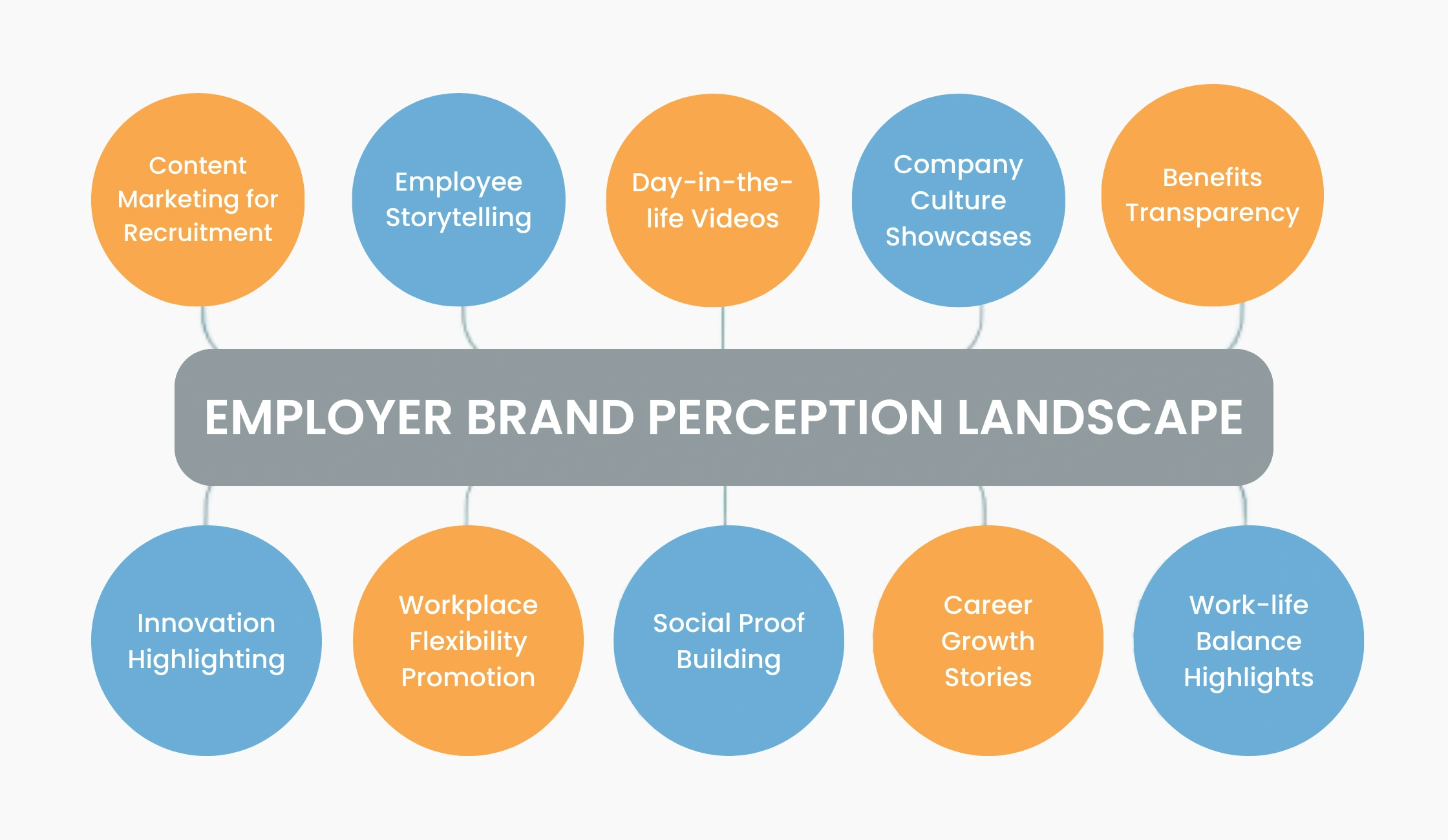
10. Use Employer Branding to Attract Potential Candidates
Employer branding helps candidates understand what it is like to work for an organisation and why a role may be relevant to their career goals. It can support sourcing by giving potential candidates useful information before a recruiter contacts them.
An effective employer brand should reflect the actual workplace experience rather than relying on generic claims about company culture.
Employer branding techniques that support sourcing include:
- Employee stories that describe real work and career experiences.
- Clear explanations of responsibilities and development opportunities.
- Accurate information about benefits, flexibility and working arrangements.
- Videos or articles showing teams and workplace practices.
- Consistent communication across career pages and professional networks.
- Useful content that addresses questions candidates may have about the organisation.
For example, when sourcing a senior engineer, share relevant information about the team's technical challenges, working practices and development opportunities. This helps the candidate decide whether the role merits further discussion.
Employer branding works best when it supports honest, consistent communication throughout the recruitment process.
How to Build a Candidate Sourcing Strategy
Having multiple sourcing methods available is useful only when recruiters apply them in a structured way. Follow these steps to build a practical sourcing strategy for a specific vacancy.
Step 1: Define the candidate profile
Work with the hiring manager to identify essential skills, relevant experience, location requirements and other job-related criteria. Distinguish mandatory requirements from preferences that can be flexible.
Step 2: Choose the most relevant channels
Select two or three priority channels based on the candidate profile and your experience with similar roles. Add secondary channels when the initial search is not producing enough qualified candidates.
Step 3: Create a targeted search plan
Prepare suitable keywords, alternative job titles, skill variations and Boolean strings where relevant. Decide how you will identify and record potential candidates.
Step 4: Personalise your outreach
Explain why the candidate's background is relevant and what makes the opportunity worth discussing. Keep the first message focused on starting a conversation rather than listing every detail of the vacancy.
Step 5: Record and follow up
Track the source, outreach date, response and next step. Follow up appropriately, respect candidate preferences and maintain accurate records.
Step 6: Review performance and adjust
Compare candidate quality, responses and pipeline progression across your chosen channels. If a source produces few relevant candidates, review your search criteria or replace it with a more suitable channel.
This process creates a repeatable approach that can be refined as recruiters learn more about the available talent market.
How to Choose the Right Candidate Sourcing Channels
There is no single channel that works equally well for every vacancy. The following guide can help recruiters decide where to start.
| Hiring requirement | Channels to consider | Key consideration |
| Specialist technical roles | Technical communities, professional networks, skills-based searches and relevant databases | Verify practical experience rather than relying on profile keywords alone |
| Senior or executive positions | Professional networks, referrals, industry research and targeted direct outreach | Confidentiality, relevance and relationship building may be particularly important |
| High-volume recruitment | Job boards, referrals, talent databases and suitable social channels | Consider reach, candidate response time and the team's capacity to process applicants |
| Recurring vacancies | Existing candidate databases, previous applicants and talent communities | Keep records accurate and re-engage candidates appropriately |
| Early-career roles | University networks, graduate communities, internship programmes and relevant social channels | Make requirements and development opportunities clear |
| Remote positions | Professional communities, online networks and geographically broader searches | Check location eligibility, working arrangements and applicable employment requirements |
Use this as a starting point, then evaluate the actual quality of candidates produced by each channel.
Common Candidate Sourcing Mistakes to Avoid
Even a well-planned sourcing strategy can underperform when recruiters make avoidable mistakes.
-
Relying on one channel: expand the search when a single source does not produce enough relevant candidates.
-
Using overly restrictive search criteria: distinguish essential requirements from preferences and consider alternative job titles.
-
Sending generic outreach: explain why the candidate's experience is relevant to the specific opportunity.
-
Ignoring existing candidate records: revisit suitable previous applicants and talent pools before starting from scratch.
-
Measuring activity instead of results: track qualified candidates and pipeline progression, not just the number of profiles found.
-
Overusing automation: review automated messages and candidate matches to maintain accuracy and relevance.
-
Neglecting candidate preferences: communicate respectfully, follow applicable privacy requirements and honour requests not to be contacted.
-
Failing to review outcomes: use sourcing data to refine the approach rather than repeating the same process for every vacancy.
Avoiding these mistakes helps recruitment teams make more informed use of their time and resources.
How iSmartRecruit Can Support Candidate Sourcing
Recruitment technology can help teams organise candidate information, search existing records and manage the workflow from candidate discovery to engagement.
iSmartRecruit offers recruitment capabilities that include candidate search and matching, resume parsing, candidate database management and recruitment automation. The available features can help recruiters organise sourcing activities and manage candidate information within their recruitment workflow.
The right setup depends on your team's requirements, existing processes and the features included in your chosen configuration. Review the available capabilities to understand how they fit your sourcing needs.

Conclusion
Effective candidate sourcing strategies combine targeted searching, relevant channels, personalised outreach and consistent performance measurement. Employee referrals, AI-assisted sourcing, professional communities, talent pools and employer branding can all contribute to a stronger candidate pipeline when they are used for the right hiring needs.
Start by defining the candidate profile, choose the channels most likely to reach suitable people, and track the quality of the candidates you find. Review your results regularly and adjust your approach as you learn which methods work best.
A focused, measurable sourcing strategy helps recruiters spend less time on irrelevant searches and more time building meaningful relationships with qualified candidates.
Frequently Asked Questions (FAQs)
1. What are candidate sourcing strategies?
Candidate sourcing strategies are proactive methods recruiters use to find, attract, and engage qualified candidates before and during the hiring process. These strategies include social media sourcing, employee referrals, talent pools, AI recruitment tools, and direct outreach.
2. What are the best ways to source candidates?
The best ways to source candidates include using social media platforms, employee referral programs, talent databases, passive candidate outreach, AI sourcing tools, and talent pipeline management.
3. How does AI improve candidate sourcing?
AI improves candidate sourcing by automating resume screening, matching candidates with job requirements, identifying passive talent, and personalising recruiter outreach. This helps recruiters save time and improve hiring accuracy.
4. Why is candidate experience important in sourcing?
Candidate experience is important because sourced candidates may not be actively looking for a job. Clear communication, timely follow-ups, and personalised outreach help build trust and increase response rates.
5. How can iSmartRecruit help with candidate sourcing?
iSmartRecruit helps recruiters improve candidate sourcing with AI-powered matching, recruitment analytics, talent pool management, and automation. It helps teams source, organise, and engage candidates more efficiently.
About the Author