
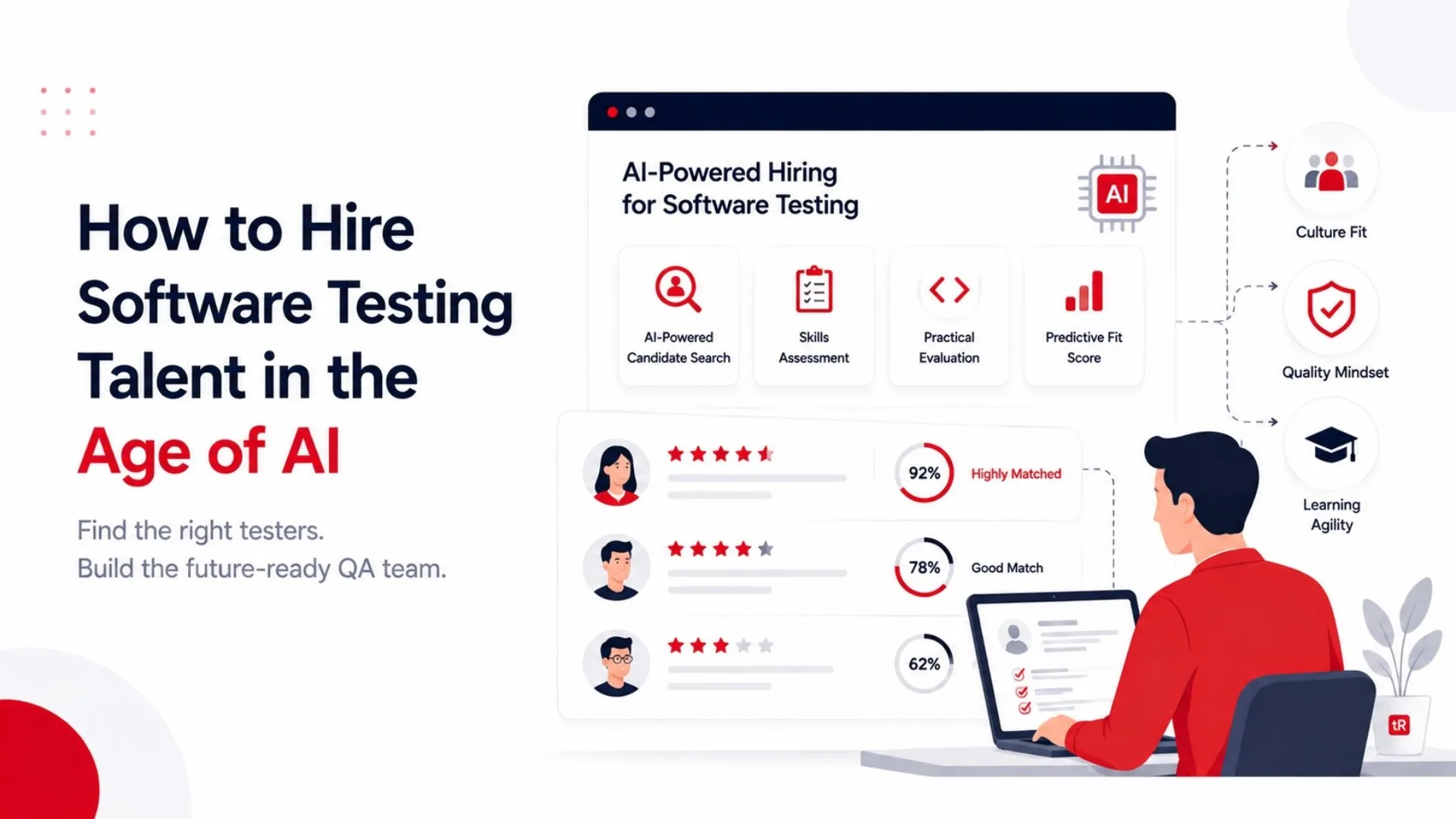
AI is changing how software testing is performed, from generating test cases to maintaining automation and identifying defects. As these tools take over repetitive tasks, the skills required from modern software testers are also changing. Technical expertise still matters, but hiring managers must now assess analytical thinking, domain knowledge, communication, and the ability to work effectively with AI.
If you are hiring software testing talent today, the goal is not simply to find someone who knows Selenium, Java, Python, or Playwright. It is to identify testers who can combine technical expertise with human judgment and use AI to improve software quality.
TL;DR
- AI is changing software testing by automating repetitive tasks such as test case generation and script maintenance.
- Hiring should assess technical skills alongside domain knowledge, analytical thinking, and AI literacy.
- Strong testers can identify business risks, edge cases, and gaps that AI-generated tests may miss.
- Evaluate how effectively testers use AI tools, refine outputs, and validate testing results.
- Communication and prompting skills are increasingly important for working with both teams and AI tools.
- Look for testers who understand modern approaches such as vibe coding and vibe testing.
- Human judgment remains essential for validating business logic, prioritising risks, and maintaining software quality.
How to Hire Software Testing Talent in the Age of AI
Artificial intelligence is transforming software testing by assisting teams with generating test cases, analyzing risk, maintaining automation, and finding defects more efficiently. As AI is being incorporated into daily testing workflows, manual testing, automation, performance testing, security validation, and quality engineering are all evolving. Hence, when you are looking to hire software testing talent, it is not just about Selenium, Playwright, or programming language expertise.
This broader approach is also important when recruiting tech talent, where technical expertise needs to be evaluated alongside problem-solving, adaptability and the ability to work with modern technologies.Organizations are now looking for professionals who have technical skills, business understanding, critical thinking, and can work effectively with AI to deliver high-quality software.
Why Hiring Strategies Need to Change
Traditional hiring has been heavily focused on skills, with tools and technologies such as Selenium, Java or Python, API testing, SQL, Agile methodologies, and CI/CD. These skills are still important, but they are not enough anymore. AI can now automate repetitive testing activities like test case generation, automation script generation, and many other tasks. The same shift is happening across hiring, where AI in recruitment is helping teams automate repetitive activities while allowing recruiters to focus more on evaluation and decision-making.
Thus, testers can spend less time on mundane tasks, but more time on areas such as validating business processes, exploring edge cases, evaluating AI-generated outputs, and improving overall software quality. Hiring strategies will have to evolve, with more emphasis on analytical thinking, understanding business, and the ability to work well with AI. This shift is part of a broader talent acquisition strategy, where organisations align their hiring process with changing skill requirements and long-term business needs. A structured candidate screening process can help recruiters evaluate these capabilities before moving candidates into deeper technical interviews and assessments.
Domain Knowledge Matters
Tech Talent Recruitment: The most effective testers comprehend the business processes that underlie the software they test. They are not merely engaged with the tools they use. Whether it is ERP, healthcare, banking, retail, logistics, or insurance, domain knowledge helps testers immensely. They design realistic scenarios, identify business risks, and validate critical workflows that AI cannot fully infer.
When interviewing candidates, assess whether they can answer questions like:
- What business risks should this feature address?
- Which users does this change affect?
- What happens if this workflow fails?
- Which downstream systems may be impacted?
These discussions reveal much more about testing capability than asking someone to write Selenium locators.
Analytical Thinking is a Core Skill
AI can generate hundreds of test cases in seconds, but it can’t always tell which scenarios are the most important. Strong testers add value by prioritizing risk, identifying missing business rules, writing edge cases, challenging requirements, and validating unexpected outcomes. These capabilities can also be evaluated through structured talent assessment tools, which help recruiters measure skills, cognitive ability, problem-solving, and job fit more objectively.
For example, an AI system might produce hundreds of test cases for an online banking application, but miss critical areas such as regulatory compliance, fraud detection, transaction limits, international transfers, network failures, or multiple users operating at the same time. What separates great testers from average ones is their ability to find these gaps and think beyond AI-generated suggestions.
Evaluate AI Literacy
Not every testing candidate needs to be an AI expert, but they need to understand how AI fits into modern quality engineering. A good interview will explore whether candidates understand how to use AI effectively while recognizing its limitations. A structured interview process can help hiring teams consistently evaluate how candidates approach AI, technical problems, risk and decision-making.
Useful interview questions include:
- How would you validate AI-generated test cases?
- What risks exist when relying entirely on AI?
- How would you review AI-generated automation?
- How can AI help reduce regression effort?
- What should humans still verify manually?
Good candidates know that AI can improve testing productivity, but they also know that human judgment is still a key to validating business logic, identifying risks, and making quality decisions.
Assess Communication and Prompting Skills
Testing is about communication at its core. Testers are in close contact with developers, product owners, business users, designers, DevOps engineers, customers, and project managers. This means that the ability to communicate clearly is as important as technical expertise. In interviews, look for the ability to explain technical concepts in plain English. Ask good clarifying questions, and see if they organize their thoughts logically and listen carefully before responding. Also consider how well they interact with AI tools.
As AI becomes part of modern hiring workflows, AI-powered interviewing can also support more consistent screening and evaluation while keeping human reviewers involved in the final assessment. Good candidates can write clear, concise prompts that describe what is needed and what the test should achieve, not overly complex or vague instructions. Good communication skills with people and AI are often a better predictor of success at work than memorized technical answers.
Measure AI Leverage, Not Just Effort
Today, all candidates have access to AI tools like ChatGPT, Claude, Gemini, and GitHub Copilot.
As AI tools for talent acquisition become more common across sourcing, screening and interviewing, recruiters also need to understand how effectively people use AI rather than simply whether they use it.
Instead of asking if they can develop an automation script from scratch, assess how effectively they use AI to solve real testing problems. For instance, give a feature and ask, “Using any AI tool you like, show me how you would automate this feature in the next 20 minutes.”
Then assess the quality of their prompts, how they review and refine AI-generated output, what corrections they make, what they choose to test, and how they validate the final solution. The goal is to hire someone who will use AI to be more productive and still maintain high-quality software. Building this into a structured recruitment process allows hiring teams to assess technical capability, problem-solving, communication and AI collaboration at different stages. Not someone who will shy away from AI.
Look for Testers With Vibe Coding and Vibe Testing
AI is enabling developers to adopt vibe coding, i.e., describing requirements in natural language, and then AI generates most of the implementation. Likewise, artificial intelligence in software testing is enabling vibe testing, where testers define expected behaviors in plain English while AI helps generate, execute, and maintain tests focused on business outcomes.
When you’re hiring software testers, seek out people who are comfortable in this AI-native environment. They should know how to use AI tools such as Claude Code, Cursor, GitHub Copilot, and ChatGPT, review and validate AI-generated code, create and refine AI-generated test scenarios using natural language, identify business risks and edge cases that AI might miss, and understand when to trust AI and when to question its output.
The best testers are defined not just by their manual or automation skills but by their ability to use AI alongside human judgment to keep software reliable, secure, and aligned with business needs.
Conclusion
Artificial intelligence is changing software testing, not by replacing skilled testers but by supporting them. Therefore, business understanding, critical thinking, communication, and AI collaboration are more important than ever. Hiring managers should consider how candidates are using AI, validating AI outputs, and identifying business risks. Are they adapting to modern AI-driven development practices, like prompt engineering, vibe coding, and vibe testing?
Organizations that evolve their hiring strategies today will build future-ready quality engineering teams capable of combining AI with human judgment to deliver reliable software. The right AI recruitment software can support this approach by helping hiring teams automate repetitive recruitment tasks while keeping human judgement at the centre of selection.
FAQs - Frequently Asked Questions
1. How is AI changing the role of a software tester?
AI automates repetitive testing, freeing testers to focus on business validation, risk analysis, and reviewing AI output.
2. Do testers still need to know Selenium, Java, or Python?
Selenium, Java, and Python still matter, but they are baseline skills. Domain knowledge, critical thinking, and AI skills matter.
3. What is vibe testing and why does it matter for hiring?
Vibe testing uses AI to generate and maintain tests from plain-language requirements, making clear specs and output validation keys.
4. How do you interview a candidate on AI literacy without requiring an AI background?
Ask how candidates validate AI-generated tests, assess AI risks, and review automation. This tests judgment, not AI expertise.
5. Why does domain knowledge (e.g., banking, healthcare, insurance) matter more now that AI can generate test cases?
AI can generate tests but may miss regulations, fraud risks, business rules, and dependencies. Domain expertise helps catch gaps.
6. What's a good practical exercise to evaluate a candidate's AI leverage?
Give candidates a feature and 20 minutes to automate it with AI. Assess prompts, refinements, edge cases, and final validation.
7. Will AI eventually replace manual and automation testers?
No. AI augments testers rather than replacing them. Human judgment remains essential for risk, business logic, and AI test gaps.
About the Author