


A polished resume and a confident interview performance can tell you a great deal about a candidate but they rarely tell you the whole story. Candidates present their best selves during the hiring process, carefully managing the impression they make. What a resume cannot show you is how someone behaves under pressure, whether their problem-solving approach fits the demands of the role, or how well their personality and values align with the culture they are joining. These are precisely the factors that determine whether a hire succeeds or fails in practice.
Psychometric testing addresses this gap. By using statistically validated assessments to measure cognitive abilities, personality traits, emotional intelligence and situational judgement, psychometric tests give recruiters and hiring managers objective, comparable data on each candidate data that goes far beyond what any interview or resume review can provide. In a market where the cost of a bad hire can reach $240,000 or more when you factor in recruitment, onboarding, lost productivity and replacement, that additional layer of insight is not a luxury. It is a commercial necessity.
This guide covers what psychometric testing is, why it matters at every stage of the hiring lifecycle, and the specific types of tests most widely used in recruitment in 2026 so you can choose the right assessment approach for the roles you are hiring and the outcomes you are trying to achieve.
TL;DR
- Psychometric tests provide objective, statistically validated data on candidates' abilities, behaviours and cultural fit giving recruiters a far more complete picture than resumes and interviews alone.
- Around 75% of Fortune 500 companies in the UK use psychometric testing as part of their hiring process, recognising it as one of the most reliable predictors of job performance and cultural alignment.
- Tests help assess candidate behaviour under pressure, problem-solving capabilities, role suitability and cultural fit all of which directly impact retention and team performance.
- Common test types include logical reasoning, verbal reasoning, diagrammatic reasoning, situational judgement and emotional intelligence assessments each measuring different capabilities relevant to different role types.
- Choosing the right test depends entirely on the role requirements and organisational needs no single test covers everything, and using the wrong test produces misleading data.
In a time where every organization looks for the best talents, psychometric testing helps you choose the right candidate through logical reasoning. However, other companies are still struggling to adopt these tests, with only 18% of companies including personality tests in their hiring strategies. To survive in this advanced world, you need to understand the importance of psychometric tests. We have various tests, but the ones you should use depend on your organizational needs. In this blog, you will discover what psychometric testing is and its importance. Without further ado, let us start.
What is Psychometric Testing?
Psychometric tests are structured, statistically backed assessments that measure a candidate's intelligence, logical reasoning, cognitive abilities and personality traits in a standardised, comparable format. Unlike resumes which are self-reported, selectively positive and impossible to verify at face value psychometric tests are designed to surface genuine capabilities and behavioural tendencies that candidates cannot easily fabricate or rehearse.
The term "psychometric" covers a broad range of assessment tools, all sharing the same core characteristic: they produce quantifiable, reliable data that can be compared across candidates and validated against real job performance outcomes. They fall into two primary categories. Aptitude tests measure what a candidate can do their cognitive ability, numerical reasoning, verbal comprehension and logical thinking. Personality tests measure how they are likely to behave their communication style, response to stress, collaborative tendencies and attitude in specific work situations.
Neither category alone gives a complete picture, which is why the most effective recruitment processes combine multiple psychometric instruments alongside structured interviews and broader talent assessment tools. Together, they allow hiring decisions to be grounded in objective data rather than impression and gut feel which is what separates consistently good hiring from occasional good luck.
Importance of Psychometric Testing
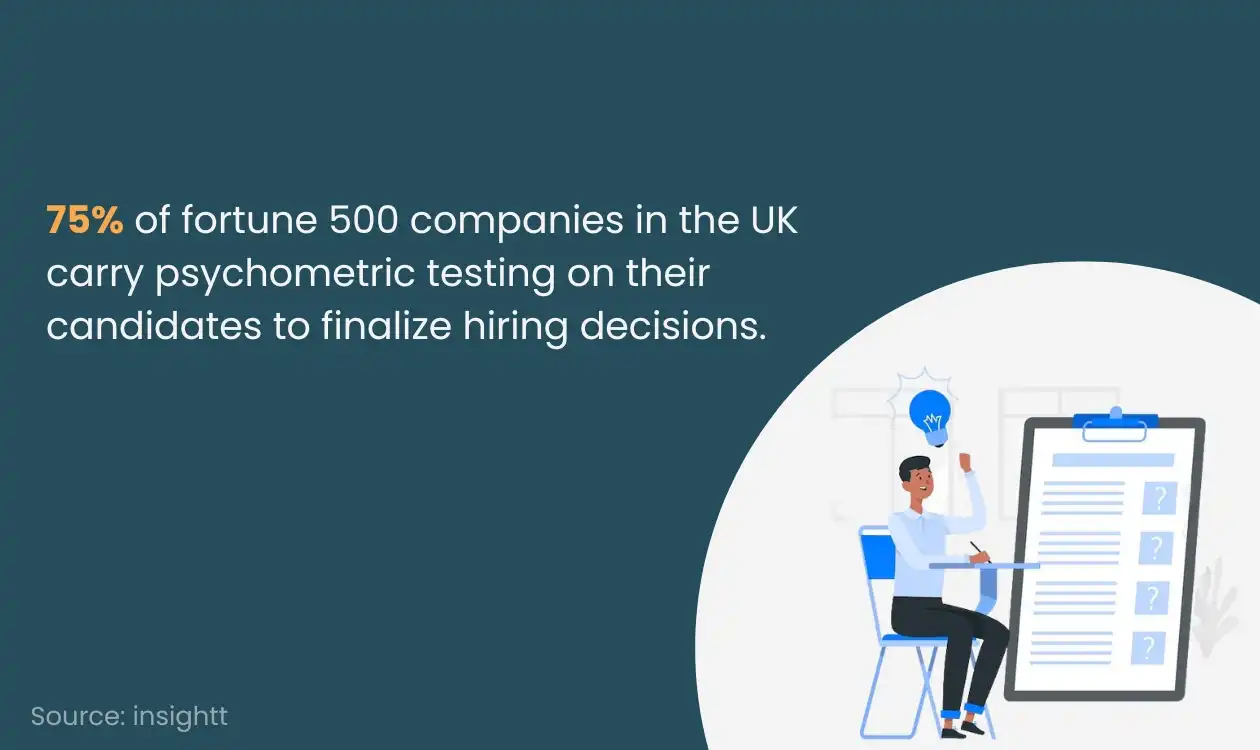
Psychometric testing can reap many benefits only if the right tests are conducted according to the job roles. There is a wide variety of psychometric tests falling under two main tests, which are personality and aptitude tests. The importance of each test depends on the type of your hire and organizational requirements. Around 75% of fortune 500 companies in the UK carry psychometric testing on their candidates to finalize hiring decisions.
Here is a list of important factors of psychometric testing.
Help in judging candidate behaviours
To keep a positive work culture and work under stressful situations your employees need to maintain their calm. Office culture requires high levels of commitment, and if your candidates behave negatively, they can cause a lot of disturbances. To avoid misconduct and ill-attitude, it is important to assess the candidates. For example, if you are hiring a customer representative, you will conduct tests to understand how the employee will react to an angry customer.
Analyzing problem-solving skills
If your organization is part of a flexible industry where external factors are highly impactful on the work, you need to know if your candidate has problem-solving skills. As your organization does not work in isolation, you need someone to be quick at problem-solving. For this, you can analyze the candidates by giving them unusual problems they may not have experienced before. They should think out of the box, as guaranteed by the psychometric tests.
Matches the candidates with the job roles
A candidate who perfectly matches your job description may not be so good in the practical field. Psychometric testing is vital for knowing which candidate will be the best performer on the ground. Suppose a military candidate is a high achiever but does not have anything on their resume other than academic skills. So, to test their logical reasoning to deal with abrupt changes in surroundings, you can take help from appropriate psychometric testing methods.
Grows your organization with cultural fitness
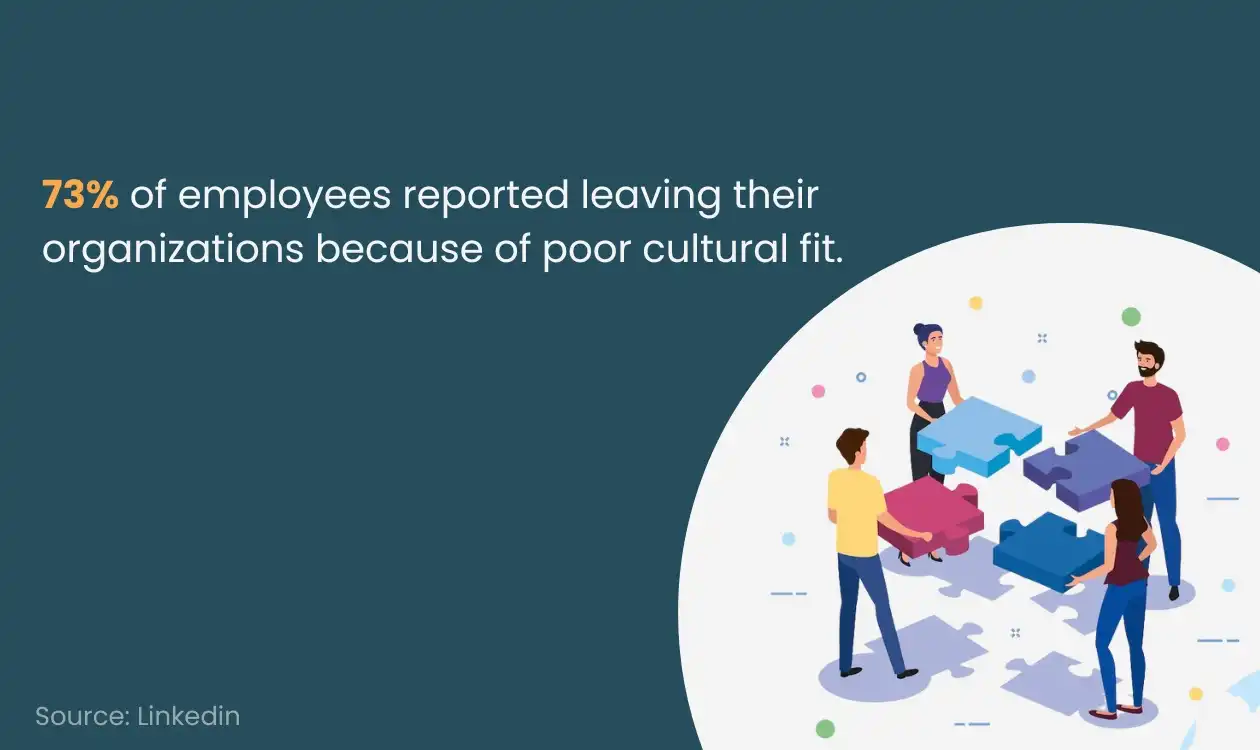
When you hire candidates who fit into your organizational culture, they add to organizational productivity. But to check if they are cultural fits, psychometric tests can reap great benefits. What if a candidate is perfect but leaves after some time because they feel suffocated in your work environment? You do not only need to judge their qualities but also their ability to adapt. According to a survey, 73% of employees reported leaving their organizations because of poor cultural fit.
Reduces turnover
When you choose the right fit for your organization with all the skills you seek who are also satisfied in your organization, it reduces turnover. Satisfied employees add to higher retention. Only through psychometric testing can you judge who may survive in your workplace and who may want to leave later. You will eventually know if an employee would stay committed or leave.
Types of Psychometric Tests
Different roles require different psychometric instruments and using the wrong test for a given role produces data that is neither accurate nor useful. The following five types of psychometric tests are the most widely used in recruitment, each measuring a distinct set of capabilities and behavioural traits.
Logical reasoning
What it measures: Critical thinking, data interpretation and the ability to analyse numerical data, patterns or sequences to reach accurate conclusions under time pressure.
Best for: Finance, data analysis, operations, engineering any role where working accurately with numbers and structured information is a core requirement.
Why it matters: High logical reasoning ability is one of the strongest general predictors of learning speed and adaptability. Even for roles not purely analytical, candidates who score well here tend to pick up new knowledge faster and apply it more confidently after joining.
Verbal reasoning
What it measures: The ability to understand written information, evaluate arguments, identify logical relationships between concepts and distinguish between what a source explicitly states and what is merely implied.
Best for: HR, legal, communications, journalism, policy, stakeholder management any role where processing and responding to nuanced information in writing or speech is central.
Why it matters: Verbal reasoning goes well beyond vocabulary it measures the quality of thinking behind language use. As information complexity keeps rising across every sector, it has become one of the most versatile predictors of professional effectiveness available.
Diagrammatic reasoning
What it measures: The ability to identify rules, understand relationships and draw conclusions from visual, non-verbal data flowcharts, abstract sequences, graphs and diagrams.
Best for: Technology, engineering, systems design, process management, scientific research environments where building, interpreting and troubleshooting complex structured systems is a daily requirement.
Why it matters: Diagrammatic reasoning captures a type of abstract intelligence that numerical and verbal tests do not the ability to think systematically about processes and structures rather than language or numbers. It works well as a complementary measure alongside other tests for a more complete cognitive profile.
Situational judgment
What it measures: Practical decision-making quality how candidates evaluate realistic, role-relevant scenarios and identify the most and least effective course of action from a set of options.
Best for: Customer-facing roles, management positions, emergency services, healthcare, law enforcement any role involving frequent interpersonal challenges, ethical dilemmas or rapid operational decisions.
Why it matters: Unlike cognitive ability tests, SJTs assess judgement in context rather than in the abstract. They are also increasingly used alongside structured interviews as a prompt for exploring how candidates actually approach real workplace challenges not just how they say they would.
Emotional intelligence
What it measures: A candidate's ability to perceive, understand, manage and effectively use emotions both their own and those of others in work and interpersonal situations. The most robust EI assessments are performance-based, not self-reported.
Best for: Healthcare, counselling, leadership, sales, HR, customer experience and team management roles where interpersonal sensitivity and emotional regulation are central to performance.
Why it matters: For senior leadership roles in particular, executive assessment data consistently shows that emotional intelligence predicts effectiveness more strongly than technical expertise or general cognitive ability alone. As the workplace demands more sophisticated collaboration, change management and stakeholder engagement, EI has become one of the most commercially significant traits to assess at the hiring stage.
Conclusion
Psychometric tests give organisations something that no resume or interview can provide alone: objective, statistically validated data on the capabilities, behaviours and traits that actually predict how a candidate will perform in a role and how long they will stay. In a hiring environment where the cost of a wrong decision is high and the talent market is competitive, that data is one of the most valuable inputs available to any hiring team.
The organisations getting the most from psychometric testing are those that treat it as an integral part of a structured, multi-method evaluation process using the right test for the right role, combining assessment data with structured interviews and skills-based evaluation, and continuously refining their approach based on outcomes. No single psychometric instrument tells the whole story, but together with comprehensive talent assessment tools, they create a far more complete and reliable picture of each candidate than conventional hiring methods alone can deliver.
As talent shortages persist and the consequences of high turnover become increasingly costly, the organisations that build objective, data-driven assessment into their hiring process will consistently outperform those still relying primarily on first impressions and credential review. Psychometric testing is not a replacement for human judgement it is what makes human judgement better informed.
FAQs - Frequently Asked Questions
1. What is psychometric testing in recruitment?
Psychometric testing evaluates candidates' skills, personality, and reasoning abilities. It helps employers select the right people objectively, going beyond resumes and interviews, which might not reveal true potential or behaviour.
2. Why is psychometric testing important for hiring?
These tests reduce bad hires and help match candidates to job roles precisely. They also improve cultural fit and lower employee turnover, making recruitment decisions data-driven and more reliable.
3. What types of psychometric tests are commonly used?
Common tests include logical reasoning, verbal reasoning, situational judgment, emotional intelligence, and personality assessments. Each type helps measure specific traits relevant to job performance.
4. How does psychometric testing improve organisational culture?
By identifying candidates who fit the company’s values and environment, psychometric tests promote a positive culture. This leads to higher employee satisfaction and retention, which benefits overall productivity.
5. Can psychometric tests be used for all job levels?
Yes, but the type of test should match the seniority and demands of the role. Entry-level hiring typically focuses on aptitude and logical reasoning, while senior and leadership roles benefit more from personality assessments, emotional intelligence and situational judgement tests that evaluate strategic thinking and interpersonal leadership.
6. How long do psychometric tests typically take to complete?
Most pre-employment psychometric assessments take between 20 and 60 minutes depending on the type and number of tests used. Aptitude tests tend to be shorter and time-pressured, while personality and emotional intelligence assessments are usually untimed and run slightly longer.
About the Author