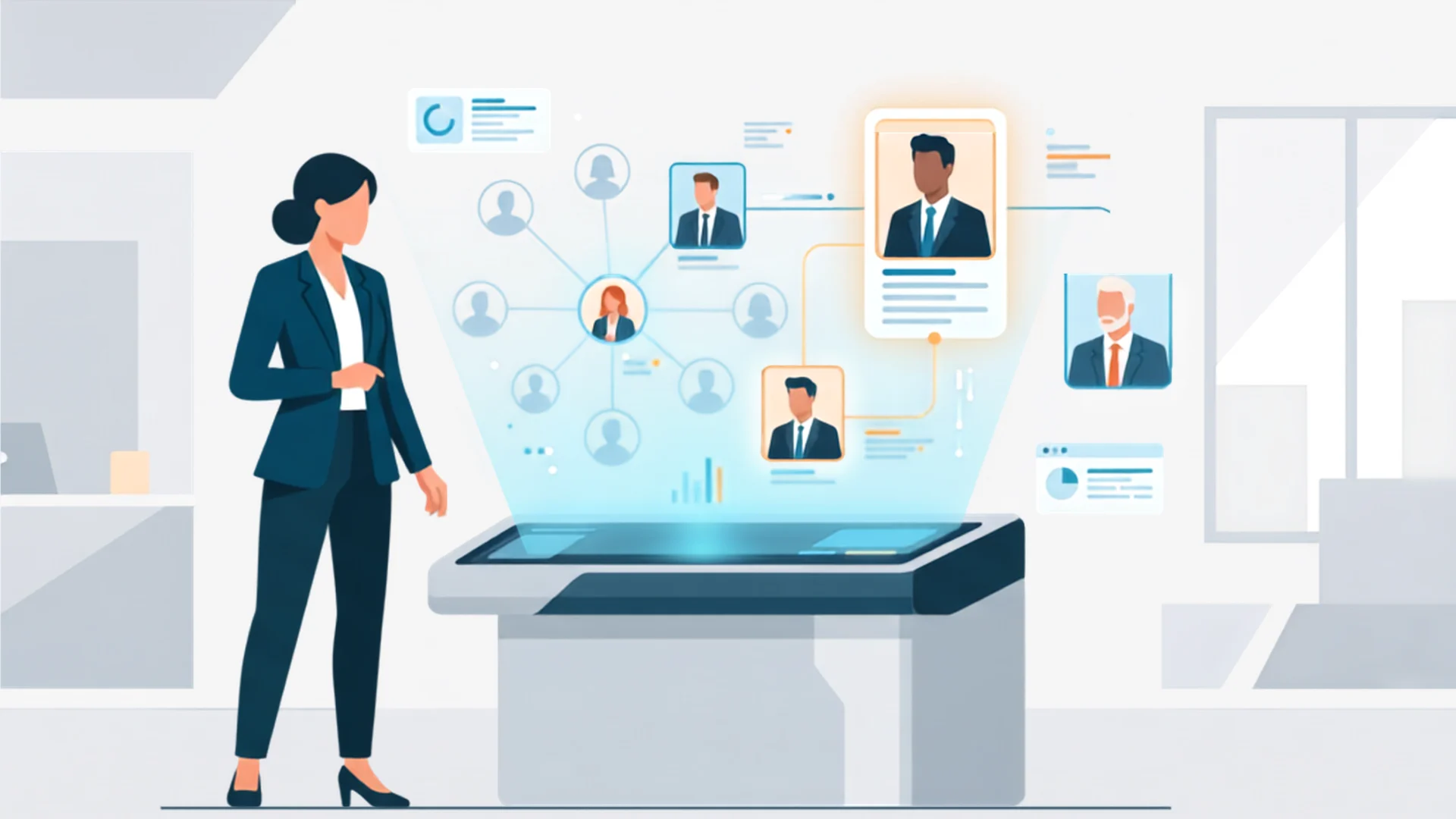
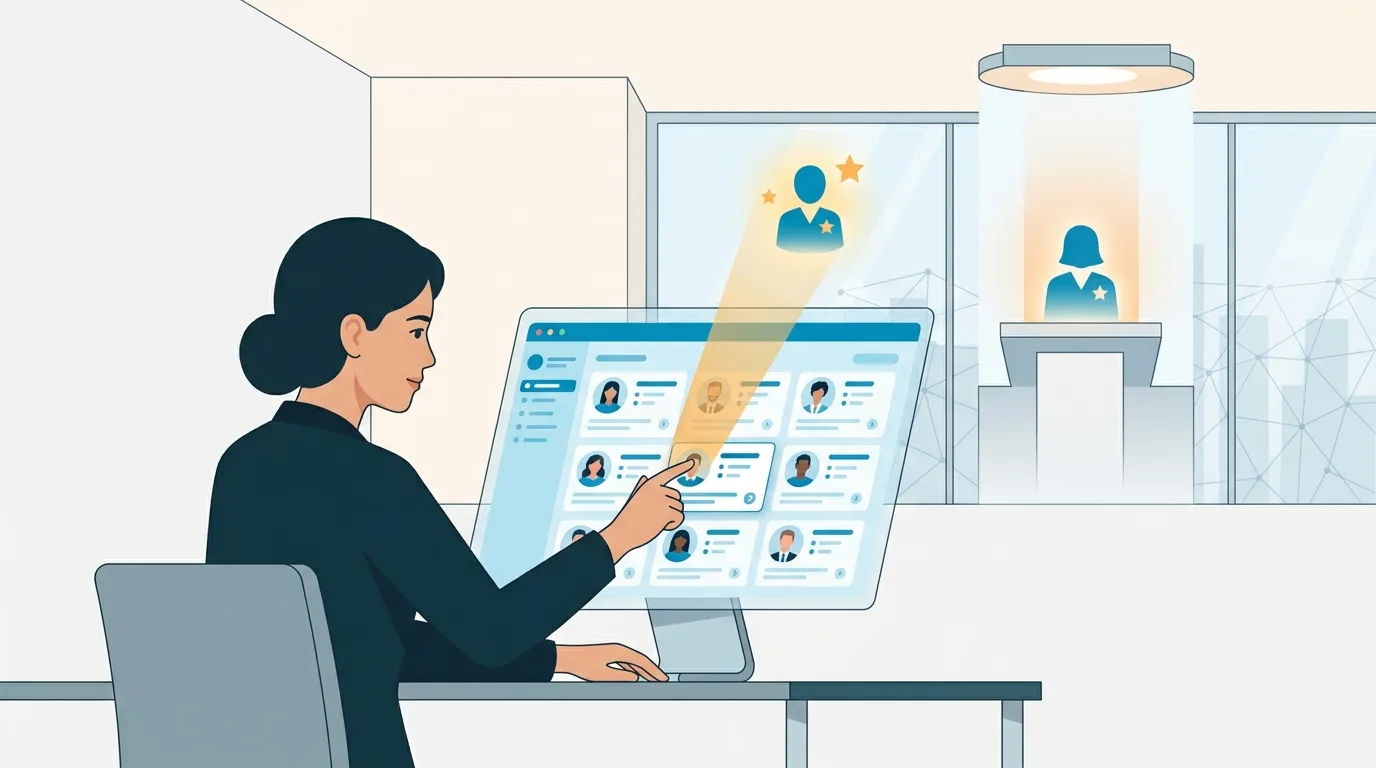
To choose the right AI agent for recruitment, start with the hiring task you want to improve, then test each shortlisted agent on four points: how well it connects to your applicant tracking system, how it ranks candidates on your own roles, whether it meets the legal requirements in the markets where you hire and how much human review it allows. Run a short pilot before you commit. This guide explains each step.
TL;DR
- An AI agent for recruitment is software that works towards a hiring goal across several steps, such as sourcing, screening, candidate chat and interview scheduling, with a recruiter reviewing the results.
- Different AI agents serve roles like sourcing, screening, chatting, and assessing candidates to streamline hiring.
- Choose by hiring goal, ATS integration, how candidates are ranked, fairness evidence, compliance in each market you hire in, scalability, user experience and cost.
- Common mistakes include focusing solely on cost, ignoring privacy, poor user experience, lack of training, and overlooking bias and scalability.
- Best practices include piloting, thorough training, continuous monitoring, human oversight, stakeholder engagement, and clear communication with candidates.
- Effective AI recruitment tools combine automation with human judgement to create a fair and efficient hiring process.
By combining AI recruitment software with human expertise, businesses can automate repetitive tasks, gain valuable data insights, and give candidates a smoother experience. This guide will help recruiters choose the right AI agent, so they can get the most out of AI tools while keeping the process fair, compliant, and efficient.
What is an AI agent for recruitment?
An AI agent for recruitment is software that carries out a connected series of hiring tasks towards a goal, such as sourcing candidates, screening applications, answering questions and scheduling interviews, with limited step-by-step instruction from a recruiter. It differs from basic recruitment automation, which follows fixed rules for one task, and from a generative AI tool, which mainly drafts content. Many products sold as AI agents combine all three, so check what a tool actually does in your workflow before you buy.
With AI recruitment tools, companies can streamline sourcing, screening, interviewing, and assessment processes. At the same time, they improve the candidate experience and make hiring decisions more strategic.
According to Boterview, in 2025, 87﹪ of companies have adopted AI in their recruitment process, with 66﹪ of hiring leaders saying it saves them a lot of time.

Types of AI Agents for Recruitment
Understanding the different types of AI agents is the first step. To get the best results, it’s important to know which agent fits each stage of recruitment. Using the right AI agent at the right stage improves efficiency, accuracy, and gives a better experience for both recruiters and candidates.
1. Conversational Companions: Your Virtual Recruiters and Chatbot
- Engage candidates instantly
- Answer questions and schedule interviews
- Guide applicants through the hiring process
2. Screening Specialists: Smart Resume Evaluators
- Parse and rank resumes efficiently
- Generate shortlists based on qualifications, skills, and experience
- Identify high-potential candidates beyond simple keyword matching
3. Sourcing Scouts: Proactive Talent Finders
- Proactively find talent across job boards, social platforms, and internal databases
- Discover passive candidates who might not apply directly
- Expand the candidate pool and reduce time-to-hire
4. Assessment Analysts: Data-Driven Candidate Evaluators
- Conduct skills assessments, behavioural evaluations, and video interview scoring
- Provide consistent evaluation insights that recruiters can review
- Support fair candidate selection
How AI Agents Support Each Stage of Recruitment
AI agents are transforming every stage of recruitment, from finding candidates to evaluating their skills. However, choosing the right AI agent requires more than understanding what it can do. Each type of agent should be evaluated for transparency, fairness, human oversight, and responsible use.
| Hiring stage | Agent type | What to check before you choose |
| Sourcing | Sourcing scouts | Which channels and databases it searches and how outreach follows consent rules |
| Screening | Screening specialists | Which factors drive the ranking and whether a recruiter can see and override them |
| Engagement | Conversational companions | Whether candidates are told they are dealing with AI and can reach a human |
| Assessment | Assessment analysts | Whether the method is documented and tested for adverse impact |
Choosing the right AI agent at each hiring stage helps organizations build a recruitment process that is efficient, fair, and transparent. By checking how agents source, screen, engage, and assess candidates, recruiters can ensure that AI supports better hiring decisions without replacing human judgment.
Key Considerations When Selecting an AI Agent for Recruitment
Choosing the right AI agent for recruitment requires careful evaluation to ensure it aligns with organisational goals and delivers measurable value.
1. Define Your Hiring Goals First
Identify recruitment priorities and pain points. Whether it’s improving candidate quality, reducing time-to-hire, or automating repetitive tasks, aligning AI-powered recruiting solutions with business objectives ensures maximum ROI. Executive search firms have different needs from high-volume recruiters, so read our guide to AI tools for executive search firms as well.
2. Tech Harmony Matters
Your AI recruitment agent should integrate seamlessly with existing ATS, CRM systems, HR tools, and APIs. Real-time data syncing ensures consistent information, improved decision-making, and smooth workflows. Ask whether the agent connects to your applicant tracking system through a documented API or a native integration, whether data syncs in both directions, which candidate fields it can read and write, and who owns the data if you leave the vendor. Request the integration documentation before the demonstration, not after.
3. Must-Have AI Superpowers
Look for features such as NLP, predictive analytics, automation, and multi-channel outreach. These capabilities enable intelligent candidate engagement, efficient screening, and insightful recommendations, enhancing both recruiter productivity and the candidate experience.
4. Test How the Agent Ranks Candidates for Skill Fit
Agents differ in what they use to rank candidates. Some compare CV text with the job description, some score answers to structured questions or assessments, and some use a language model to summarise and rate a profile. Ask each vendor which inputs and factors drive the ranking, then run the agent on a small set of past roles where you already know the outcome. Compare its shortlist with your own and note where a recruiter would disagree and why. A tool that cannot explain its ranking is difficult to defend to a candidate, a client or a regulator.
5. Privacy and Compliance Come First
Confirm how the agent handles candidate data in every market where you hire. GDPR and UK GDPR apply to candidate data in the EU and UK, and some US cities and states add rules for automated hiring tools. See the compliance section below, and ask each vendor for its data processing terms and security documentation.
6. Fairness Above All
No AI agent can promise to remove bias. Ask the vendor which factors the agent uses to rank candidates, what bias testing has been done and how recently, whether the results are available to you, and how a recruiter can review or override a recommendation.
7. Ready to Grow with You
Scalability and workflow customisation allow the AI agent to adapt to changing hiring volumes and organisational needs, ensuring long-term effectiveness.
8. Experience That Delights
User-friendly dashboards for recruiters and mobile-friendly experiences for candidates improve adoption and engagement. A positive interface reduces errors, accelerates processes, and leaves candidates with a favourable impression.
9. Value for Money
Evaluate pricing models against potential ROI. The best AI agents deliver measurable benefits such as reduced time-to-hire, improved candidate quality, and enhanced recruiter efficiency, while remaining cost-effective.
Scorecard for comparing AI recruitment agents
Selecting the right AI hiring agent involves more than comparing features or pricing. Organizations need to evaluate how well an agent fits their hiring goals, integrates with existing systems, handles candidate data, and supports fair and transparent decisions. These criteria help recruiters make informed choices before adopting an AI hiring solution.
| Criterion | Question to ask | Evidence to request |
| Fit with hiring goals | Which stage and task will it improve, and how will we measure that? | Named use case and baseline metric |
| Integration | How does it connect to our ATS and what data moves each way? | API documentation and integration list |
| Ranking and skill fit | Which factors drive the ranking and can a recruiter override them? | Written explanation and a test on our past roles |
| Fairness | What bias testing has been done, when and by whom? | Audit summary or testing method |
| Compliance and security | Where is candidate data stored and who is the data processor? | Data processing agreement and security documentation |
| Human oversight | Where does a recruiter review or overturn the agent? | Workflow demonstration |
| Cost | What is the full cost at our hiring volume? | Written quote with usage limits |
A well-informed selection process helps organizations avoid costly mistakes and choose AI hiring agents that deliver real value. By checking evidence for integration, fairness, compliance, human oversight, and total cost, recruiters can adopt solutions that improve hiring efficiency while maintaining trust and accountability.
AI recruitment compliance in the USA, UK and EU
Legal requirements depend on where candidates and employees are located, not only where your business is based. This section is general information, not legal advice, so confirm requirements with legal counsel for each market.
USA
Requirements come from a mix of city, state and anti-discrimination laws. New York City Local Law 144 requires an independent bias audit, a published audit summary and notice to candidates for automated employment decision tools. Illinois requires employers to notify applicants and employees when AI is used for employment decisions, from 1 January 2026. California’s automated-decision system regulations under its Fair Employment and Housing Act took effect on 1 October 2025.
UK
UK GDPR restricts decisions based solely on automated processing that significantly affect people. The Data (Use and Access) Act 2025 changed these rules, and the Information Commissioner’s Office published a report and draft guidance on automated decision-making in recruitment on 31 March 2026. The ICO found that many employers treat their tools as decision support when, in practice, the tools may be making solely automated decisions.
EU
The EU AI Act classifies AI used to filter applications or evaluate candidates as high-risk. Obligations for these systems were postponed from 2 August 2026 to 2 December 2027.
Colorado is deliberately excluded: Sources conflict: one source says it was amended and pushed to 1 January 2027, while others still show 2026 dates. Add it only after checking the legislature’s own text.
What Are the Common Mistakes to Avoid When Choosing an AI Agent for Recruitment?
Implementing an AI agent for recruitment can dramatically improve hiring outcomes, but common missteps can reduce its effectiveness. Understanding these mistakes helps recruiters make informed choices and avoid costly errors.
- Choosing solely on cost: It’s tempting to go for the cheapest option, but this can backfire. A lower-cost AI agent might lack important features, struggle with integration, or fail to scale as your hiring needs grow. Think of it as investing in a long-term partner rather than a quick fix.
- Ignoring privacy and compliance: Candidate data is sensitive, and missteps here can damage your organisation’s reputation. Make sure your AI agent complies with GDPR and local employment laws, and that candidate data is handled securely and transparently.
- Neglecting user experience: Even the smartest AI is useless if it’s hard to use. If recruiters or candidates struggle with the platform, adoption drops, mistakes happen, and the overall experience suffers. Look for intuitive dashboards and seamless candidate interactions.
- Skipping training and monitoring: AI can’t run itself. Without proper training and ongoing monitoring, recruiters may misinterpret insights or underuse the platform. Regular check-ins help you make the most of your AI agent while keeping processes fair and efficient.
- Overlooking bias management: AI can unintentionally reflect human biases if not carefully managed. Choose agents that are transparent, explainable, and regularly audited for fairness to ensure every candidate gets a fair shot.
- Neglecting scalability: Your hiring needs will grow, and your AI agent should grow with you. Choosing a tool that can’t handle higher volumes or new workflows limits long-term effectiveness.
- Judging by the demonstration alone: A polished demonstration shows the best case. Test the agent on your own roles and data before you decide.
- Treating the agent as the final decision maker: Recommendations should support a recruiter’s judgement, not replace it, particularly where a decision significantly affects a candidate.
Best Practices for a Successful AI Agent Implementation
Proper planning and execution are critical to maximise the benefits of an AI agent for recruitment. Following best practices ensures smooth adoption, improves recruiter efficiency, and enhances the candidate experience.
1. Start Small with a Pilot Programme
Instead of implementing the AI across the entire organisation at once, start with a small pilot. This helps you spot integration issues early and see how the system works in real-life scenarios. Gathering feedback from recruiters during this stage also makes full-scale deployment much smoother. Agree the success measures and the length of the pilot before it starts, and compare the results with your current process. Our AI recruitment agent use cases show examples of tasks suited to a first pilot.
2. Train Recruitment Teams Thoroughly
Even the smartest AI won’t help if your team doesn’t know how to use it. Provide hands-on training on features, dashboards, and insights, and make sure recruiters understand how to interpret AI recommendations. When teams feel confident using the platform, they can make smarter decisions and work more efficiently.
3. Monitor and Optimise Performance Continuously
An AI agent isn’t a set-it-and-forget-it tool. Keep an eye on key metrics like time-to-hire, candidate quality, and engagement rates. By regularly reviewing performance and making small adjustments, you ensure the AI keeps delivering accurate, valuable results.
4. Balance Automation with Human Oversight
AI can take care of repetitive tasks, but human judgment is still crucial. Encourage recruiters to review AI insights, consider contextual factors, and make the final call. This combination ensures a fair, ethical, and human-friendly process.
5. Engage Stakeholders Early
Get IT, HR, and hiring managers involved from the start. Early engagement ensures smoother integration, better alignment with organisational goals, and faster adoption. Additionally, it helps everyone understand their role in ensuring the successful implementation of AI.
6. Communicate Clearly with Candidates
Transparency builds trust. Let candidates know when AI is used for screening or assessments, and explain how their data is protected. Clear communication not only improves candidate experience but also encourages higher participation and engagement.
Conclusion
Selecting the right AI agent for recruitment requires careful consideration of organisational goals, technology integration, compliance, fairness, user experience, and cost-effectiveness. When implemented thoughtfully, AI agents can streamline hiring and save recruiters time, provided that fairness testing and human review stay in place. By combining AI automation with human judgment, recruiters can create a more efficient, fair, and engaging recruitment process.
Platforms like iSmartRecruit demonstrate how modern AI recruitment tools can support organisations at every stage of hiring, providing scalable, compliant, and user-friendly solutions that empower recruiters to make smarter, data-driven decisions. Leveraging such tools strategically ensures that both recruiters and candidates benefit from a seamless, intelligent, and highly effective recruitment experience.

Frequently Asked Questions (FAQs)
1. What is an AI recruitment agent, and how can it improve the hiring process?
An AI recruitment agent is software that performs connected recruitment tasks towards a defined hiring goal. It can support candidate sourcing, screening, matching, interview scheduling and candidate communication. By automating repetitive work, it helps recruiters reduce manual effort and manage hiring workflows more efficiently. Its results depend on data quality, system configuration and human oversight.
2. What is the difference between an AI agent and recruitment automation?
Recruitment automation follows predefined rules to complete specific tasks, such as sending scheduled emails or updating candidate records. An AI agent can work towards a goal across multiple steps, such as sourcing candidates, preparing outreach and coordinating interviews and adapting its actions based on responses. Many recruitment platforms combine both technologies, so it is important to understand which features are rule-based and which are AI-driven.
3. Can AI recruitment agents integrate with an existing ATS or CRM?
Many AI recruitment agents offer integrations with Applicant Tracking Systems (ATS) and recruitment CRM platforms, but compatibility varies by vendor. Before choosing a solution, check API availability, data synchronisation, authorised record updates, user permissions, duplicate handling and audit logs. These checks help ensure that the agent works effectively with your existing recruitment technology.
4. How can you evaluate an AI agent's candidate skill-matching accuracy?
Test the agent using anonymised candidate profiles and predefined, job-related skill criteria. Compare its shortlist against an independently reviewed sample, check false positives and false negatives, and examine whether candidate rankings are supported by relevant evidence. Human reviewers should also investigate significant differences between the agent's recommendations and recruiters' assessments.
5. How do AI recruitment agents support fair hiring?
AI recruitment agents can apply consistent, predefined evaluation criteria across candidates, which may help reduce inconsistent assessments. However, they can also reproduce biases in training data or the criteria they are given. Fair use requires regular bias testing, transparent ranking criteria, representative data and human review of AI-generated recommendations.
6. Are AI recruitment agents compliant with GDPR and employment laws?
Compliance is not automatic. It depends on the vendor, the data being processed and how the organisation deploys the tool in each hiring market. Before implementation, review the vendor's data processing terms, security documentation, bias audit results and applicable employment regulations. Where required, conduct a Data Protection Impact Assessment (DPIA) to identify and manage privacy risks.
7. What metrics should I track to measure the success of AI recruitment tools?
Track time-to-hire, cost-per-hire, qualified candidate conversion, candidate engagement and recruiter productivity to measure operational impact. For AI screening and matching, also monitor precision, recall, false negatives, ranking consistency, human overrides and fairness indicators. Compare these metrics against pre-implementation performance to understand whether the technology is delivering measurable improvements.
About the Author