


The ROI of AI recruitment agents is the financial and operational return a hiring team gains from automating sourcing, screening and scheduling, measured against what the tools cost to buy, set up and run. Calculate it as total benefits minus total costs, divided by total costs, multiplied by 100, using your own cost-per-hire, time-to-fill and recruiter-hours data. Published figures vary widely, so this guide shows how to build a defensible calculation rather than rely on headline percentages.
The ROI of AI recruitment agents goes well beyond simple cost reduction. It reaches into talent acquisition efficiency, quality of hire, and long-term retention, making AI a sustainable strategic advantage for modern businesses rather than just a tactical fix.
TL;DR
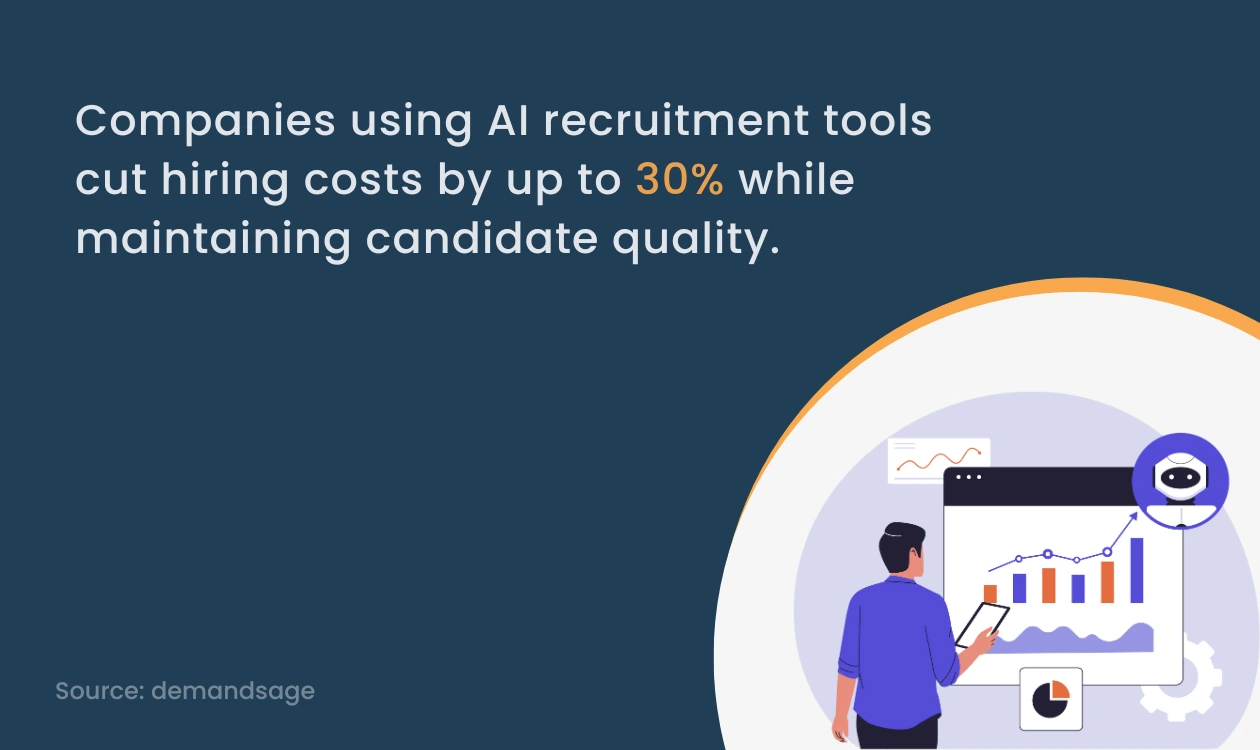
- AI recruitment agents automate screening and sourcing, delivering an average 30 per cent reduction in cost-per-hire and 25 to 50 per cent faster time-to-hire.
- Better candidate matching leads to higher retention rates, directly reducing the long-term cost burden of bad hires.
- Track key metrics including cost-per-hire, time-to-hire, retention rates, and recruiter productivity to measure and continuously improve AI recruitment ROI.
- Companies report an average ROI of 340 per cent within 18 months of properly implementing AI recruitment tools.
- Combining AI automation with human judgment, ongoing training, and compliance-conscious adoption is essential to maximising long-term value.
What Is the Real ROI of AI Recruitment Agents?
Recruitment ROI is essentially a measure of the value a business gains compared with the resources invested in its hiring process. Calculating ROI in recruitment is not only about counting direct costs saved. It also considers factors such as reduced time-to-hire, improved candidate quality, better retention rates, and overall organisation efficiency.
An AI recruitment agent is software that carries out defined hiring tasks, such as sourcing, screening and scheduling, with limited human input.
The ROI of AI recruitment agents is therefore not limited to short-term financial benefits. It aligns directly with business performance, productivity, and employee satisfaction. AI-driven hiring tools convert recruitment from what used to be a cost-heavy operational function into a long-term strategic investment. In essence, the ROI of AI Recruitment Agents bridges financial efficiency with strategic workforce planning.
How much can AI save on recruitment costs?
AI recruitment agents save money mainly by reducing recruiter hours spent on screening, sourcing and scheduling, by shortening vacancy time and by lowering reliance on paid agency fees. The size of the saving depends on hiring volume, your current cost-per-hire and how much of the workflow you automate, so no single percentage applies to every team.
The main sources of savings are:
- Recruiter time: Fewer hours on first-pass CV screening, outreach and interview scheduling.
- Vacancy time: Faster shortlists reduce the days a role stays open.
- Agency spend: In-house sourcing and screening can replace some external fees.
- Replacement costs: Better-matched hires may leave less often, although this takes longer to measure.
Most published savings figures are reported by software vendors and use different methods, so treat them as prompts for your own calculation. For a US benchmark of current costs, see SHRM’s recruiting benchmarking data
Verify: The exact SHRM cost-per-hire figure; secondary sources disagree between $4,700 and $5,475 for non-executive roles
Why Do Traditional Recruitment Methods Struggle With ROI?
While manual hiring has been the norm for decades, it struggles to compete with the ROI of AI Recruitment Agents in delivering scale and efficiency.
Hidden Costs of Manual Hiring
Traditional recruitment demands countless human hours for reviewing CVs, conducting initial screenings, writing job descriptions, and coordinating interviews. These appear manageable at first, but quickly add up, inflating the cost per hire.
Long Hiring Cycles and Productivity Loss
Delays in filling key roles create productivity bottlenecks that are often invisible on a budget sheet but very real in their business impact. SHRM’s benchmarking data puts the median time-to-fill for non-executive roles at 39 calendar days in 2026, down from 44 days in 2025. Every open day carries a cost in lost output and extra workload, which you can estimate by multiplying your own daily vacancy cost by your time-to-fill. Longer cycles compound direct recruitment costs with lost output, increased strain on existing staff, and delayed projects.
Poor Retention and Wrong Hires
Another hidden challenge is retention. A wrong hire not only adds recruitment costs but also training expenses, workflow disruption, and eventual replacement costs. Traditional recruitment struggles with objective decision-making, and biases or rushed processes often lead to poor matches. This significantly impacts business outcomes and highlights why tracking the ROI of AI Recruitment Agents has become essential for HR leaders.
How Do AI Recruitment Agents Improve ROI Compared to Manual Hiring?
AI recruitment agents deliver measurable improvements in efficiency, cost, and quality.
Reduced Screening and Sourcing Costs with Automation
AI-powered hiring tools can scan thousands of CVs and job applications in minutes, which frees recruiters from repetitive first-pass screening. Reported cost-per-hire reductions vary by vendor, hiring volume and starting process, and most published figures are vendor-reported rather than independent. Test any percentage against your own data. Automation can reduce manual workloads and deliver a shortlist of the most relevant candidates.
Verify: if a named, dated source for a specific reduction is retained, cite it.
Faster Time-to-Hire
By automating sourcing, screening, and even basic candidate interactions, AI significantly cuts time-to-hire. Faster staffing not only lowers operational costs but also prevents lost productivity from unfilled roles.
Improved Candidate Quality and Fairness
AI in hiring improves candidate matching by analysing skills, experience, and job requirements in depth. It can also apply criteria more consistently, although AI can reproduce or reduce unconscious bias found in historical data. Regular bias audits and human review remain essential. A consistent improvement in candidate quality directly contributes to higher productivity and improved retention, multiplying the ROI of AI recruitment agents. These accumulated benefits reveal how the ROI of AI Recruitment Agents consistently outperforms legacy approaches.
Verify: Add a current, official reference on AI in hiring regulation for the UK and USA before publishing
Comparison: ROI of Traditional Recruitment vs. AI Recruitment Agents
Recruitment is essential for organizational growth, but traditional hiring can be time-consuming and costly. AI recruitment agents offer a smarter, faster, and more efficient approach. The following table compares both methods across key recruitment factors.
| Factor | Traditional Recruitment | AI Recruitment Agents |
| Time-to-Hire | Weeks to months | Days to weeks |
| Cost-per-Hire | High due to manual tasks | Lower with automation |
| Candidate Quality | Variable bias-prone | Data-driven, better fit |
| Retention Rates | Moderate to low | Higher due to better matching |
| Recruiter Efficiency | Time-consuming tasks automated | High bandwidth |
| Scalability | Limited by manpower | Easily scalable |
AI recruitment agents provide significant advantages in terms of speed, cost, efficiency, and scalability. While traditional recruitment offers a human touch, combining AI technology with human expertise can make the hiring process more effective and successful.
Which Key Areas of Recruitment Show the Highest ROI from AI Agents?
The ROI of an AI Recruitment Agent is most evident in areas where efficiency and quality directly impact results.
Enhanced Candidate Sourcing
AI systems can search multiple channels simultaneously, curating a higher-quality talent pool. This targeted sourcing boosts efficiency while reducing missed opportunities.
Staffing agencies can particularly benefit by leveraging AI to scale faster, increasing placement speed and improving operational efficiency.
Chatbots and Candidate Engagement
AI recruitment chatbots improve engagement by answering questions, scheduling interviews, and keeping candidates updated. This creates a smoother candidate experience. Measures such as response time, interview scheduling time and candidate drop-off rate show whether engagement is improving ROI.
Retention and Better Matching
Matching candidates not only on experience but also on cultural fit significantly reduces turnover. High retention rates directly translate into reduced hiring costs in the long term.
Lower Turnover Costs
Each employee costs the company anywhere from 30﹪ to 200﹪ of their salary when factoring in replacement and training. AI-driven, accurate hiring decisions reduce this wastage. Explore practical use cases of AI recruitment agents that illustrate how AI delivers measurable improvements across recruitment stages.
How to Calculate the Real ROI of an AI Recruitment Agent?
Calculating the ROI of AI in hiring requires combining both quantitative and qualitative insights.
Key Components of ROI in AI Recruitment
- Time-to-hire reduction
- Decreased cost per hire
- Improvement in the candidate quality score
- Retention rate increase
- Productivity gains from quicker onboarding
Measuring Cost Savings with AI
As a hypothetical illustration, a company that makes 200 hires a year and reduces cost-per-hire from £4,000 to £2,500 saves £1,500 per hire, or £3,00,000 a year. If the AI platform, implementation and training cost £80,000 a year, the net benefit is £2,20,000 and the ROI is 275 per cent. These figures are assumptions for illustration, not benchmarks.
ROI Formula Example
A simple formula to measure the ROI of AI recruitment agents is:
ROI (Per Cent) = (Total Benefits − Total Costs) Total Costs × 100
Total costs include licences, implementation, integration, training and internal admin time.
Benefits here account for cost savings, productivity gains, reduction in turnover, and improved quality hires.
By applying this formula repeatedly, businesses can track the evolving ROI of AI Recruitment Agents over time.
AI recruitment agents vs a traditional recruitment agency: How to compare ROI
To compare AI recruitment agents with a traditional agency, calculate the total annual cost of each route for the same roles. Use your own fee schedule rather than an industry average.
- Add up agency fees for the roles you would move in-house.
- Add the AI platform cost, implementation, training and extra recruiter time.
- Add any agency spend that remains for roles AI cannot fill.
- Compare time-to-fill and quality of hire for both routes.
AI tends to suit repeatable, high-volume roles. Niche or senior searches may still need specialist agency support, so the comparison should be role by role.
What ROI Metrics Should Businesses Track in AI Recruitment?
To measure the ROI of AI in recruitment, businesses should track key metrics that reveal improvements in hiring costs, efficiency, recruiter productivity, and candidate quality. The following table highlights the essential metrics, how to calculate them, and what to compare.
| Metric | How to calculate | What to compare |
| Cost-per-hire | Total internal and external hiring costs divided by the number of hires | Before and after implementation |
| Time-to-fill | Days from requisition opening to offer acceptance | Your baseline and a published benchmark |
| Recruiter productivity | Hires per recruiter per month | Before and after |
| Quality of hire | Hiring manager or performance rating at a set point, such as 6 or 12 months | AI-assisted and other hires |
| Retention | Share of hires still employed after 12 months | AI-assisted and other hires |
Tracking these metrics helps businesses understand whether AI recruitment tools are delivering measurable value. Comparing results before and after implementation provides a clearer picture of cost savings, hiring efficiency, and overall recruitment performance.
Problems in Measuring the ROI of AI Recruitment Agents
Despite their potential, calculating AI recruitment ROI is not always straightforward.
Data Quality Issues
Poorly structured HR data or inconsistent applicant tracking can distort ROI calculations. Understanding and overcoming common challenges in adopting AI recruitment agents is key to realising their full ROI potential.
Over-reliance on AI Metrics
Companies may overlook the human factor by focusing solely on automation numbers. For instance, cultural fit and candidate engagement still matter.
Complexity of Intangible Benefits
Improvements in employer branding or fairness in hiring are harder to quantify, though they play a huge role in long-term ROI.
How Can Companies Maximise ROI With AI Agents in Recruitment?
Human + AI Collaboration: AI handles bulk data processing, while recruiters use insights to build stronger relationships. A hybrid model achieves the highest ROI. As AI transforms workflows, recruiters evolve from administrative roles to strategic partners, as detailed in our article on changing recruiters' roles.
Training and Change Management: Upskilling HR teams ensures recruiters understand how to interpret AI insights effectively. This maximises ROI in AI-driven hiring.
Strategic AI Adoption: Companies that gradually adopt AI and track results against recruitment ROI metrics see more consistent outcomes.
How to evaluate AI recruitment platforms for ROI
Evaluate a platform by testing whether it can improve your own numbers, not by comparing vendor claims.
- Record baseline cost-per-hire, time-to-fill and recruiter hours before any pilot.
- Calculate total cost of ownership, including licences, integration and training.
- Check integration with your applicant tracking system and data quality requirements.
- Ask for named results with a stated method and period, and treat unnamed percentages with caution.
- Review bias testing, data protection and compliance with local hiring rules.
- Run a time-limited pilot with a comparison group, then recalculate ROI.
How Does the ROI of AI Recruitment Agents Evolve?
AI recruitment ROI is not static and can grow as teams mature in their use of the tools.
Lower repetitive workload: As automation handles repetitive work, cost-per-hire can fall further, although licence, integration and oversight costs remain.
Predictive Analytics for ROI Growth: AI systems learn from past data to predict top performers, reducing future hiring risk and improving retention-driven ROI.
Continuous improvement: Many AI hiring tools improve with more data and tuning, but gains are not automatic and need monitoring.
From Cost Centre to Investment: Recruitment is no longer just an operational cost. With AI agents, it becomes a long-term strategic investment that builds efficiency, boosts retention, and provides a measurable competitive advantage.
Final Take: ROI of AI Recruitment Agents
The ROI of AI Recruitment Agents shows that recruitment has evolved from a cost centre to a measurable investment with transformative benefits. By automating sourcing, enhancing match quality, and reducing turnover while boosting retention, AI makes hiring significantly more efficient and cost-effective. The benefits are real, but they depend on data quality, adoption and careful measurement. Early adopters who continuously refine their AI strategies enjoy not only cost savings but also a stronger, higher-quality workforce. AI recruitment ROI is therefore about more than cutting costs. It is about building a measurable, repeatable way to hire faster and better.

Frequently Asked Questions (FAQs)
1. How do AI recruitment agents improve ROI in hiring?
AI recruitment agents improve hiring ROI by automating repetitive tasks such as candidate sourcing, resume screening, interview scheduling and candidate communication. This reduces manual effort, lowers recruitment costs and shortens time-to-hire. They can also improve candidate matching, helping businesses make better hiring decisions and increase employee retention.
2. How do you calculate the ROI of AI recruitment agents?
To calculate the ROI of AI recruitment agents, subtract the total investment cost from the financial benefits generated, divide the result by the total investment cost and multiply by 100. The calculation should include software subscriptions, implementation, integration, training and maintenance expenses, along with measurable savings from reduced recruiter hours, agency fees and hiring costs.
3. Is an AI recruiting platform cheaper than a traditional recruitment agency?
An AI recruiting platform can be more cost-effective than a traditional recruitment agency, particularly for businesses hiring frequently or filling high-volume roles. However, the overall cost depends on software subscriptions, recruitment volume, internal recruiter time and agency fees. Businesses should compare the total cost per successful hire to determine which approach delivers better ROI.
4. Which recruitment ROI metrics should HR leaders track?
HR leaders should track cost-per-hire, time-to-hire, time-to-fill, quality of hire, employee retention, recruiter productivity and agency expenditure. These metrics help businesses evaluate recruitment efficiency, hiring quality and overall spending. Comparing performance before and after AI implementation provides a clearer understanding of the technology's actual impact.
5. Can AI recruitment agents reduce hiring bias?
AI recruitment agents can support fairer hiring by applying consistent, job-related screening criteria to candidates. However, AI systems can also reproduce existing biases present in historical recruitment data. Businesses should regularly audit AI decisions, conduct bias testing, maintain human oversight and ensure compliance with applicable employment regulations.
6. How can businesses measure the ROI of conversational AI in recruiting?
Businesses can measure conversational AI ROI by evaluating improvements in candidate engagement and recruitment efficiency. Metrics such as automatically resolved candidate enquiries, saved interview scheduling time, application completion rates, recovered recruiter hours, and candidate satisfaction help demonstrate its value. These benefits should be compared against the platform's subscription, implementation and operating costs.
7. What challenges do businesses face when measuring AI recruitment ROI?
Businesses often face challenges such as inconsistent recruitment data, difficulty measuring intangible benefits and attributing improvements directly to AI implementation. Integration costs, employee adoption, and overreliance on automation metrics can also affect ROI calculations. Establishing clear benchmarks before implementation and evaluating performance over a defined period helps businesses measure returns more accurately.
About the Author