


Finding the right leader can define a company's next decade or derail it. That's why organizations turn to executive recruiters when a critical leadership role needs to be filled with precision, discretion, and a clear understanding of the business.
An executive recruiter specializes in identifying and placing senior-level leaders, including CEOs, CFOs, COOs, CTOs, CHROs, and other C-suite executives. Unlike traditional recruiters who may rely heavily on job postings and active applicants, executive recruiters proactively identify qualified leaders, including passive candidates who are not actively looking for a new role.
Executive search also goes beyond sourcing. Recruiters help define the leadership profile, map the relevant talent market, assess candidates, manage confidential communication, and advise clients throughout the search.
This guide explains what executive recruiters do, how they find and evaluate leadership talent, what they charge, and why companies use them for high-impact hiring decisions.
TL;DR
- Executive recruiters specialise in finding and placing senior leaders, including C-suite executives.
- They proactively identify both active and passive candidates through networks, market research, referrals, databases, and direct sourcing.
- Their work usually includes role definition, market mapping, candidate assessment, shortlist development, client advisory, and offer support.
- Executive recruiters work closely with boards, executives, HR leaders, and hiring managers throughout the search.
- Confidentiality is especially important when replacing an existing leader, conducting succession planning, or entering a sensitive market.
- Executive search is generally more research-intensive and specialised than traditional recruitment.
- Retained executive search fees commonly fall within a percentage of first-year compensation, but pricing varies by firm, role, location, and engagement terms.
What is an Executive Recruiter
An executive recruiter - also called an executive headhunter or executive search consultant - is a specialized talent professional who finds and places candidates for senior leadership and C-suite roles.
They are not simply filling positions from a pool of applicants. Executive recruiters research the talent market to identify leaders who have the experience, capabilities, leadership style, and strategic background required for a particular organisation.
Many of the strongest candidates are passive candidates. They may already be successful in their current positions and have no plans to apply for another job. An executive recruiter approaches these individuals directly and explains why a particular opportunity may be relevant to their career.
This distinction matters because executive search requires a research-led approach, strong relationships, industry knowledge, and the ability to assess leadership beyond what is visible on a CV.
What Does an Executive Recruiter DoNULL
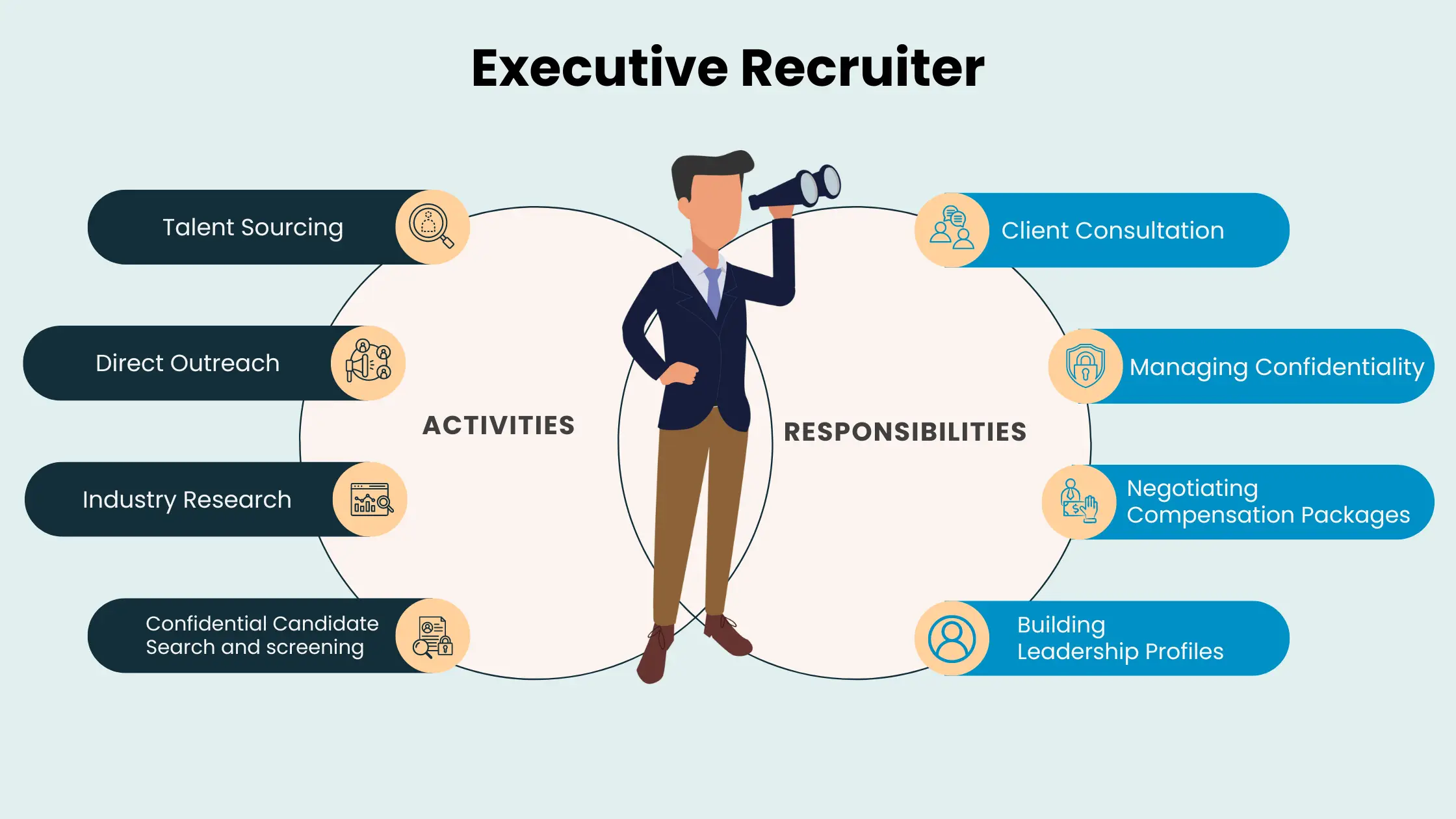
An executive recruiter, headhunter, or executive search recruiter finds candidates for senior roles. These include CEOs, CFOs, COOs, and other top executives. Unlike general recruiters, executive recruiters focus on leadership roles. These require specific skills, industry experience, and a strategic vision.
Key Executive Recruiter Responsibilities
1. Sourcing Top Talent
Executive recruiters do more than post a vacancy and wait for applications.
They use professional networks, referrals, executive databases, market research, talent mapping, industry relationships, and direct outreach to identify potential candidates.
A major part of executive search involves finding passive candidates who are not actively applying for jobs.
For example, a recruiter conducting a CFO search may research finance leaders at companies with similar business models, growth stages, or geographic footprints. The recruiter can then assess which executives have relevant experience before approaching them confidentially.
The objective is not to produce the largest possible candidate pool. It is to identify a focused group of leaders who genuinely match the client's requirements.
2. In-depth Candidate Evaluation
A strong CV is only the starting point.
Executive recruiters evaluate a candidate's leadership record, business impact, strategic thinking, decision-making, communication style, and ability to operate within the client's environment.
Areas commonly considered include:
- Leadership track record: What measurable business results has the executive delivered?
- Strategic capability: Can the candidate connect leadership decisions with wider business objectives?
- Cultural and organisational alignment: Is the executive likely to succeed within the company's environment and leadership structure?
- Decision-making and communication: How does the candidate operate under pressure and communicate with different stakeholders?
- Adaptability: Can the executive lead through growth, transformation, restructuring, or uncertainty?
- Motivation: Why would the candidate consider the opportunity, and does the role match their long-term goals?
Depending on the assignment, firms may also use structured interviews, leadership assessments, reference checks, or other evaluation methods.
The exact assessment approach should reflect the role rather than relying on a one-size-fits-all checklist.
3. Close Client Collaboration
Executive headhunters engage deeply with hiring clients, often including board members or senior stakeholders. They:
- Clarify role expectations and long-term goals
- Help define ideal leadership profiles
- Provide market intelligence and compensation benchmarking
4. Ensuring Confidentiality and Discretion
Many executive searches involve sensitive circumstances, replacing an underperforming leader, preparing for a succession transition, or building out a new strategic function. In each case, confidentiality is non-negotiable.
A breach at this level doesn't just create awkwardness. It can destabilize teams, damage board relationships, and undermine the entire search. Experienced executive recruiters treat discretion as a core professional obligation, not a courtesy.
Why Executive Recruitment is Crucial?
Executive recruitment or headhunting is crucial because hiring the right executive can significantly impact a company's success, profitability, and strategic direction. Hence, executive recruitment is a key part of growing businesses. Senior executive headhunters help companies avoid bad hires. They carefully screen and recruit candidates. These candidates must have experience and the ability to lead and innovate.
Executive recruitment helps reduce this risk by taking a more deliberate approach to identifying and evaluating leadership talent.
The process is particularly valuable when the role:
- Has significant strategic responsibility
- Requires scarce industry expertise
- Involves confidential succession or replacement
- Has a large impact on business performance
- Requires access to passive candidates
- Needs an independent view of the leadership market
The goal is not simply to hire quickly. It is to make a well-informed leadership appointment that fits the organisation's current needs and future direction.
How Executive Search Recruiters Find Talent?
Executive recruiters go beyond traditional job postings to find top candidates. Some of their methods include
1. Networking: Senior-level recruiters develop relationships with executives, industry professionals, board members, investors, and other relevant contacts. These relationships can provide referrals and introductions to potential candidates.
2. Direct Sourcing: Recruiters identify suitable passive candidates and approach them directly. The conversation usually focuses on the opportunity, its strategic importance, and why the role may be relevant to the executive.
3. Comprehensive Screening: Recruiters conduct detailed conversations to understand leadership experience, achievements, motivations, compensation expectations, and suitability for the role.
4. Industry Research: Recruiters research companies, competitors, leadership teams, organisational structures, and emerging talent to identify executives who may fit the assignment.
5. Market Mapping: For difficult searches, recruiters may map the relevant talent market before contacting candidates. This helps identify where qualified executives are working, how large the available talent pool is, and which organisations are likely to contain suitable leaders.
Modern executive search teams may also use executive search software, AI-assisted research, data enrichment, and relationship intelligence to speed up research. These technologies support the recruiter's work but do not replace human judgement when evaluating leadership suitability.

Executive Recruiters vs. General Recruiters: Key Differences
While executive and general recruiters match candidates to roles, they differ in focus, process, and expertise.
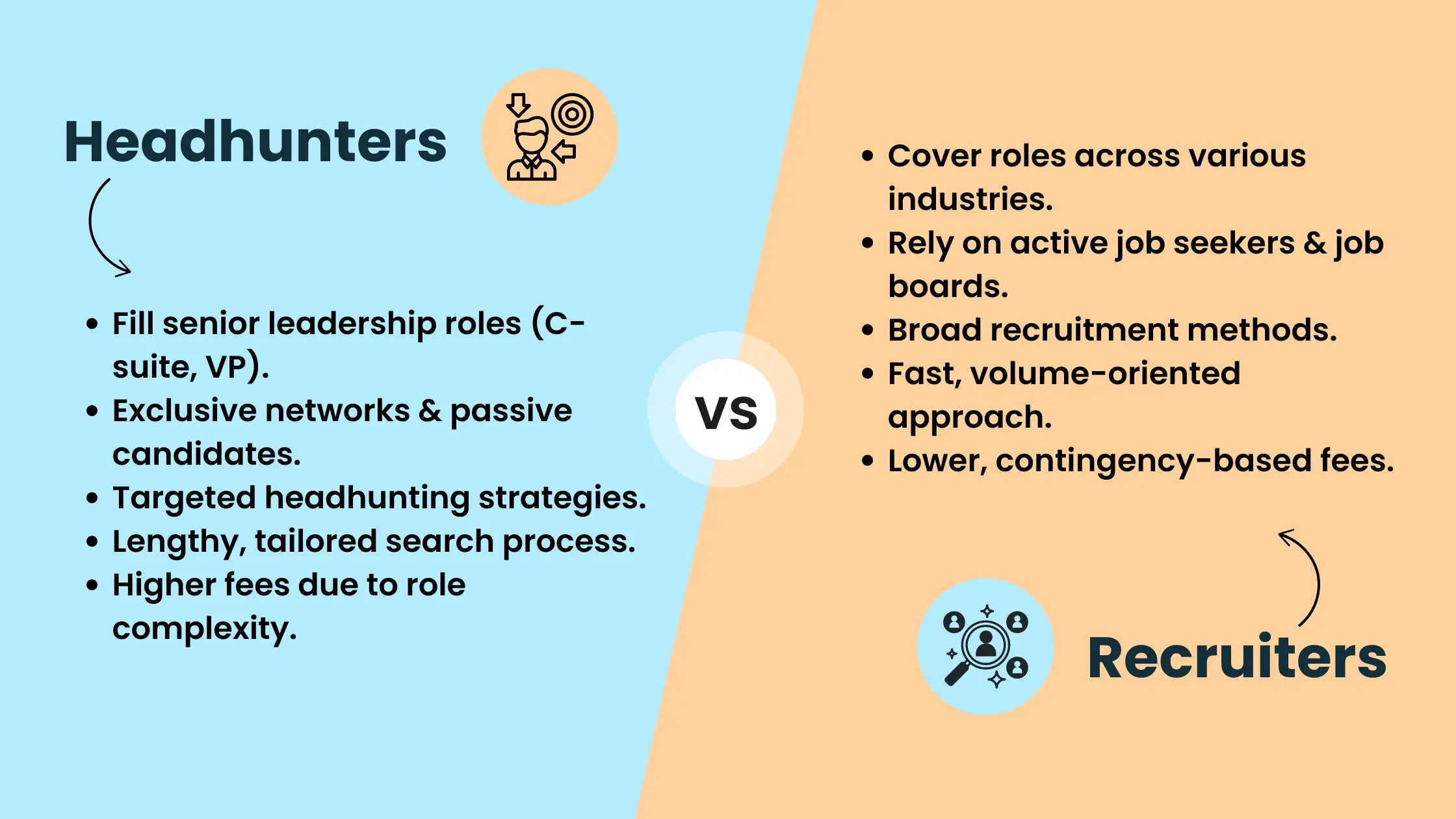
1. Focus: Executive recruiters specialise in senior leadership and C-suite roles. General recruiters handle a wider range of positions at all levels.
2. Sourcing: C-suite recruiters target passive, high-level candidates through networking and direct outreach. General recruiters rely more on job boards and active applicants.
3. Process: Executive search processes are longer. They involve detailed tests and multiple interviews to ensure a fit with leadership and the culture. General recruitment is quicker and more standardised.
4. Client Relationship: Recruiters for executives work closely with clients to offer strategic advice and insights. General recruiters focus on efficiently filling roles with a more transactional relationship.
5. Fees: Executive recruiters charge higher fees, often a percentage of the executive's first-year salary. General recruiters have lower, flat placement fees.
What Are the Biggest Challenges Executive Recruiters Face Today?
Executive recruiters face several challenges while sourcing and placing leadership talent for organisations. These challenges require both expertise and strategic approaches.
1. Competition for Top Talent
Top executives are in high demand. They often get multiple job offers from rival companies. This makes it challenging to secure the best candidates, especially in a competitive market.
2. Confidentiality and Discretion
Executive searches often involve sensitive information. So, it's crucial to maintain confidentiality. Leaks or breaches can harm the reputations of clients and candidates. They can also damage the recruitment firm's credibility.
3. Cultural Fit
Beyond qualifications, it's essential to find executives who fit the company's culture and leadership style. Misalignments in values or management approaches can lead to long-term organisational issues.
4. Extended Hiring Process
Executive recruitment processes can take months due to the level of scrutiny, multiple interviews, and stakeholder involvement. Balancing thoroughness with timely placement is a constant challenge.
5. Managing Client Expectations
Clients often expect quick results from executive searches. Managing these expectations and ensuring clear communication throughout the process can be challenging.

What Executive Search Actually Costs
Executive search pricing depends on the search model, seniority of the role, location, compensation package, difficulty of the assignment, and the firm's expertise.
For retained executive search, a commonly cited 2026 market range is around 25% to 35% of first-year compensation, although actual fees vary and some firms use different structures or minimum fees. Current published 2026 guides show retained-search ranges around this level, with the exact calculation and payment schedule defined in the engagement agreement.
For example, if an executive's agreed first-year compensation is $400,000 and the search fee is 30%, the professional fee would be $120,000. This is only an illustration; the actual fee depends on the firm's agreement with the client and what is included in the compensation base.
Retained search fees are often paid in instalments linked to stages of the engagement rather than only after the candidate joins. The engagement may also specify a replacement or guarantee period if the placed executive leaves within an agreed timeframe.
The fee generally covers work such as:
- Search strategy and role calibration
- Market research and mapping
- Candidate identification
- Passive candidate outreach
- Candidate assessment
- Shortlist development
- Interview coordination
- Reference checking
- Offer support
- Search reporting and client communication
Additional expenses, such as travel, assessments, background checks, or other agreed services, may be handled separately.
When comparing executive recruiters, companies should therefore look beyond the percentage alone. The scope of research, candidate access, assessment methodology, exclusivity, reporting, guarantee terms, and overall search strategy can all affect the value of the engagement.
Conclusion
Executive recruiters don't just fill roles, they help organizations secure the leadership that shapes their future. For any senior hire that carries strategic weight, the expertise, networks, and discretion of an experienced executive search professional are genuinely difficult to replicate.
Whether your organization is navigating succession, entering a new growth phase, or rebuilding a leadership team, the right executive recruiter brings clarity, rigor, and access to a search that's too important to leave to chance.
Once you're familiar with executive recruitment, you can discover best practices in our All-In-One Guide to Executive Search.
.webp.dat)
Frequently Asked Questions (FAQs)
1. What does an executive recruiter do?
An executive recruiter sources, evaluates, and places senior-level leaders such as CEOs and other C-suite executives. They manage confidential outreach, assess leadership fit, and guide organizations through strategic executive hiring decisions.
2. How is an executive recruiter different from a headhunter?
The terms are often used interchangeably, but an executive recruiter typically follows a structured, full-lifecycle executive search process with strategic advisory support, while "headhunter" more narrowly describes the direct outreach and sourcing side of that work.
3. When should a company hire an executive recruiter?
Companies should hire an executive recruiter when filling C-level or senior leadership positions that require confidentiality, proactive sourcing of passive candidates, and in-depth leadership evaluation beyond what internal HR resources can typically provide.
4. Do executive recruiters only hire C-level positions?
No. While they mainly focus on C-suite roles, executive recruiters also place senior vice presidents, directors, and other high-impact leadership positions where the cost of a mis-hire is significant.
5. How do executive recruiters find passive candidates?
Executive recruiters use market mapping, industry networks, referrals, leadership databases, and executive search software to identify and approach passive candidates confidentially, often building relationships long before a specific search opens.
6. How much do executive recruiters charge?
Executive search fees typically range from 25% to 40% of the placed executive's first-year total compensation, with C-suite roles commanding the higher end of that range due to search complexity and the depth of evaluation involved.
7. Why do companies still hire executive recruiters when they have internal talent teams?
Executive recruiters bring access to passive candidates who are not visible to internal teams, along with market intelligence, compensation benchmarking, and the confidentiality needed for sensitive leadership transitions that internal processes are not always equipped to handle.
About the Author