

TL;DR
- HR outsourcing involves delegating HR functions to external providers to save costs and focus on core business.
- There are various models, including Application Service Provider, Business Process Outsourcing, and Total HR Outsourcing.
- Outsourcing covers services like hiring, performance management, compensation, and employee relations.
- Benefits include cost savings, specialised expertise, efficiency, compliance with laws, and updated technology usage.
- Risks involve data insecurity, communication gaps, increased employee turnover, and potential negative impacts on company culture.
- Companies must weigh pros and cons carefully and may use Professional Employer Organisations for full HR outsourcing.
- Maintaining a balance between outsourced HR and in-house efforts is crucial to preserving company culture and employee engagement.
Outsourcing means obtaining work that was previously done by employees inside the company from sources outside the company. If someone has a specialization in an event that is not critical to the business and is unable to do it cost-effectively, it is better to get it done from outside the company. An asset of any firm is its employees. Leading companies worldwide are taking the most strategic approach to managing human resources.
HR outsourcing refers to the process by which a company uses the HR outsourcing services of a third party to save its HR functions. A company can outsource some or all functions from a single or a combination of HR service providers located in many destinations like India, China, and the Philippines.
For example, you can hire a property management virtual assistant to outsource property management tasks to another country. This lets companies focus on core operations while accessing quality property management services.
Why Do Companies Choose to Outsource HR?

The points that support the firm decision to outsource the HR services are as follows:
-
To enable the business to focus on key functions.
-
Cost savings.
-
To create a suitable and cost-effective platform to work on.
-
To transfer focus from an internal process to the business goals.
-
Transferring the risk to the people of the organization.
Models of HR Outsourcing
HR outsourcing is not one-size-fits-all. There are three primary models, each suited to different business sizes and operational needs.
-
Application service provider - A group of many companies specializes in providing hardware and software applications in support of big firms that have developed application packages to support HR activities in an organization.
-
Business process outsourcing - The difference between ASP and BPO is that BPO clients have direct connections to firm employees through call center solutions. Multinational companies mostly go for BPO as they operate in many countries, which employ a lot of people. In these situations, they also need reliable ways to manage international payroll without building complex in-house systems.
-
Total HR outsourcing - In this, the whole function of HR is outsourced to the service providers. There is no particular HR department in firms.
In these models, the utilization of functional service provider services can further enhance the efficiency and effectiveness of outsourced HR functions, offering specialized expertise that aligns with the strategic goals of the company.
What HR Functions Can Be Outsourced?
HR outsourcing services involve the whole organization, and any shortcut or opportunistic behavior from the service provider will affect the company's long-term benefit. The company's HR advantage is sustainable because it is very difficult to be copied by others.
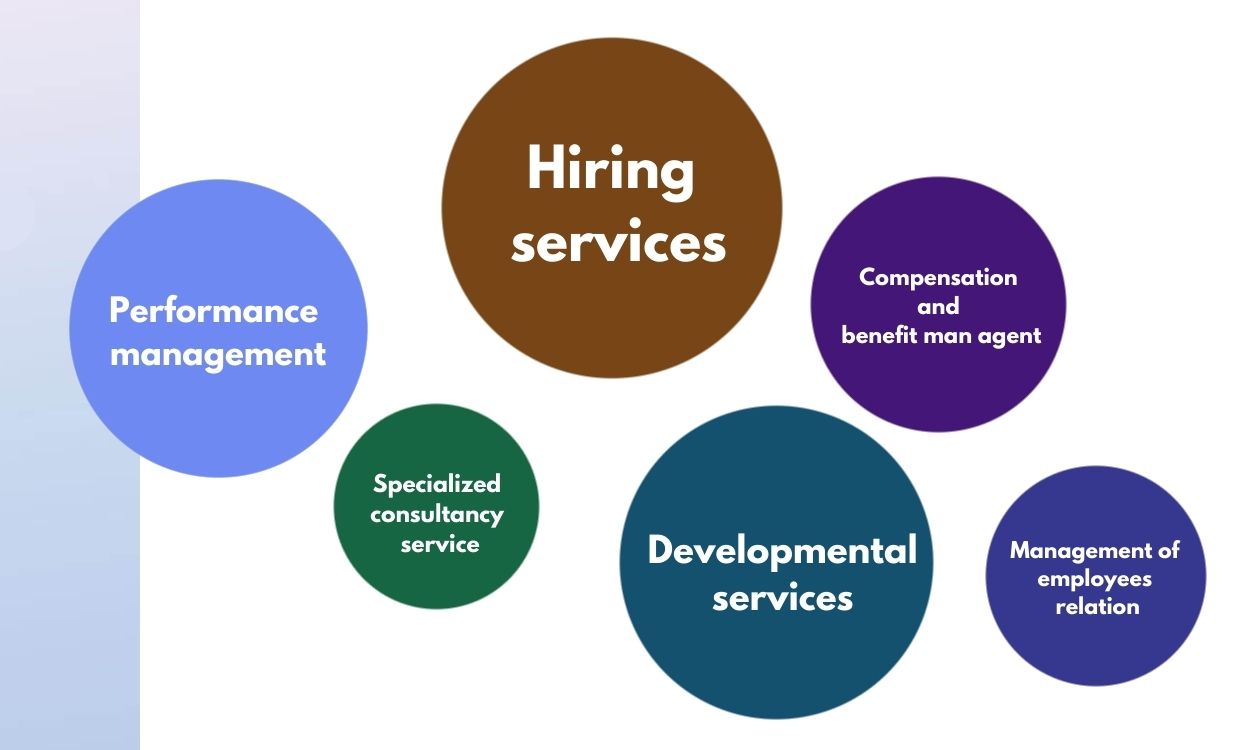
HR can take the following outsourcing services from outside the company
-
Hiring services - Recruiting and selecting is the HR outsourcing service that a company can conquer from outside the company. A variety of people join the labour markets at different stages of their career, firms find these people and allow them the opportunity to be hired by them.
-
Developmental services - In the area of outsourcing external development resources, companies buy markets with developed knowledge. An organization can enhance the capability of its employees by giving them exposure to outside companies, or by running internal upskilling programs through dedicated collaborative learning tools that scale training without adding headcount.
-
Performance management - Organisation performance based on their total organizational level, departmental level, and individual employee level. Employees are chosen based on the above level to work in HR functions.
-
Compensation and benefits manager - Compensation and incentives play a vital role in an HR department. Employees feel motivated when they get perks, bonuses, and rewards besides the salaries for their dedication to work in the organization.
-
Specialized consultancy service - Consultancy is the most popular service of today's business world. Many MNCs and big firms provide policies and insurance to their employees so that they can stick and work on the organization for a longer period.
-
Management of employee relations - Apart from outsourcing, the HR department also manages the relationship between the employees to ensure that the work runs smoothly at all times and all organizational goals are achieved.
Advantages of HR Outsourcing
HR department enjoys the following benefits in an organization
1. Significant Cost Savings
The most significant advantage of HR outsourcing is increased savings. Even if you manage to keep your HR costs low, the total cost of HR functions can be high. It would be unfair and risky for a startup to rely on a single HR employee to manage recruitment, employee benefits, and payroll. As a result, you'll need a team of HR professionals or expert global PEO services to carry out the various functions. As a result, your expenses rise. The advantage of outsourcing HR services is that you are no longer responsible for managing HR costs.
2. Access to Specialist Expertise
External HR providers employ professionals with deep, focused expertise. Whether it is employment law, executive compensation, or talent acquisition strategy, a specialist firm brings a level of knowledge that a generalist in-house hire rarely matches. This expertise is available immediately, without the cost of building it internally over time.
3. Greater Operational Efficiency
When companies outsource their human resources, they can concentrate on their core business processes rather than on human resources.
4. Stronger Legal and Regulatory Compliance
Employment law changes constantly. Minimum wage updates, health and safety requirements, data protection regulations, and changes to benefits legislation can be difficult for internal HR teams to track continuously. External HR providers build compliance monitoring into their core service, reducing the legal risk carried by the business.
5. Access to Current HR Technology
Established HR outsourcing firms invest consistently in modern tools — from AI-powered recruitment platforms to workforce analytics dashboards. Companies that outsource gain access to this technology without the capital outlay of purchasing and maintaining it themselves.
Disadvantages of HR Outsourcing
HR outsourcing department also has some barriers that affect their work in firms are
1. Data insecurity
HR data is among the most sensitive information a company holds — personal details, payroll records, performance history, and, in some cases, health data. Sharing this with a third party introduces genuine security risk, particularly given the rise of cybercrime. Any breach affecting an outsourced provider can expose the company to both regulatory penalties and reputational damage.
2. Split between employees and the company
When a company is outsourced, an outsider handles workplace issues that may not be acceptable to all employees. This frequently creates a major split between employees and the company, which can harm the company's overall productivity. As a result, dealing with the disadvantage of outsourcing HR functions is difficult.
3. Increases Employee turnover
Another significant disadvantage of outsourcing human resources is the high rate of employee turnover. When you outsource your human resources functions, you will almost certainly be in contact with a representative. This HR representative will become acquainted with your company's work culture, dynamics, and other HR concerns over time. However, as with other business uncertainties, this person may leave without making any effort to support your company.
4. Adverse consequence on organization culture
Employees are strongly supported and advocated for them by great in-house HR teams. They work to resolve internal conflicts, advance their professional and personal development, and bridge communication gaps between staff and management. Outsourced HR teams may be less concerned with these issues, which harm overall workplace morale and culture.
5. Reduced Internal Control
Outsourcing HR means accepting that certain decisions and processes will be managed according to the provider's systems and procedures. For companies that value close control over how HR issues are handled, this reduced oversight can be uncomfortable — and occasionally problematic.
Importance of HR Outsourcing
In today's world of business, a new concept has been added to reduce the complications of managing day-to-day HR issues more effectively and efficiently. Depending upon the size of the firm's business and how much control one wants to maintain over HR functions, one can either outsource all the tasks or some to an outsourcing company. If you need to hand off the entire HR function, consider a PEO(Professional employer organization). A PEO becomes the employer of handling all the tasks very certainly and conveniently. If one needs no PEO then he/she can sign a contract with some other outsourcing company.
Conclusion
HR outsourcing can help businesses improve efficiency, reduce costs, and stay compliant when implemented strategically. The key is finding the right balance between outsourced expertise and in-house involvement to maintain company culture and employee engagement. With the right provider and clear communication, HR outsourcing becomes a valuable tool for supporting long-term business growth.
Frequently Asked Questions (FAQs)
1. What is HR outsourcing?
HR outsourcing is the practice of engaging an external provider to manage some or all of a company's human resources functions — including recruitment, payroll, compliance, and employee relations — rather than handling them entirely in-house.
2. Which HR functions are most commonly outsourced?
Payroll processing, recruitment, benefits administration, compliance management, and training and development are the most frequently outsourced HR functions. Payroll and compliance are often prioritised due to the high cost of getting them wrong.
3. What is the difference between HR outsourcing and a PEO?
A Professional Employer Organisation (PEO) acts as a co-employer, taking on full responsibility for HR, payroll, and compliance on behalf of the client company. Standard HR outsourcing typically covers specific functions without the co-employment arrangement. PEOs are most common in smaller businesses that want to hand off HR entirely.
4. Does HR outsourcing reduce costs?
In most cases, yes. Outsourcing eliminates the overhead of maintaining a full in-house HR team and converts fixed HR costs into variable ones. Savings are most significant in recruitment, payroll processing, and compliance management.
5. What are the biggest risks of HR outsourcing?
The primary risks are data security, communication gaps, and cultural disconnect. These can be mitigated through strong contractual protections, clear SLAs, regular communication, and retaining some in-house HR capability.
6. Is HR outsourcing suitable for small businesses?
Yes - in many cases, small businesses benefit most from outsourcing. It gives them access to professional HR support and compliance expertise without the cost of building an in-house team. A PEO arrangement is particularly popular among early-stage businesses.
7. How do I choose the right HR outsourcing provider?
Evaluate providers based on their industry experience, range of services, technology infrastructure, data security practices, service level agreements, and cultural fit with your organisation. Requesting references from existing clients is always advisable.
About the Author