


Executive search firms invest significant time and resources in identifying senior leaders, managing client relationships, conducting confidential searches and delivering successful assignments. As the number of assignments grows, spreadsheets, disconnected databases and manual processes can make these activities increasingly difficult to manage.
Executive search software helps firms centralise executive profiles, streamline research, automate administrative tasks and improve visibility across assignments. However, the real value of the technology lies in its ability to deliver measurable business outcomes.
The ROI of executive search software measures the financial benefits a firm receives from the software compared with the total cost of implementing and using it. These benefits may include reduced administrative costs, more productive consultants, shorter assignment cycles and additional revenue from completed assignments.
In this guide, we explain how to calculate executive search software ROI, which metrics to track, how to estimate financial benefits and what firms should consider before investing in a new platform.
TL;DR
-
Executive search software improves productivity and reduces administrative work.
-
Advanced search and database management help consultants find suitable leadership talent faster.
-
Key ROI metrics include time saved, cost per assignment and revenue per consultant.
-
Calculate ROI by comparing measurable benefits against total software costs.
-
iSmartRecruit streamlines executive search with advanced search, CRM, automation and reporting.
What Does ROI Mean in Executive Recruitment?
ROI in the executive search process is about measuring the effectiveness and value derived from the investment made in hiring C-level talent.
When evaluating executive recruitment ROI, firms need to consider the costs involved in finding, attracting, assessing, hiring, and onboarding executives.
These costs can include:
- Executive recruitment software subscriptions
- Recruiter and search consultant salaries
- Candidate sourcing expenses
- Recruitment advertising and other search-related costs
- Software implementation and training
- Other operational expenses involved in the executive recruitment process
However, the value of executive recruitment should not be measured only by immediate financial returns. A successful executive hire can influence organisational growth, strategic decision-making, team performance, revenue generation, and cost reduction over a much longer period.
Therefore, measuring ROI in executive recruitment should include both direct financial outcomes and long-term business value.
For example, a successful executive placement may help a company improve leadership performance, strengthen its culture, achieve strategic objectives, or reduce the cost of replacing an unsuccessful hire.
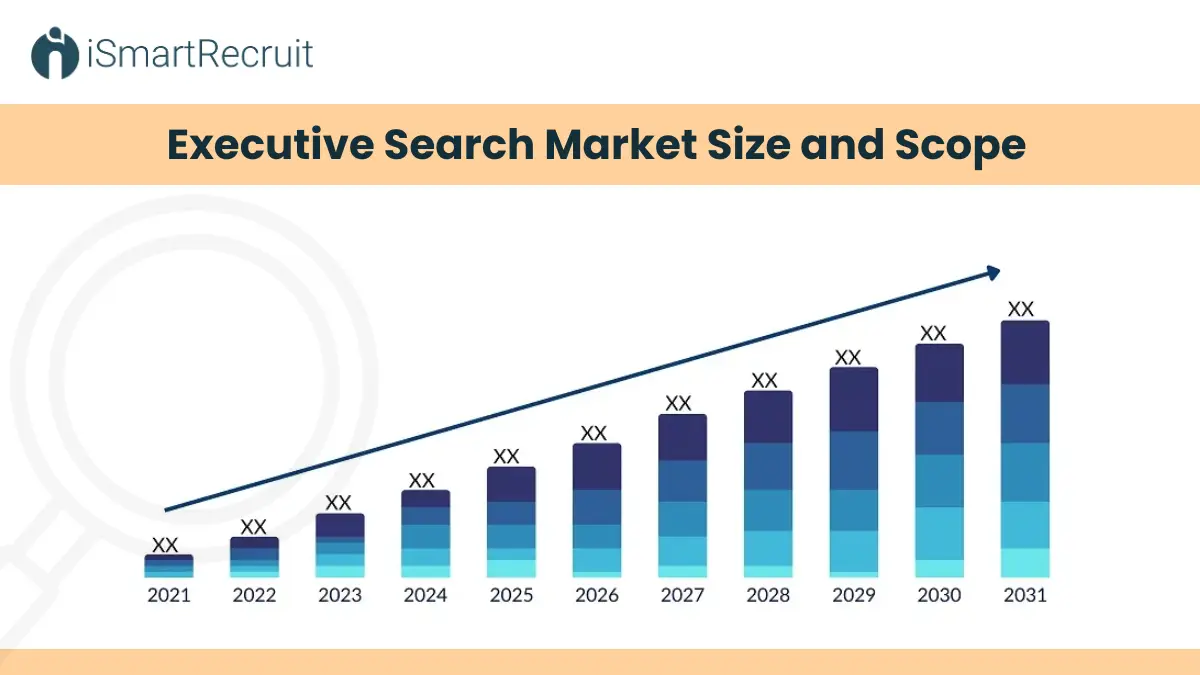
As mentioned in a LinkedIn report, the global executive recruitment market was valued at USD 16.5 billion in 2021. It is projected to grow at a CAGR of 6.96% and reach USD 24.7 billion by 2027.
Hence, the demand for software for executive search will eventually increase. Here is the market potential for executive search software.
So, calculating Executive ROI is super important, right?
So, it is true that executive recruitment software's ROI is substantial for executive search firms.
Here are some key factors that can influence executive recruitment software ROI:
- Specific software features: The more effectively relevant features are used, the greater the potential operational value.
- Integration with recruitment processes: Software delivers more value when it fits naturally into the firm's existing workflows.
- Scale of operations: Firms managing a larger number of searches may have more opportunities to benefit from automation and workflow improvements.
- User adoption: Recruiters need to consistently use the software for its efficiency benefits to translate into measurable ROI.
Let’s explore some key areas where executive recruitment software normally delivers ROI:
1. Higher Efficiency Gains
Executive recruitment software completely simplifies many aspects of your recruitment process, like executive talent sourcing, accurate profile matching, and smooth communication with top executives and your clients.
This reduces the time spent on each search and allows your executive headhunters and recruiters to handle more clients and searches simultaneously.
Thereby, your executive search firm increases productivity and reduces labour costs.
2. Improved Quality of Hires for Clients
With executive recruitment software, your search agency can leverage advanced analytics and more comprehensive executive search data.
It helps firms identify and attract candidates who are better fits.
This can lead to longer tenure and greater satisfaction in the leadership roles filled for your clients.
This, in turn, improves your firm's reputation and reduces costs associated with turnover, such as re-hiring and re-training.
3. Better Candidate and Client Experience
Executive recruitment software can provide smoother, faster, and more transparent communication channels between your search firm, candidates, and clients.
This improved interaction can enrich client satisfaction and retention and generate more referrals and repeat business.
As a result, your revenue directly increases.
4. Significant Cost Reduction Through Automation
Automating repetitive recruitment tasks with executive recruitment software decreases the need for extensive administrative support and lowers the overhead costs associated with maintaining large executive recruitment teams.
Faster placements of top executives for your clients lower the costs linked to lengthy search durations, like continued advertising and lost productivity.

5. Data-Driven Executive Recruitment
Executive search software comes with robust reporting and analytics features which can offer insights into market trends, compensation benchmarks, and C-level talent expectations.
These powerful insights help your executive search firm advise its clients more effectively, position itself as an industry leader and attract more business. To learn more about building a successful executive search strategy, explore our in-depth guide on Executive Search.
Why Executive Search Firms Should Measure Software ROI?
Calculating ROI is not just an accounting exercise. It helps executive search firms understand whether their recruitment technology is producing measurable business value.
Measuring software ROI can help firms:
- Justify the software investment: Compare technology costs with measurable financial and operational benefits.
- Identify operational gains: Understand where automation and improved workflows are saving recruiter time.
- Make better technology decisions: Use performance data when considering renewals, upgrades, or changes in recruitment technology.
- Find additional savings: Identify underused features, inefficient processes, and workflow gaps.
- Demonstrate value to stakeholders: Provide partners and finance teams with measurable evidence of software performance.
- Improve forecasting: Build a performance baseline that can support future recruitment technology and resource planning.
Without measuring ROI, firms may know how much their software costs but not how much value it is actually generating.

How to Calculate the ROI of Executive Search Software?
The ROI of executive recruitment software involves assessing both the tangible and intangible benefits it provides to your executive search agency.
Here’s a structured approach to understand and estimate the ROI of this technology:
Step 1: Identify Total Costs
First, you need to collect all the costs associated with the software. This includes:
- Initial Purchase Price: The upfront cost of purchasing the software.
- Implementation Costs: Any expenses related to setting up the executive recruitment software, such as integration with your HRIS systems, customisation, and data migration.
- Training Costs: Expenses for training your executive recruiters to use the new executive recruitment software effectively.
- Maintenance and Support Costs: Ongoing costs for software updates, client support, and maintenance after installation.
Step 2: Quantify Savings and Gains
Next, identify and quantify the financial benefits generated by the executive search software.
These can include:
- Reduction in Time to Hire
- Increased Recruiter Efficiency
- Improved Candidate Sourcing
- Reduced Administrative Work
- Improved Quality of Hires
- Client Retention and Acquisition
- Reduced Cost per Search
For example, if automation saves each recruiter several hours per week, estimate the financial value of that saved time based on the relevant employee cost.
Similarly, if faster search execution helps a firm complete more assignments, the additional revenue can be included as part of the overall benefit.
Step 3: Calculate ROI
Once you define the costs and gains, it is time to calculate the ROI using the following formula:

This formula will give you the ROI as a percentage and show the net return per dollar spent.
Step 4: Consider Intangible Benefits
While not directly quantifiable in dollars, these subjective benefits contribute to your search firm's long-term success and competitive positioning.
Here are some benefits:
- Improved employer brand reputation:
- Enhanced client relationships
- Strategic decision-making
Executive Search Software ROI: A Worked Example
Consider a hypothetical executive search firm with a team of consultants and researchers managing multiple leadership assignments each year.
The firm implements executive search software to centralise its database, automate administrative tasks and improve assignment visibility.
After establishing a baseline and measuring results over 12 months, the firm estimates the following benefits.
| Financial Metric | Annual value |
| Labour value of administrative time saved | $7,000 |
| Additional contribution margin from completed assignments | $5,000 |
| Total attributable benefits | $12,000 |
| Annual software subscription and implementation costs | $4,000 |
| Net benefit | $8,000 |
| Annual ROI | 200% |
The calculation is:
ROI = ($12,000 − $4,000) ÷ $4,000 × 100 = 200%
Under these assumptions, the firm generates $8,000 in net benefit during the year.
The example is illustrative, not a claim about actual iSmartRecruit customer results. It assumes the benefits are attributable to the software, measured over the same period and free from double counting.
For instance, the additional contribution margin must not include the same consultant hours already counted as a labour saving unless the two benefits are genuinely separate. If saved time enables additional assignments, firms should calculate the incremental contribution from those assignments without counting the same productivity benefit twice.
This approach provides a more credible assessment than assigning an arbitrary financial value to every hour saved.
How Long Does It Take to See a Return on Executive Search Software?
The time required to achieve a positive return varies between firms. It depends on implementation costs, team adoption, existing processes, assignment volume and the time required for operational improvements to translate into financial outcomes.
Some benefits, such as reduced duplicate data entry, may become visible relatively early. Other benefits, such as increased repeat business or additional completed assignments, may take longer to establish.
Three factors influence the timeline.
Implementation and Data Quality
A firm with a well maintained executive database and clearly documented processes may find it easier to adopt a new platform.
By contrast, fragmented records, duplicate profiles and inconsistent workflows can require additional data migration and training.
User Adoption
Software delivers limited value if consultants continue to rely on disconnected spreadsheets or fail to maintain accurate records.
Training, clear ownership and consistent usage standards help ensure that the platform supports the firm's actual operating processes.
Assignment Volume and Revenue Cycle
Firms managing a high volume of suitable assignments may be able to realise productivity benefits more quickly. However, executive search assignments can have long delivery cycles, and improvements in operational efficiency may not translate immediately into completed assignments or revenue.
Review early operational indicators monthly and evaluate financial outcomes over a longer period appropriate to the firm's business cycle.
How to Measure ROI Before and After Implementation
A structured measurement process helps firms distinguish genuine improvements from normal business fluctuations.
1. Establish a Baseline
Record the current cost per assignment, research hours, administrative hours, assignment duration, consultant productivity and relevant revenue metrics.
Use a representative period and account for seasonal differences where possible.
2. Define Success Criteria
Identify the outcomes the software is expected to improve. For example, a firm may aim to reduce administrative effort, improve the reuse of existing executive profiles or increase assignments completed per consultant.
Targets should reflect the firm's current performance rather than arbitrary industry benchmarks.
3. Track Results Consistently
Use software reports, timesheets, finance records and assignment data to monitor progress. Keep definitions consistent so that comparisons remain meaningful.
Where feasible, compare similar assignments or teams to understand whether improvements are associated with software adoption rather than unrelated business changes.
4. Attribute Benefits Carefully
Not every improvement will result directly from the software. Changes in client demand, team size, consultant experience and market conditions can affect results.
Document the assumptions used in the calculation and separate benefits that can be measured directly from those that are estimated.
5. Recalculate ROI Regularly
Review the financial model at suitable intervals, such as quarterly and annually. Include actual implementation expenses, subscription costs and any additional services used during the evaluation period.
This process helps firms determine whether the software continues to deliver value and identify areas where adoption or workflows need improvement.
Which Executive Search Software Features Have the Greatest Impact on ROI?
The features that contribute most to ROI depend on a firm's operating model and current bottlenecks. Firms should prioritise capabilities that address measurable inefficiencies rather than selecting software solely because it has a long feature list.
Executive Database Management
A centralised database makes it easier to maintain executive profiles, career histories, contact information and relationship records.
It can reduce duplicated research and help consultants reuse existing knowledge across relevant assignments.
Advanced Search and Matching
Boolean search, fuzzy matching and other advanced search capabilities can help researchers identify relevant profiles from extensive databases.
Their financial value depends on the time saved, the quality of the results and the extent to which the firm can reuse its existing data.
Executive Relationship Management
Relationship management tools help firms maintain client and executive interaction histories, follow up on relevant conversations and coordinate long term engagement.
These capabilities can support business development and repeat assignments when combined with effective relationship management practices.
Workflow Automation
Automated reminders, task assignments, communication workflows and status updates reduce repetitive coordination.
The greatest value typically comes from automating frequent, predictable tasks while preserving appropriate human oversight for sensitive executive search activities.
Reporting and Analytics
Reporting tools help firms evaluate assignment progress, consultant productivity, workload distribution and operational performance.
Consistent reporting makes it easier to identify bottlenecks and quantify the results of process improvements.
For more detail on evaluating these capabilities, read our guide to executive recruitment software and its key features.
How to Choose Executive Recruitment Software That Delivers ROI
Choosing executive recruitment software requires an assessment of both functional suitability and total cost of ownership.
Before making a decision, executive search firms should evaluate the following factors.
-
Fit with executive search workflows: Confirm that the platform supports confidential assignments, long term executive relationships and complex research processes.
-
Database search capabilities: Evaluate whether researchers can locate relevant profiles efficiently using the search methods they need.
-
Automation: Identify repetitive tasks that the platform can reduce without compromising quality or confidentiality.
-
Reporting: Check whether the system provides the data needed to measure productivity, assignment performance and financial outcomes.
-
Integration requirements: Assess how well the software works with existing email, calendar and business systems.
-
Implementation and training: Understand the resources required to migrate data, onboard users and establish consistent workflows.
-
Security and compliance: Review access controls, data protection practices and relevant regulatory requirements.
-
Pricing and scalability: Compare the full cost of ownership against the firm's expected usage, growth plans and measurable benefits.
A useful evaluation process involves defining the firm's most important operational problems, mapping them to software capabilities and identifying the KPIs that will demonstrate whether the investment has worked.
How iSmartRecruit Supports Higher Executive Search ROI
Choose iSmartRecruit if you want to leverage higher Executive as well as Recruitment ROI. Want to know why?
Let’s explore certain reasons why top executive search firms trust iSmartRecruit to drive higher ROI.

Advanced Analytics: iSmartRecruit provides comprehensive analytics and reporting features that help executive search firms understand market trends and optimise their C-level recruitment strategies.
Automation of Routine Tasks: Our ATS for executive search automates time-consuming tasks like executive talent sourcing and resume parsing significantly reducing operational costs.
Customisable Features: We offer customisable features that adapt to specific executive recruitment workflows your clients have to enhance overall efficiency.
Superior Profile and Job Matching: Use the world’s first two-way AI-driven algorithms for precise executive and job matching and boost your search firm’s placement success rates.
Integrated CRM: Our executive search CRM comes equipped with an integrated CRM to streamline client interactions and manage relationships effectively.
Global C-level Talent Access: Enables access to a broader global talent pool of top executives and elevates the chances of finding the perfect match for executive roles.
Robust Security Measures: iSmartRecruit makes sure that data security and GDPR compliance with international standards protect both search firm and executive information.
User-Friendly Interface: Get a user-friendly interface that simplifies training and maximises usability for all team members.
Dedicated Support: Your executive search firm gets dedicated customer support to ensure smooth executive recruitment operation and quick resolution of any issues your team faces.
So, are you ready to leverage all of the benefits you just witnessed above for your search firm? Then, let’s connect, and let us show you how iSmartRecruit can simplify your end-to-end executive search!

Conclusion
The ROI of executive search software depends on more than subscription costs or the number of features available. It reflects how effectively a firm uses technology to improve productivity, manage assignments, control operating costs and support sustainable revenue growth.
By establishing a baseline, selecting meaningful KPIs, calculating total costs and measuring attributable benefits, executive search firms can make more informed software investment decisions.
The most reliable approach is to connect every expected benefit to a measurable operational or financial outcome, review the results consistently and refine workflows as the business evolves.
For firms looking to improve their executive search operations, the next step is to identify the biggest sources of inefficiency and assess which software capabilities can address them.
Frequently Asked Questions (FAQs)
1. What is the difference between executive search software ROI and executive hiring ROI?
Executive search software ROI measures the value a search firm gains from its technology investment. Executive hiring ROI measures the business impact of hiring a leader.
2. How long should firms measure executive search software ROI?
Measure operational improvements monthly and review financial outcomes quarterly or annually, depending on the firm's assignment volume and revenue cycle.
3. How can firms avoid overstating software ROI?
Use reliable baseline data, count only attributable benefits, include all relevant costs and avoid counting the same productivity gain twice.
4. Can smaller executive search firms benefit from executive search software?
Yes. Smaller firms can benefit from centralised executive data, streamlined workflows and reduced manual administration, provided the software's cost and capabilities fit their needs.
5. How can firms determine whether their current executive search software is delivering value?
Compare current performance against pre-implementation benchmarks, review software adoption, assess operational bottlenecks and evaluate whether measurable benefits justify the total cost.
About the Author