


TL;DR
- Adopt multilingual recruitment best practices to reach wider talent pools and improve hiring outcomes.
- Localise adverts and career pages for culture and market norms rather than relying on literal translation.
- Use language-aware ATS features and AI-assisted translation with human review for key decisions.
- Validate assessments and standardise structured interviews across languages to reduce bias.
- Keep data privacy and local legal compliance documented and auditable.
- Measure language-based KPIs from pilot to scale and iterate quickly.
- Assign local champions with central governance to maintain consistency and speed.
Hiring across languages is no longer a niche challenge reserved for multinational corporations. As organisations expand into new markets, build distributed teams, and compete for talent across borders, language strategy has become a core component of effective talent acquisition.
The business case is well established. McKinsey research consistently shows that diverse teams outperform less diverse peers, and consumer studies suggest roughly 75% of people prefer to engage with information in their native language. For recruitment teams, the implication is direct: candidates who encounter a localised, professionally executed hiring experience are more likely to apply, engage, and accept offers.
This guide covers the practical steps, technology considerations, and governance models that help hiring teams implement multilingual recruitment best practices at scale.
Why multilingual hiring matters for modern organisations
Global teams need more than coordination. They need cultural fluency and linguistic fit to serve customers and collaborate effectively across time zones. When recruiters adopt multilingual recruitment best practices, they attract passive candidates who search in local languages and lower the risk of role misunderstanding. The result is a shorter time to hire and better quality of hire.
The benefits extend across the entire hiring cycle:
Wider candidate reach:
Local language job adverts attract candidates who do not search in English, immediately expanding the addressable talent pool.
Improved quality of hire:
Localised role descriptions reduce ambiguity around responsibilities, seniority, and expectations, producing better-matched applicants.
Stronger employer brand:
Candidates who experience a professional, localised hiring process remember it and share it with peers in their networks.
Lower compliance risk:
Locally adapted processes ensure contracts, right-to-work checks, and data handling meet in-country legal requirements.
Design job adverts and career pages for language diversity
The job advert is often the first meaningful interaction candidates have with your organisation. Treating language as a tick-box leads to literal translations that confuse applicants. Instead, follow multilingual recruitment best practices by building templates that are localised for culture, labour market norms and role expectations.
Practical steps for adverts and careers pages
- Create central templates for role families and adapt the copy for local context, terminology, and any regulatory specifics.
- Publish listings in the local language and in English where a bilingual audience is relevant to talent attraction.
- State the required language proficiency clearly and explain how it will be evaluated during the selection process.
- Use plain language throughout and avoid idioms, colloquialisms, or slang that do not translate meaningfully across regions.
Example: A London fintech needed a product manager in Madrid. The team published Spanish and English adverts. The Spanish version explained the local regulatory context and expected working hours. Applications rose by 40% and the interview-to-offer ratio improved because candidates understood expectations from the start.
Use language-aware recruitment technology
To scale, you need systems built for multiple languages. A modern ATS should support translations, language tagging and local data rules. When technology follows your language strategy, you reduce manual work, improve the candidate experience and keep consistent records for compliance.
Key features to prioritise
- Multilingual career portals and automated job distribution that publish the right language version to local job boards.
- Editable machine translation for CVs and screening questions so humans can refine important details.
- Language skill tagging and metadata for targeted search and reporting by language group.
- Scheduling tools that account for time zones and local holidays to reduce no-shows.
- Audit trails and stored consent records for cross-border data transfers to meet local law.
Tip: Use AI translation for high-volume tasks and initial triage, but include human review before final decisions. Machine translation speeds up screening while human reviewers preserve nuance where communication skills matter.
Localise assessments rather than simply translate them
Word-for-word translation of assessments can change how questions are interpreted. Language shapes problem-solving and situational judgment. Adopt multilingual recruitment best practices by validating tests in each market and avoiding culturally loaded scenarios that advantage one group over another.
How to validate assessments
- Pilot tests with local staff or contractors to surface ambiguous phrasing and cultural bias.
- Adjust scoring rubrics to separate language complexity from domain skill.
- Prefer situational judgement and work sample tests that focus on role behaviours rather than local references.
Real insight: A global consulting firm adapted a case assessment for three markets and found that questions relying on local regulatory knowledge produced false negatives. After local validation, the pass rate evened out, and client satisfaction improved because consultants matched client needs more closely.
Structure interviews for consistency across languages
Interviews are the gateway to fair hiring decisions. Train hiring teams to run structured interviews and use consistent competency frameworks across regions. Make language a dimension in your scorecard so assessors know whether proficiency is essential, desirable or irrelevant.
Best practices for multilingual interviews
- Share interview questions in advance, where possible, to level the playing field for non native speakers.
- Use phone interpreter services only when necessary and when the role does not require the language being evaluated.
- Record interviews and keep transcripts in candidate files to support decisions and appeals.
- Provide local points of contact who can answer candidate questions in their language.
Example: A global SaaS company introduced a universal interview template and local language scorecards. Standardisation led to a 30% reduction in unconscious bias complaints year on year and more comparable candidate evaluations across regions.
Comply with local law and data privacy requirements
Implementing multilingual recruitment best practices means mapping data protection, right to work checks and employment law for every jurisdiction you hire into, particularly as organisations expand into new markets. This becomes even more important as teams look to employ global talent without local entities while staying compliant across regions.
Compliance checklist
- Document explicit consent for processing candidate data in the candidate's preferred language.
- Store sensitive data in line with local rules and flag any cross-border transfers.
- Work with local HR or legal teams to ensure offer letters are valid and enforceable in the local language.
Practical note: Keep a record of the language used in each contract and the candidate's acknowledged copy. That small step reduces disputes and supports local enforcement where necessary.
Candidate experience and employer brand
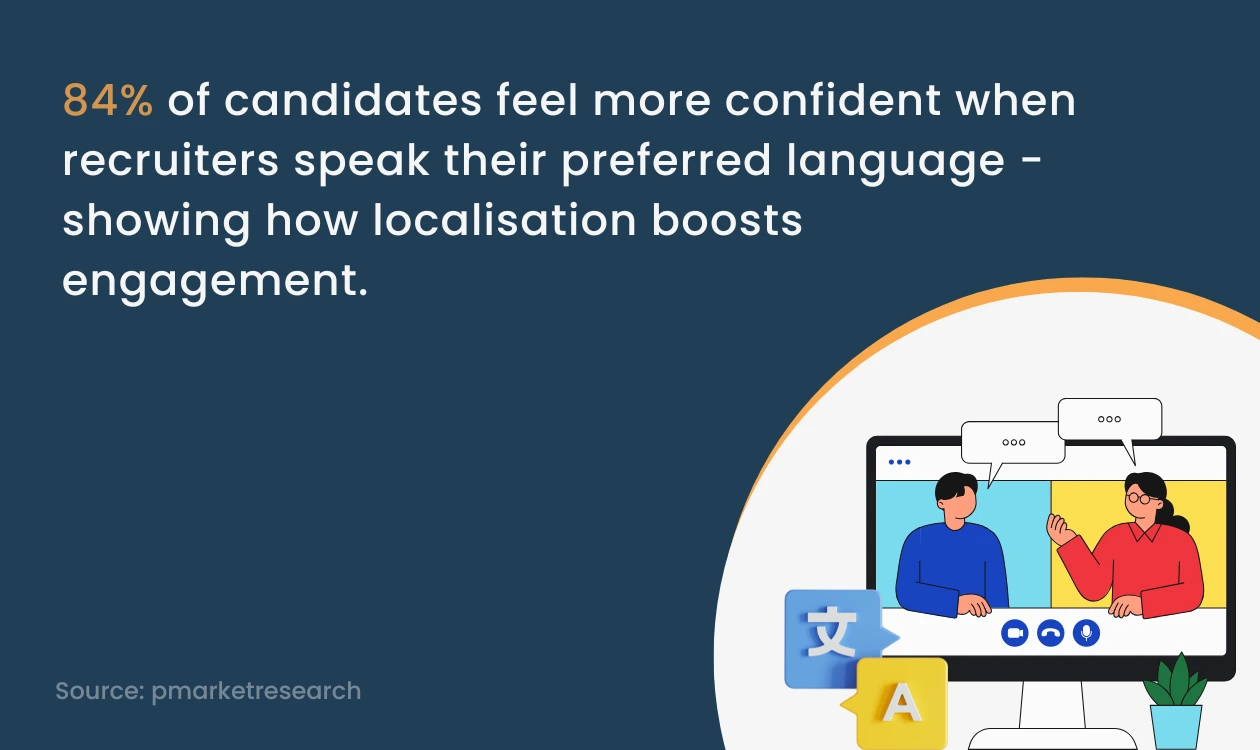
Language shapes how candidates judge your employer brand. Clear, localised communication builds trust. In fact, 84% of candidates feel more comfortable engaging with recruiters who communicate in their preferred language, highlighting how localisation directly improves candidate confidence and engagement. Candidates who receive updates and feedback in their language are more likely to accept offers and recommend your company.
Practical touches that matter
- Localised onboarding guides and buddy programmes to support early retention.
- Translated offer letters and total reward summaries so employees clearly understand compensation and benefits.
- Feedback and survey follow-up in the candidate's preferred language to close the loop professionally.
Case snapshot: A European e-commerce firm centralised templates and added language tags across their ATS. Within twelve months, local hires rose by 50% and new joiner satisfaction increased across markets because expectations were clearer from application to onboarding.
Measure success and iterate
Metrics tell you what works. Track applications by language, interview to offer ratios, offer acceptance rates and candidate satisfaction by region. Run A/B tests on advert language and monitor which versions deliver higher quality applicants and longer retention.
Suggested KPIs
- Applications per posting by language
- Interview to offer ratio by language group
- Offer acceptance rate localised by region
- Candidate Net Promoter Score by language
Start with a focused pilot in a single region or function. Use that pilot to test job templates, ATS configurations and interview formats. A typical pilot runs in eight to twelve weeks. Use the proof point to expand to other regions over the following six to twelve months while iterating on templates, training and ATS settings.
Roles, governance and scaling
The most effective multilingual hiring programmes use a hybrid ownership model. Central HR sets the standards, selects and configures the tools, and maintains governance. Local HR adapts content, executes hiring in line with in-country legal and cultural requirements, and feeds insights back to the centre.
Appointing local champions in each market is the practical mechanism that makes this work. Local champions maintain relevance and responsiveness while central oversight preserves consistency across markets.
As one talent acquisition leader put it: "Treat language as a core hiring dimension, not an afterthought. It is where diversity strategy meets operational rigour."
Implementation checklist
- Define language policy by role family and market - essential, desirable or not required.
- Build central templates and localise for culture, labour law and market norms.
- Configure your Applicant Tracking System for language tagging, editable machine translation and data consent capture.
- Pilot assessments and interviews with local validation to remove cultural bias.
- Measure KPIs by language and region and iterate from pilot to scale.
- Assign local champions and maintain central governance for standards and training.
Conclusion
Implementing multilingual recruitment best practices is one of the most direct ways global hiring teams can improve both the fairness and effectiveness of their talent acquisition. When language is treated as a core hiring dimension rather than an administrative detail, the results are measurable: broader talent pipelines, stronger candidate experience, reduced bias, and better role fit across markets.
The organisations that invest in a clear language strategy, supported by the right technology, governance structure, and local expertise, gain a meaningful competitive advantage in attracting and retaining global talent. Start with a focused pilot, measure rigorously, and scale what works.

Frequently Asked Questions (FAQs)
1. What are the first steps to implement multilingual recruitment best practices?
Begin with a pilot in a single market or function. Localise job adverts for that region, configure your ATS to tag and store language preferences and train a small group of hiring managers on structured interviews. Collect KPIs during the pilot to refine your playbook before scaling.
2. How do I assess language skills fairly?
Define role-relevant language requirements and use validated assessments that measure practical tasks such as business writing or presentations. Avoid relying only on self-reporting and provide interview questions in advance where appropriate to reduce disadvantage for non native speakers.
3. Can AI help with multilingual recruitment?
Yes. AI assists with translation, CV parsing across languages and initial candidate matching. Use AI for volume tasks and ensure human review for final evaluations. Audit models for fairness and document when automated decisions are used.
4. How should data privacy be handled in cross-border recruitment?
Obtain explicit consent in the candidate's preferred language, document transfers and store data according to local law. Involve local legal teams to ensure compliance and keep an auditable trail of consent for recruitment processing.
5. What metrics indicate success for multilingual hiring?
Track applications by language, interview to offer ratio, offer acceptance rates and candidate satisfaction. Monitor these metrics by region and language to identify issues and optimise processes.
6. Who should own multilingual recruitment policies?
Best practice is hybrid ownership. Central HR should set standards, tools and governance. Local HR should adapt content and execute hiring in line with legal and cultural requirements. Local champions ensure relevance while central oversight preserves consistency.
7. How do I avoid cultural bias in translated assessments?
Pilot assessments with local employees, calibrate scoring to separate language difficulty from technical skill and replace culturally specific scenarios with behaviour-based situations relevant to the role.
8. How quickly can a team scale multilingual recruitment best practices?
Timelines vary with size and complexity. A focused pilot can run in eight to twelve weeks. Use that proof point to expand to other regions over six to twelve months while iterating on templates, training and ATS configuration.
About the Author