

The AI hiring slowdown is reshaping the recruitment landscape, catching many agencies off guard. After years of surging demand for AI and tech talent, companies are pulling back, pausing headcount, restructuring AI teams, and tightening budgets. For agency owners who built their revenue around tech placements, the pressure on margins is real and immediate.
This blog focuses on what matters most: why the AI hiring slowdown is happening and what recruitment agency owners can do right now to protect profitability.
TL;DR
- The AI hiring slowdown is a market correction driven by over-hiring, budget cuts, and AI tooling reducing headcount needs.
- Agencies must diversify revenue, reduce operational costs, and shift toward retained work.
- Recruitment automation tools are key to maintaining output with leaner teams.
- Agencies that adapt now will be best positioned when demand returns.
What Is Driving the AI Hiring Slowdown?
The AI job market slowdown is not a single event; it is the result of several pressures converging at once:
Over-hiring during the boom
Companies hired AI talent aggressively between 2020 and 2023, often ahead of genuine business need. Many are now in correction mode, with redundancies flooding the market with experienced candidates and reducing urgency to engage external recruitment agencies.
Budget rationalisation
As economic pressure mounts, finance teams are scrutinising AI headcount costs against measurable business outcomes. Where the ROI case is difficult to make, hiring is paused sometimes indefinitely. In many organisations, what looks like an AI-driven restructuring decision is, in reality, a financial one.
AI tools are reducing headcount requirements
There is a notable irony here: AI itself is reducing the number of roles companies need to fill. Coding assistants, automated testing platforms, and AI-driven analytics tools are quietly shrinking technical team sizes across sectors, directly affecting placement volumes for recruitment agencies.
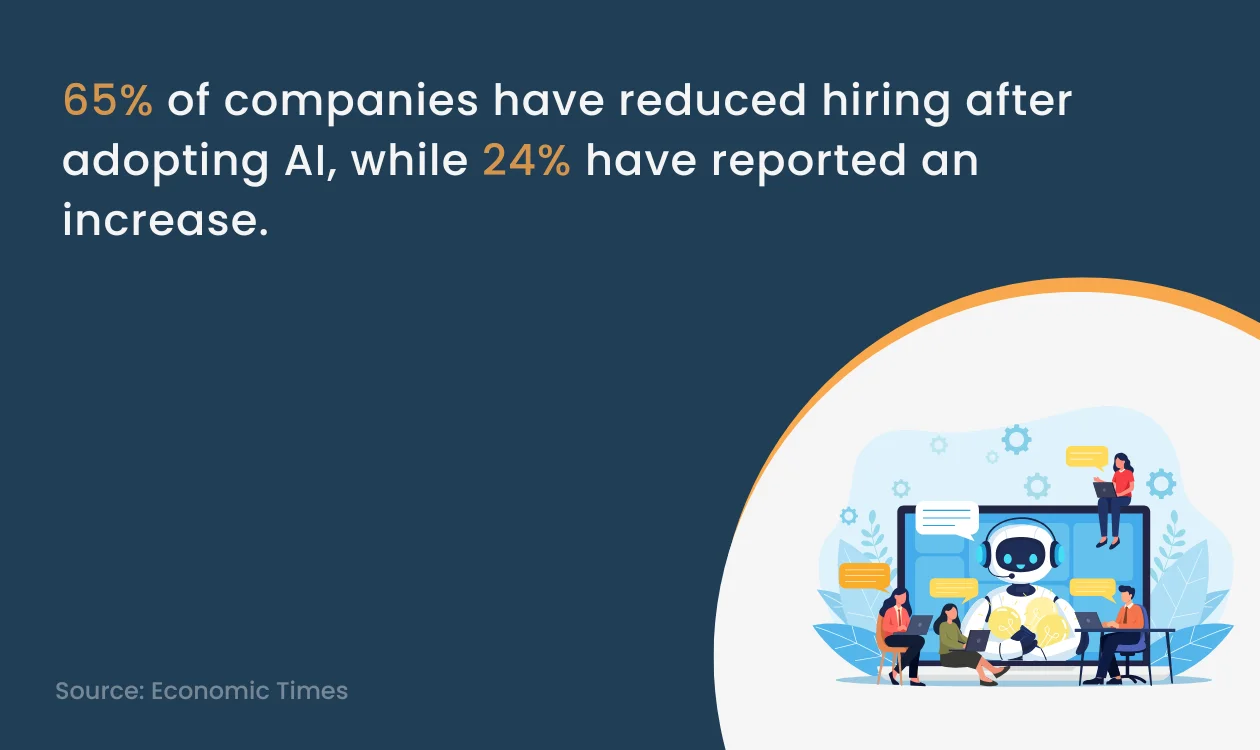
According to The Economic Times, 65% of companies have reduced hiring after adopting AI, while only 24% reported an increase in recruitment activity, reinforcing how AI adoption is contributing to more cautious workforce expansion.
Hiring is becoming more selective, not just slower
Organisations are not stopping all hiring; they are becoming far more deliberate. Roles that are higher-cost, slower to deliver ROI, or tied to legacy processes are being cut or left unfilled. The bar for what justifies an external hire has risen considerably.
Macroeconomic caution
Rising employer costs, global economic instability, and reduced venture funding have made businesses broadly more conservative on headcount, particularly for senior technical roles carrying high base salaries and equity expectations. A meaningful recovery in hiring volumes is not expected in the near term.
The result is an AI hiring freeze across many organisations, fewer open roles, longer decision cycles, and sustained downward pressure on agency fees.
The Real Impact on Your Agency
The commercial consequences for recruitment agency profitability are direct and compounding:
- Lower placement volumes, fewer open roles mean fewer opportunities to generate revenue.
- Margin compression clients are pushing back on fees in a softer, more competitive market.
- Extended sales cycles, hiring decisions take longer and require more stakeholder sign-off, creating cash flow pressure.
- Increased competition, more agencies are chasing fewer mandates, driving down rates.
- Rising cost-per-placement with candidates taking longer to place and clients requiring more nurturing, the internal cost of each successful hire increases even as revenue per placement falls.
Agencies heavily concentrated in AI and tech hiring are feeling this most acutely. The path forward requires both defensive and offensive action.
Five Strategies to Stay Profitable
1. Audit and Reduce Your Cost Base
Start with what you can control. Review every operational expense, including technology subscriptions, headcount ratios, office costs, and advertising spend. In a high-volume market, inefficiencies are masked by revenue. In a slowdown, they become a direct threat to survival.
Look closely at your technology stack for overlapping tools, underutilised platforms, and subscriptions that made sense during growth but no longer earn their cost. Even modest reductions across multiple line items can meaningfully protect margin.
2. Shift Toward Retained and Project-Based Revenue
Contingency recruitment is the first model to suffer when hiring volumes fall. When clients do have roles, they increasingly use contingency arrangements to hedge against engaging multiple agencies with no commitment and cancelling searches without consequence.
Retained search provides upfront revenue regardless of search duration and creates more committed, exclusive client relationships. Project-based RPO arrangements offer longer-term, more predictable income. Repositioning even part of your service offering toward these models significantly improves financial resilience and changes the nature of your client relationships for the better.
3. Diversify Into Adjacent Markets
If your agency is concentrated in pure AI and tech placements, the AI talent demand decline represents a direct and immediate revenue risk. Diversification does not mean abandoning your specialism; it means extending it intelligently.
Consider expanding into:
- AI governance, risk, and compliance: Regulatory frameworks around AI are expanding, and companies need specialists to navigate them.
- AI integration roles in non-tech sectors: Healthcare, finance, logistics, and manufacturing are all implementing AI and need people to manage adoption.
- Change management and transformation: As organisations restructure around AI tools, demand for experienced transformation professionals is growing despite the broader tech hiring slowdown.
These markets leverage your existing knowledge while reducing dependency on a single vertical.
4. Use Recruitment Automation to Do More With Less
Recruitment automation tools are one of the most effective operational levers for protecting margins when placement volumes drop. Automating candidate sourcing, screening, interview scheduling, and pipeline reporting reduces the manual hours consultants spend on low-value activities, lowering cost-per-placement without cutting team capacity.
More importantly, agencies that invest in integrated recruitment CRM and ATS platforms gain real-time visibility into consultant productivity, time-to-fill, pipeline conversion rates, and revenue forecasting. In a downturn, this data is not optional; it is essential for protecting margins and making informed commercial decisions.
The goal is not to replace consultants, but to make each consultant more productive and ensure their time is focused on revenue-generating activity. Agencies that combine smart automation with strong client and candidate relationships will outperform competitors that rely purely on manual processes.
5. Deepen Client Relationships Now
Client retention is worth significantly more than client acquisition during a downturn. The cost of maintaining a strong existing relationship is a fraction of what it takes to win a new client, and existing clients who trust you are far more likely to engage you first when hiring resumes.
This is the moment to invest in account management that goes beyond checking in on live roles. Stay engaged with talent planning conversations, share relevant market intelligence, and remain visible and valuable even when there is no active mandate. Agencies that stay present and useful during the slowdown consistently receive the first call when conditions improve.
Conclusion
The AI hiring slowdown is a correction, not a conclusion. AI remains a powerful driver of workforce transformation, and demand for skilled professionals will return, likely with a stronger focus on deployment, integration, and governance.
Agencies that use this period wisely will emerge stronger: streamlining operations, diversifying revenue, and strengthening client partnerships. Smarter use of technology will be central to that shift. Agencies investing in integrated recruitment platforms such as iSmartRecruit will be better positioned to control costs, improve visibility, and protect margins during uncertain times.
Profitability in a slowdown is not about doing more, it’s about operating with greater efficiency, clarity, and precision.
.png.png)
Frequently Asked Questions (FAQs)
1. What is the AI hiring slowdown?
The AI hiring slowdown is a significant drop in hiring activity across AI, machine learning, and data science roles. After a period of rapid expansion during the AI boom years, many companies are now recalibrating due to over-hiring, tighter budgets, and increased scrutiny on ROI.
2. Why is AI hiring slowing down?
AI hiring is slowing due to over-hiring during the boom years, tighter budgets, increased scrutiny on ROI, and AI tools reducing the need for certain technical roles. Broader economic caution has also made businesses more conservative about expanding headcount.
3. How does the AI hiring freeze affect recruitment agencies?
Agencies face lower placement volumes, fee pushback from clients, longer sales cycles, and more competition for fewer mandates, with those concentrated in AI and tech feeling the impact most.
4. How can recruitment agencies stay profitable during a hiring slowdown?
By cutting operational costs, shifting to retained or RPO revenue models, diversifying into adjacent markets, using recruitment automation tools to reduce cost-per-placement, and investing in existing client relationships.
5. Will AI talent demand return after the slowdown?
Yes. The slowdown is a market correction, not a permanent decline. Demand is expected to return with a focus on AI deployment, integration, and governance rather than foundational model development.
About the Author