

.webp "High-Volume Hiring: Top 5 Strategies for Success in 2026")
High-volume hiring is one of the most complex challenges in modern recruitment. Whether a company is scaling rapidly, opening new locations, meeting seasonal demand or restructuring an entire department, the pressure to hire large numbers of people quickly without sacrificing quality puts enormous strain on even the best-resourced HR teams. One wrong turn and you end up with a pipeline full of unsuitable candidates, a burnt-out recruitment team, and roles that stay unfilled for months.
The difficulty is not finding applicants. In most high-volume hiring scenarios, applications arrive in abundance. The real challenge is processing them accurately and at speed, maintaining a consistent candidate experience across hundreds or thousands of touchpoints simultaneously, and making hiring decisions that hold up over time because a mis-hire at scale doesn't just affect one role, it affects the business's ability to deliver.
In 2026, the organisations winning at high-volume hiring are those that have stopped trying to do it the way it has always been done. They are combining the right recruitment technology with structured processes, smart sourcing strategies and strong employer brands to move faster, hire better and reduce the operational burden on their teams. This guide covers the five proven strategies that make the biggest difference along with the analytics, tools and candidate experience principles that tie them together.
TL;DR
- High-volume hiring involves recruiting large numbers of employees swiftly, often for multiple roles or locations.
- Challenges include maintaining quality while managing bulk applications, increasing efficiency, and fierce competition for talent.
- Top strategies involve leveraging recruitment technology, creating candidate-centric content, and fostering strong networks.
- Recruitment analytics help optimise time, costs, and hiring decisions through key performance indicators.
- Enhancing candidate experience and employer branding is vital to attract and retain high-quality candidates.
- A case study of U.S. Security Associate highlights the success of using AI recruitment tools in managing mass hiring effectively.
- Companies should continuously innovate their hiring strategies to stay competitive amidst rapid business growth.
High-volume hiring is like trying to fill a theatre with the right audience for the right movie.
All while the clock's ticking.
It's not about collecting the people; It's about finding the perfect match for each.
Seems very difficult, right?
Don't panic; your ice (solution) is on the way to simmer you down.
And that is the High-Volume Hiring.
However, when it comes to high-volume hiring, quality gets compromised. Right?
But not anymore; here are the top 5 high-volume hiring strategies for success in 2026.
Let’s dive into the nitty-gritty of leveraging tech, streamlining your process, and even some Jedi mind tricks to attract the right talent. This ain't your grandpa's hiring process!
So, buckle up; it's time to tame the High-Volume Hiring beast and build a dream team that'll knock the competition out of the park.
What is High-Volume Hiring?
High-volume hiring also known as mass hiring or bulk hiring is the process of recruiting a large number of employees within a defined time period, either for a single role across multiple locations or for multiple different roles simultaneously. It is distinct from standard hiring not just in scale, but in the operational complexity it creates: hundreds of applications to process, multiple stakeholders to coordinate, tight deadlines and a candidate experience that must hold up across every touchpoint at pace.
Organisations typically undertake high-volume hiring for the following reasons:
-
The company is establishing an office at a new location
-
Due to seasonal hiring demand - for example, the need for customer support executives in the retail industry during the festive season
-
Rapid growth or sudden exponential product demand in the market
-
Restructuring the company
-
Need of new departments for product enhancement
However, there are plenty of challenges companies face in conducting high-volume hiring. Let’s see those obstacles. Each of these scenarios shares the same fundamental challenge: the need to hire the right people, at speed, without letting quality slip which is exactly where the right strategy and the right technology make all the difference.
Most Common Challenges of High-Volume Hiring
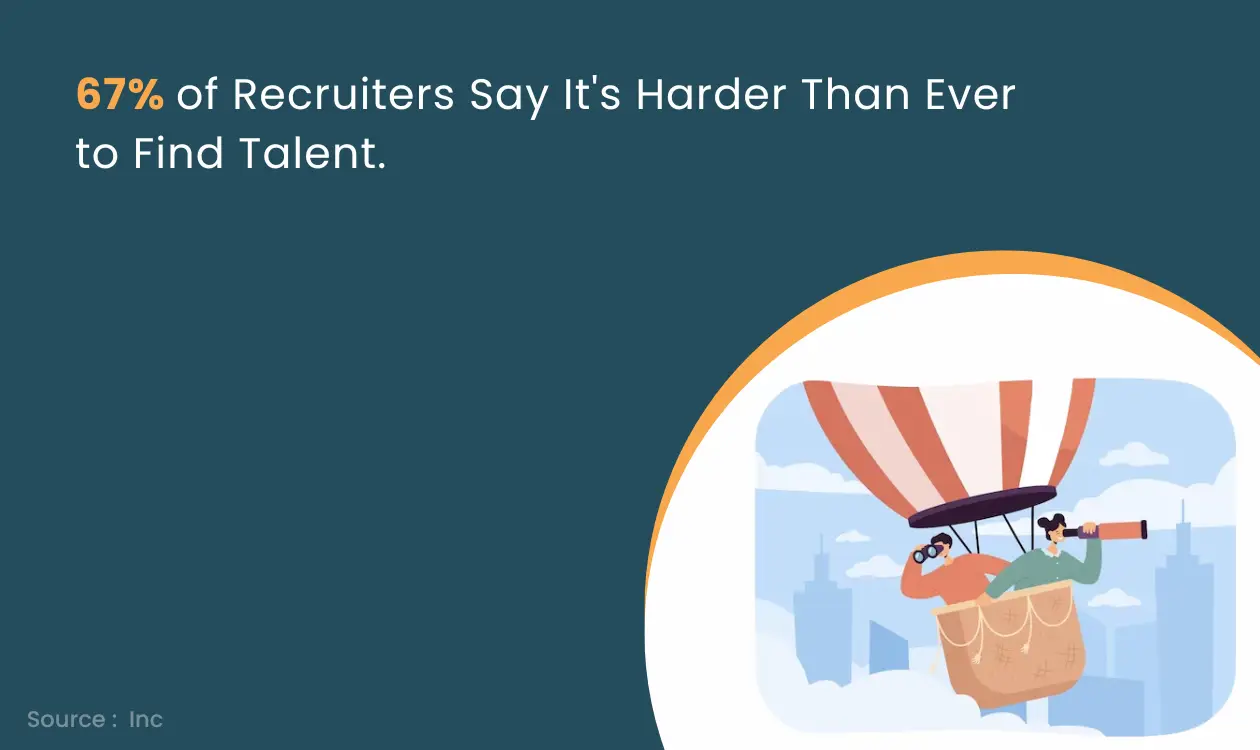
Even experienced recruitment teams find high-volume hiring a significant operational challenge. According to a survey by Inc., 67% of recruiters say it is harder than ever to find talent and mass hiring amplifies every difficulty that already exists in standard recruitment.
The following are the most common problems recruiters face in high-volume hiring.
-
Evaluating quality and quantity both at the same time.
-
When companies hire people in mass, Increasing the efficiency of high-volume can be a huge pain point for recruiters. It’s a time-consuming process, and it demands a lot of resources and team effort.
-
Cut-throat competition to hire the best people in the market.
-
Assess and decide which applicants are suitable for which role.
Full-proof Strategies for High-Volume Hiring in 2026
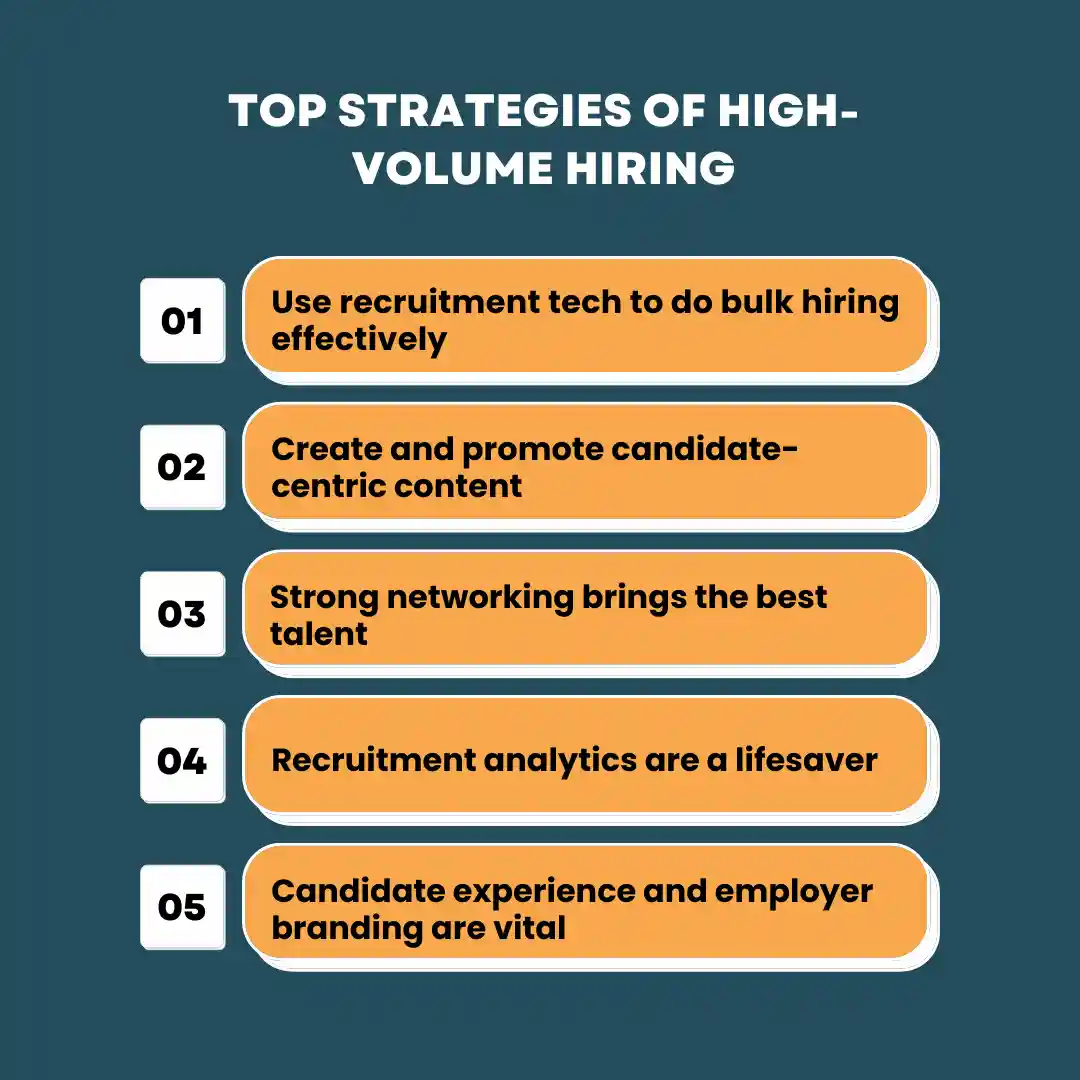
1. Use recruitment tech to do bulk hiring effectively
Mass talent acquisition is hectic and full of complex workflows. However, nowadays, plenty of online AI-based recruitment tools are available to make mass hiring easy and effective. These hiring software and systems are the biggest saviour for recruiters and HRs. Software like Applicant Tracking Software streamlines recruitment workflow via recruitment automation features.
Tools like resume parsers use keywords and Boolean strings to search through thousands of resumes and check for existing resumes to find relevant candidates.
Recruitment Chatbot eliminates the prescreening round by asking skill assessment questions and saves time for HRs and recruiters by scheduling interviews.
Using recruitment tech and tools will reduce the cost-to-hire and time-to-hire, helps to include candidates in the recruitment funnel and increase candidate engagement by sending an automated reply to the candidates.
Furthermore, the Programmatic Job Advertisement technique would be the best approach in high-volume hiring software. It means relying on recruitment tech (data, analytics, and AI) to automate and simplify the overall mass hiring process.
2. Create and promote candidate-centric content
Content has become a core component of effective high-volume hiring strategy not as a nice-to-have, but as a direct driver of application volume and candidate quality. Organisations that create compelling, candidate-focused content attract more relevant applicants, reduce application drop-off and build the kind of employer brand awareness that makes every future hiring campaign easier to execute.
Hence, the marketing team must closely work with the recruitment team and post content such as infographics with the help of engaging infographic templates that engages with the potential candidates. They must design candidate-centred content. As a result, it’ll be easy to attract more candidates to the recruitment pipeline. Also, recruiters and HRs must create catchy job Ads and clear job descriptions to allure a more diverse talent pool. Recruitment Marketing features are the best solution to promote content efficiently and find the right talent from diverse platforms.
3. Strong networking brings the best talent
Building a strong network is a long-term strategy to find and hire the best candidate possible. It offers benefits like faster hiring, quality candidates, and less turnover. Hence, employers need to build a powerful reputation, search for events and platforms to engage in increasing their network, and communicate often. It enables them to attract more candidates in the recruitment pipeline for open roles.
In addition, It’s true that skilled people know skilled people. Therefore, employers must leverage their employee’s network and former worker database to source suitable candidates for the open role. Employers and hiring managers need to create a fruitful employee referral program to get the referral of the perfect candidates. They must mention the perks, benefits, or bonus incentives employees will get.
Also, ATS provides features like an employee referral portal to manage employee referrals and streamline referral programmes. This way, the system will be more transparent.
Moreover, companies receive numerous applications during the hiring season. However, they may not hire every candidate. Thus, the company can save the essential data of every applicant in the talent database, which they can leverage for future hiring. It would be a good idea to review the candidate database to source suitable candidates.
4. Recruitment analytics are a lifesaver
At scale, you cannot improve what you do not measure and recruitment analytics are the tool that transforms high-volume hiring from a reactive scramble into a data-driven, continuously improving operation. They provide the feedback loop that allows hiring managers and employers to make evidence-based decisions about where to invest, what to stop doing and where the process is breaking down.

Recruitment KPIs to measure the success of high-volume hiring
-
Time to hire - allows measuring how effective the recruitment strategy is.
-
Source of hire - calculate advertising spend and provide an answer of which channel is more efficient, which channel is expensive and ineffective, and the most used and relevant channel where an employer must invest.
-
Offer acceptance rate - calculate the candidate drop-off rate, whether engagement is good or not.
-
Cost-per-hire - measures internal and external recruiting costs in high-volume hiring.
Together, these metrics create the analytical foundation that separates organisations optimising their high-volume hiring from those simply repeating the same approach regardless of results.
5. Candidate experience & employer branding are vital for high-volume recruiting
Consistent and effective interaction with candidates is the key factor for good employer branding, positive applicant experience, and a higher offer acceptance rate. A survey by CareerBuilder found that 22% of job seekers said that if they have a poor experience during the hiring process for a firm, they will tell other applicants not to apply to that company.
It may get tougher when recruiters have to communicate with many candidates. But tools like Recruitment Chatbot eliminate this human limitation by providing 24x7 support and answering the standard questions candidate ask. This constant candidate engagement eventually results in positive employer branding.
Also, in order to improve candidate experience in the mass recruiting process, recruiters and HRs must convey a positive work culture to the candidates.
The hiring team should also provide the mobile optimised application and easy-apply option because a survey by Indeed concluded that 42% of job seekers cite lengthy applications as the most frustrating part of the application experience, and 78% of job seekers would apply via mobile if it were more accessible.
Case Study of High-Volume Hiring
Let's explore a volume recruiting example of a U.S. Security Associate who uses AI recruitment technology and conducts efficient high-volume hiring.
U.S. Security Associate used tech solutions for high-volume recruiting
U.S. Security Associate (USA) hires 50,000 workers yearly at over 400 branches. However, they struggled with many challenges, such as attracting qualified candidates, filling positions faster, and higher hiring costs.
Rather than spending countless hours on the recruiting and assessment process, they chose to go forward with the technology-oriented approach to attract and hire quality candidates at the right scale and speed.
Afterwards, they got a better result in mass hiring via using online recruitment tools. They were able to see the benefits, such as increased candidate volume, selection rate, and offers. Also, the time-to-fill decreased.
Final Thought On Innovative High-Volume Hiring Strategies
High-volume hiring is not a challenge that technology solves once and then goes away. The talent market shifts, candidate expectations evolve, new regulations emerge, and the business needs that drive mass hiring campaigns change faster than most annual HR strategies can keep up with. The organisations that consistently win at high-volume hiring are those that treat it as a discipline continuously measuring outcomes, testing new approaches and updating their tools and processes as the market demands.
The five strategies covered in this guidetechnology adoption, candidate-centric content, network building, analytics and candidate experience are not independent tactics. They work best as a connected system: technology enables scale, content drives application volume, networks improve quality and speed, analytics identify what to improve, and candidate experience ties it all together into an employer brand that compounds over time.
For teams looking to scale these strategies across a growing or evolving hiring operation, the right staffing and recruitment software makes the difference between a system that holds up under pressure and one that breaks down exactly when you need it most. The best time to build that infrastructure is before the next high-volume hiring need arrives not after it does.
Happy High-volume Recruiting!!
Want to know how iSmartRecruit reduces your time-to-hire by half (50%) in High-volume hiring? Then, book a free demo and learn about the highly scalable ATS features that will enable you to hire top-notch talent faster in bulk hiring.

FAQs - Frequently Asked Questions
1. What is high-volume hiring and why is it important?
High-volume hiring means recruiting a large number of candidates quickly to fill many positions. It is vital for businesses experiencing rapid growth or seasonal demands, helping them stay competitive by quickly building effective teams.
2. How can technology improve high-volume hiring?
Technology like AI recruitment tools and applicant tracking systems simplify candidate screening and scheduling. iSmartRecruit offers efficient solutions that reduce time-to-hire and enhance candidate engagement during bulk recruitment.
3. What challenges do recruiters face in high-volume hiring?
Recruiters struggle with balancing quality and quantity, managing resources, and competition for top talent. Tools from iSmartRecruit can help overcome these obstacles by automating processes and iamproving recruitment efficiency.
4. How does employer branding impact high-volume recruitment?
A positive employer brand attracts more qualified candidates and improves offer acceptance rates. Consistent candidate engagement, supported by tools like Recruitment Chatbots from iSmartRecruit, boosts your company's reputation effectively.
About the Author