

TL;DR
- Employee referral programmes leverage trusted networks within a company to improve hiring quality and retention.
- Successful programmes require clear strategies, employee participation rules, effective communication, and progress tracking.
- Creative and meaningful rewards, from cash bonuses to emotional incentives and tech gadgets, motivate referrals.
- Top examples include PURE, Salesforce, Google, and Zappos, each with unique, engaging referral approaches.
- In 2026, dedicated referral software and AI-assisted matching are making programmes easier to run and track than ever.
If you're looking for someone to help you with a project, who do you trust? Some random person who walks up to you, or someone your best friend vouches for?
That's exactly what an employee referral programme is. It's about encouraging your team to find your next hire for you.
So what makes a referral programme truly effective, and why should you build one? Buckle up. You're about to learn about 13 of the best employee referral programme examples, so you can see which approach might work for your company.
Let's get started!
What is Employee Referral Programme?
Employee referral programmes are a form of recruitment hiring managers use to encourage their hires to recommend trusted candidates for an open vacancy. Hence, it's an internal hiring method with high odds of success because employees know best what their company needs and who would be a compatible match. It is also known as an internal referral programme.
Referral hires also tend to stick around longer. Research consistently shows referral candidates convert to hires at a notably higher rate than job board applicants, and most studies put one-year retention for referral hires somewhere around 40 to 46 percent, compared to roughly 33 percent for job board hires. The exact numbers vary by study, but the direction is consistent: people referred by someone who already understands the role and the culture tend to be a better, longer-lasting fit.
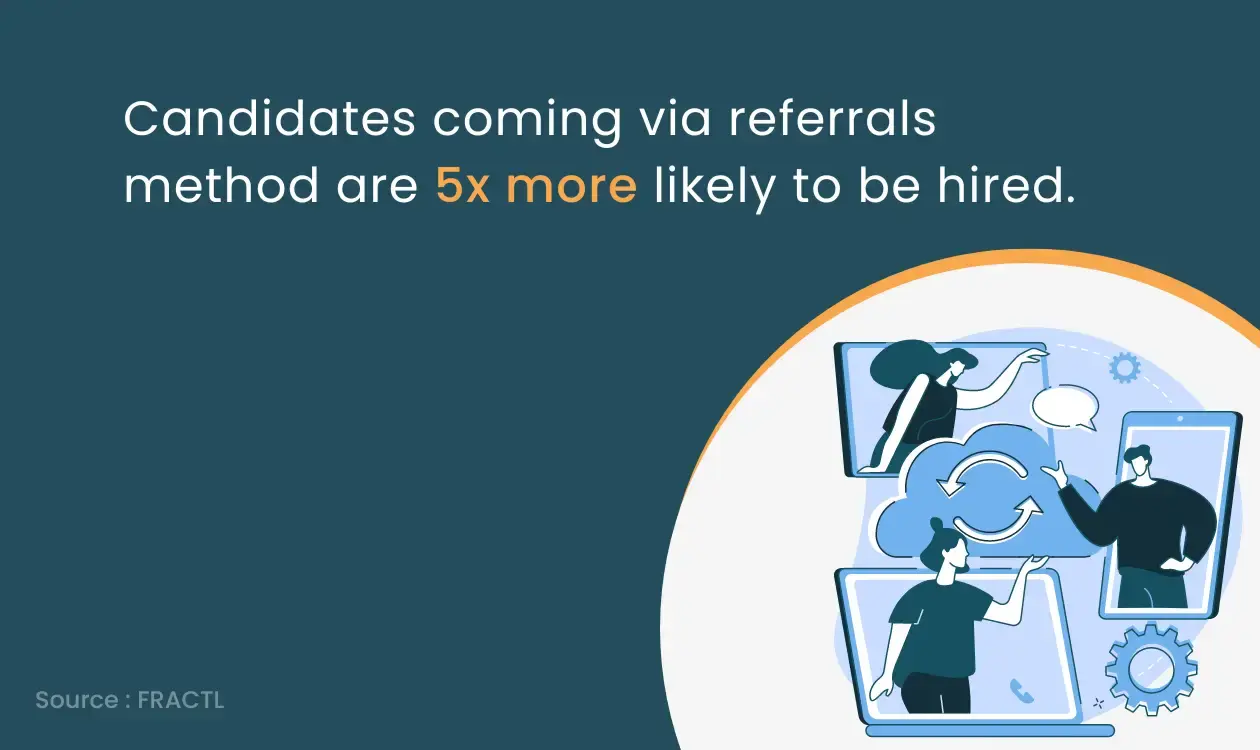
It is not surprising that referrals are at the top of the most time and cost-effective recruiting techniques, making the candidates coming via this method five times more likely to be hired. Thus, referral hiring increases employee retention because your team members know the candidate profile that fits organisational values, goals, and brand.
But what it takes to develop a quality employee referral programme that will bring the best results to your hiring process? Recruiters seek various ways, methods, and techniques to improve the recruiting process and find the best talents.
Employee referral programmes often emerge among the most efficient tools for attracting high-quality talents that stay in a company for a long time.
How to Setup Best Employee Referral Programmes?
First of all, it's the HR departments that have the responsibility for outlining a well-performing company referral programme. Still, development starts with ensuring buy-in from the executives and leaders. Hence, HR professionals must analyse the hiring needs and provide benefits of referrals before presenting their plans. Let's understand the strategy to create effective employee referral programmes.
1. Outline Your Strategy
Once HR experts get the green light, it's time to move on to the final design and strategy of a future employee referral programme. It is recommendable to think through every detail and process and leave no place for ambiguity, mistakes, or failure.
That also means evaluating why you need a company referral programme and whether it is best for your company to source candidates. What needs and long-term goals will you meet by introducing this recruitment form? What will be the ideal outcomes?
Some goals recruiters could achieve by choosing this method are improving the quality of hire and boosting employee retention and morale.
Thus, referral programmes' positive outcomes are lower recruiting costs, eliminating time-consuming hiring methods, and enhancing the talent pipeline.
Another crucial element of the employee referral programme is to consider what is the best way to maximise the number of internal referrals. There are many valuable tips on enhancing your referral efforts; accepting them even when there is no open position and fostering a transparent process are among the most efficient ways.
2. Set Clear Participation Rules
Besides identifying the most efficient communication channels, good recruiters should also consider what's in it for the employees providing them with quality referrals. Although one could recommend an acquaintance who is the perfect match simply because they love their workplace, think about rewarding the hires.
Also, consider whether there will be restrictions on who can participate in the programme and the conditions. You could discourage employee participation if too many limits or paperwork are in place.
3. Communication with the Employees
Working on continuous and effective communication with employees and customers is essential. That means recruiters must think of channels they will use to communicate with the hires and perform the process.
Ensure your employees know that your company has a referral programme, and be ready to provide them with additional information and answer their questions. Thus, let your new hires know you offer this opportunity during the onboarding process.
The goal is to provide employees with a smooth, quick, and easy programme. Consider how the hires will submit their referrals and create a form they will use when sending the files. You can choose various options, depending on what you perceive as the most efficient channel. However, you could opt for the company's intranet, email, Excel spreadsheets, or paper.
Some companies use HR technology and tracking systems to collect referrals, while others also use LinkedIn.
4. Track Progress and Keep Improving
The recruiter must implement progress tracking to ensure that the process seamlessly flows and foresee any necessary tweaks. Those data and insights can improve the referral programme and get the best process outcome.
As you measure the programme's success, consider the other metrics and how many employees you plan to hire using referrals. Consider whether you will use other recruitment methods and the number of expected hires resulting from that technique.
It is recommendable to continue tracking even after you have reached your referral hiring quota and to shift your attention to the retention levels of referral hires. Compare it to the rates of those hires sourced using external methods and analyse which brings better results to the organisation.
13 Best Employee Referral Programme Examples
These are some of the best employee referral programme examples for those considering this hiring approach.
1. PURE - Fast and Efficient
The American group of insurance companies has an astonishing success with its employee referral programme: PURE sources 40 and 60 per cent of employees using this method. If you are wondering what's their secret ingredient, it's efficiency.
As soon as they welcome new hires, recruiters ask if they know someone whose skills and experience would be a good fit for the company. With their straightforward and in-res strategy, they generate many referrals in a short time while also emphasising the programme.
2. Salesforce - Happy Hours
The cloud-based software company is another American business with a highly well-performing referral programme. They achieve success by providing employees with generous rewards, which are not always financial.
The company is known for creative ways of doing things, and their hires have access to a mindfulness room and support when they don't receive a promotion for over 18 months and are paid to volunteer to help the community.
Their creativity expands to how they collect referrals, and their method is to organise Happy Recruitment Hours, allowing team members to invite friends who could be a good fit. Hence, they also have a fast process that's also fun and engaging.
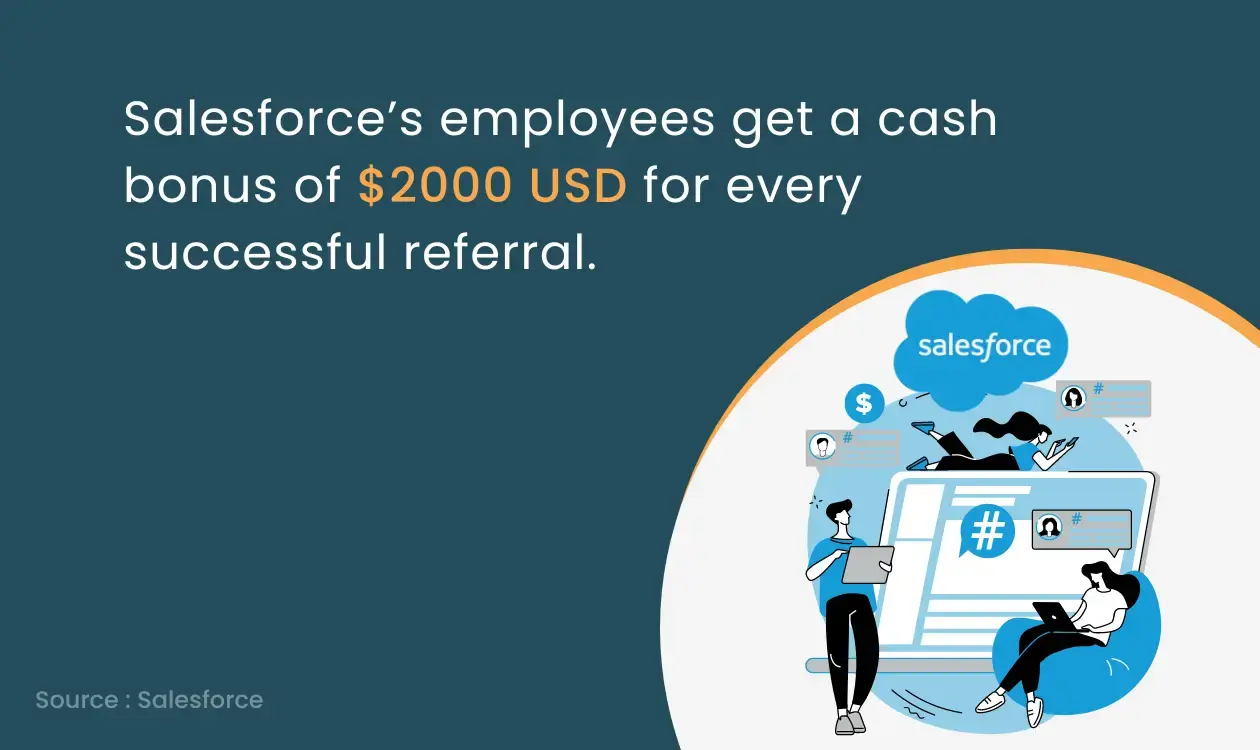
Another fun fact is that Salesforce's employees get a cash bonus of 2.000 USD for every successful referral.
3. Inmobi - Extraordinary Strategy
Mobile advertising enterprise - Inmobi transformed its employee referral programme out of necessity back in 2015. In the beginning, they had only six recruiters to manage 900 people. It was logical that they couldn't keep up with the hiring demand, so they created a great strategy.
After every successful referral for the engineering manager, the referee got a Royal Enfield bike in India (the equivalent of Harley Davidson in India), and the US office employees got a Vespa. Thus, the referrers could choose between a bike and a trip to Bali. The vehicles were parked in front of the company to increase employee motivation.
4. Google - Ask Bettter Questions
A giant that doesn't need an introduction. Google is another company that likes a quick and straightforward approach. Instead of investing in a comprehensive and demanding programme, Google's recruiters ask their new employees simple questions, such as "Who's the best software developer you know in California?"
That kind of incitement makes people think a bit harder about whom they will refer to, which is known as aided recall. Well, it works for Google!
5. Accenture - Emotional Reward
Dutch consulting and IT enterprise Accenture is thoughtful, innovative, and creative. Their employee referral programme works on an intrinsic emotional reward principle: they let their employees donate a part of their referral bonus. Thus, hires get to choose the charity or community.
6. Fiverr - Gamification
When the global freelance platform needed more freelancers, they upgraded their game and started using Zao, a company that offered an employee referral programme. Hence, whenever a freelancer shares their job ad on social media, they would get points. Thus, Fiverr used a leaderboard to incite competition and keep everything transparent.
7. Intel - A Diversity-Focused Approach
The American tech enterprise doesn't only care about the successful company referral programme but also about diversity and inclusion efforts. Hence, the referral bonus doubles when hires successfully refer people from underrepresented groups.
8. Godaddy - Codes and Puzzles
The American dedicated WordPress hosting makes its best employee referral programme loyal to the niche by putting a poster with code employees have to decode. The coded message says, "If you know of a coder in your network who kicks ass, refer to GoDaddy Recruiting."
9. Booking.com - Solving a Specific Gap
When the Booking.com team of hiring managers had difficulty finding someone who speaks Portuguese and English to fill their customer support vacancy in Brazil, they brought Portuguese food to the office. That way, they reminded the employees that they needed Portuguese-speaking customer service representatives, filling the position in no time.
10. Zappos - Culture-First Referrals
Zappos, an online shoe store, recently updated its employee referral program. In which they are heavily focused on cultural fit rather than just skills and experience. So, they're not just looking for people who are good at their jobs but also people who fit in with their company culture. When an employee refers a candidate, they are asked to explain why they believe the candidate would be a good cultural fit for Zappos. If the referred candidate is hired, the referring employee receives a bonus that includes a combination of cash and exclusive experiences, like a lunch with the CEO or participation in a Zappos culture event. This approach not only strengthens the company culture but also encourages employees to think more deeply about the kind of people they bring into the company.
11. Enterprise Rent-A-Car: Friendly Competition
The American car rental company loves competition, and its employee referral programme indicates passion. They source one-third of all its employees through internal referrals by creating a contest between the regions where they can refer more people.
12. Distillery - Tech Rewards
The American software development company used what their employees love the most to create a successful programme: they reward their employees with new tech gadgets for every referral.
13. Referral Factory: Simple, Smart, and Automated
Referral Factory stands out for its easy-to-use and highly customizable approach to employee referrals. The platform allows companies to design and launch branded referral programs in minutes, without needing technical expertise. Employees can effortlessly share job openings with their networks through personalized referral links, making the process smooth and engaging for everyone involved.
What sets Referral Factory apart is its automation. Recruiters can track referrals, send updates, and manage rewards seamlessly from one dashboard. This efficiency encourages more participation and ensures that no potential candidate slips through the cracks.
Referral Factory’s success lies in its simplicity and employee-friendly design. By making referrals interactive and rewarding, it motivates teams to become proactive talent scouts. The result? Faster hiring, lower costs, and stronger cultural alignment-all powered by your own people.
Key Takeaway
Across all of these examples, two things stand out. First, creativity and a reward that actually feels meaningful matter more than the size of the bonus. Second, ease of participation is non-negotiable. The simpler it is for an employee to refer someone, the more referrals you'll get.
A few practical ideas worth borrowing: lean into emotional incentives alongside financial ones, consider gamifying the programme to add friendly competition, and make a point of publicly recognising your top referrers. Recognition costs nothing and tends to outperform expectations.
If you don't already have an employee referral programme, this is a good time to start one.
So what are you waiting for? Start implementing an employee referral program today and see the benefits for yourself!

FAQs - Frequently Asked Questions
1. What is an employee referral programme?
An employee referral programme encourages current employees to recommend candidates for open roles. It leverages trusted internal networks to surface quality hires faster and often leads to better long-term retention.
2. How can I create an effective referral programme?
Start with leadership buy-in, set clear goals, and communicate the programme well to employees from day one, including during onboarding. Keep submission simple and reward participation. Recruitment software can help streamline tracking and follow-up.
3. What types of rewards motivate employees to make referrals?
Financial bonuses work, but emotional incentives, charity donations, unique experiences, and tech gadgets often perform just as well or better. Publicly recognising top referrers also meaningfully boosts participation.
4. How does employee referral improve hiring quality?
Employees understand company culture and role requirements firsthand, so they tend to recommend candidates who genuinely fit. Referral hires often stay longer and perform well, which reduces turnover and strengthens team cohesion over time.
5. Do bigger cash bonuses lead to more or better referrals?
Not reliably. Research consistently shows that bonus size has less impact than expected. What actually drives participation is how easy the process is and whether employees feel genuinely recognised for contributing.
6. What software can help manage an employee referral programme?
Dedicated referral platforms (such as ERIN, Drafted, or Referral Factory) and most modern ATS tools can automate tracking, reminders, and reward management, which removes much of the manual follow-up that causes informal programmes to stall.
About the Author