

Three terms. Three distinct functions. And yet, talent acquisition, talent management, and human resources are routinely used interchangeably in ways that create confusion, misaligned expectations, and poorly structured hiring teams.
Understanding the difference is not just a matter of terminology. It determines how an organisation structures its people function, which tools and technologies each team needs, and how these three functions work together to drive business performance.
This guide breaks down what each function does, why it matters, and how talent acquisition, talent management, and HR relate to and support each other.
TL;DR
- Talent acquisition, talent management, and HR are distinct but interrelated functions within organisations.
- Talent acquisition focuses on sourcing and hiring the right talent using specialised software and processes.
- Talent management develops and retains employees through mentoring, training, and succession planning.
- HR oversees the overall employee lifecycle, including onboarding, compliance, culture, and conflict resolution.
- Effective collaboration between these functions leads to improved business performance and stronger company culture.
Do you know the difference between talent acquisition, talent management, and HR? These three hr terms are distinct, that are used individually. Read this article to know more about these terms.
Understanding the Three Functions
Before comparing them, it helps to understand what each function is actually responsible for.
| Talent Acquisition | Talent Management | Human Resources | |
| Primary focus | Finding and hiring talent | Developing and retaining talent | Managing the full employee lifecycle |
| Time horizon | Short to medium term | Medium to long term | Ongoing |
| Key activities | Sourcing, screening, interviewing, hiring | Training, mentoring, succession planning | Compliance, policies, culture, conflict resolution |
| Success metric | Quality of hire, time-to-fill | Retention rate, employee performance | Employee satisfaction, legal compliance |
| Tools used | ATS, sourcing platforms, job boards | LMS, performance management software | HRIS, payroll, compliance tools |
These functions overlap and inform each other, but each has a distinct mandate. Treating them as interchangeable leads to gaps in coverage, unclear ownership, and weaker outcomes across all three.
What Is Talent Management?
Talent management is the approach where the strategy has been formed to attract the right and top talent, and onboard them. Help them to grow their skills by keeping the objective of the company in the mind.
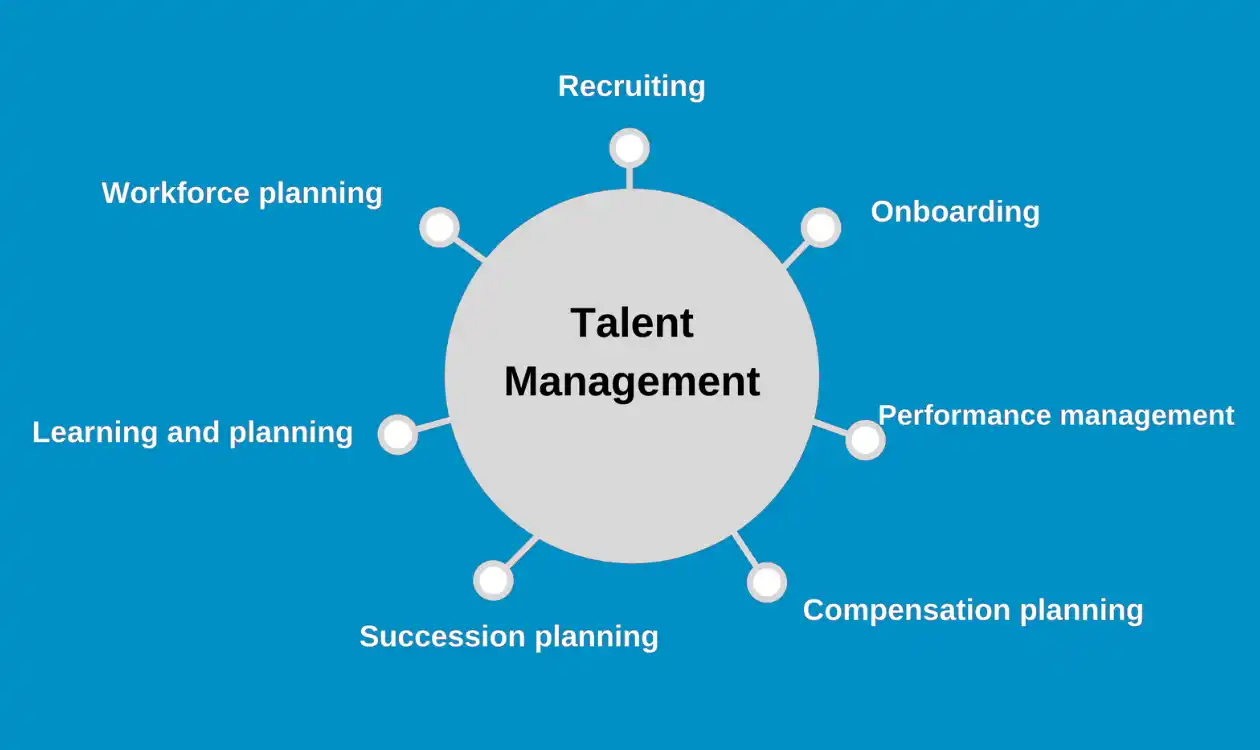
In short, the talent management process comes into the frame in order to develop and retain the workforce of the top talents and accomplish the organization's goals. The talent management process includes the seven most critical facets, that are given below:
-
Recruiting
-
Performance management
-
Compensation planning
-
Succession planning
-
Learning and planning
-
Workforce planning
Roles and functions of the talent management team
Talent Management is the continuous process of creating and maintaining employees all throughout an organization. The work of a Talent Management expert includes:
-
Mentor high-potential employees
-
Convey employee training programs
-
Reward and mentor employees and promote them
Why Talent Management Matters
1. Help business to performance
Talent management reaches the company to the most deserving talents. Talent management becomes more effective when these three components come together: Talent allocation, positive candidate experience, and HR team strategies. This helps businesses to achieve their goals by improving their performance.
2. Help the business to stay in the competition
Hiring the top and qualified talent through talent management and developing relationships with employees, help businesses to become ready for any challenge. A strong team of employees makes the competition tougher.
3. Help to form a productive team
An effective talent management strategy helps companies to form a productive team by hiring qualified candidates. Consequently, this productive team will bring more creativity to the team.
4. Decrease the turnover rate
When employees feel safe and valued in the company, they will stay with the company for a long time. Every employee wants to grow and needs an opportunity to improve their skills. So, if these things are grabbed by the employees they will never leave the organization.
What Is Talent Acquisition?
Talent acquisition is the process that takes place by employers or recruiters who track the top talents and recruit and onboard them in order to meet the organization's needs.
It is the same as the function of the human department. The talent acquisition team identifies, acquires, assesses, and hires the candidates to fill the open position in the company.
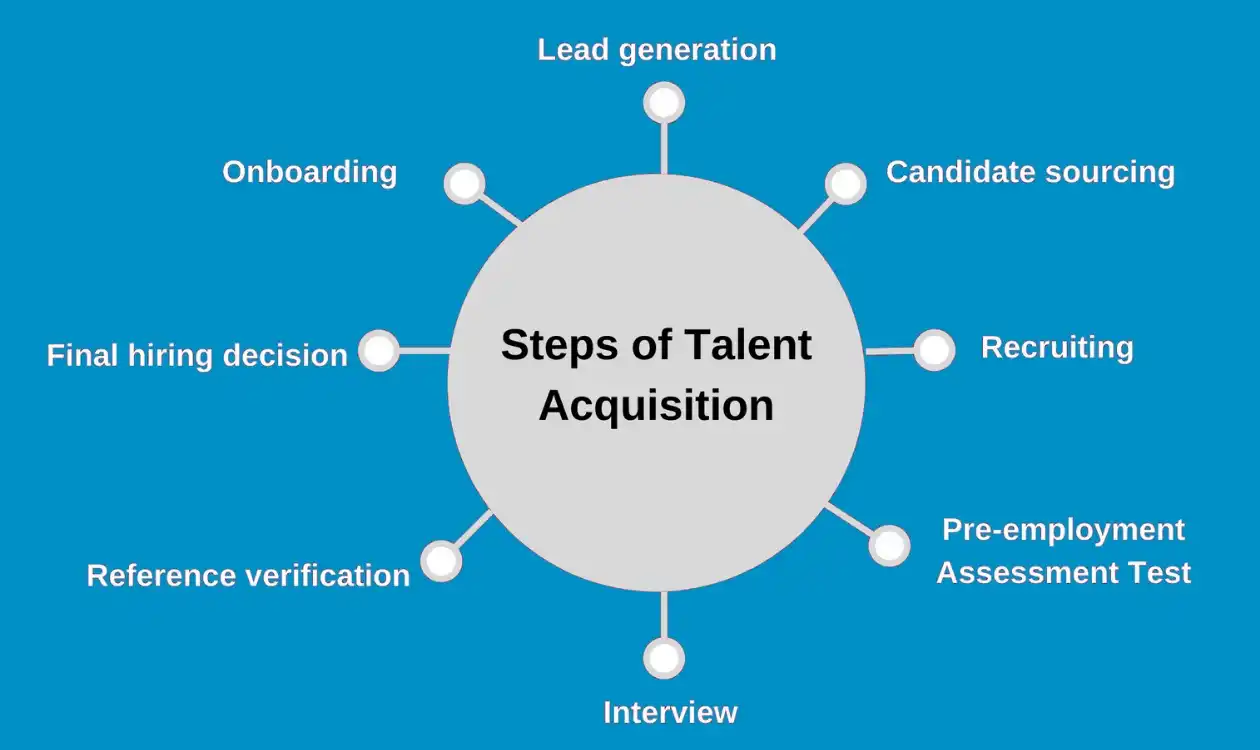
And for this whole process, the talent acquisition department usually adopts standalone Talent Acquisition software. This software automates the hiring process. The following steps include in talent acquisition:
-
Candidate sourcing
-
Recruiting
-
Interview
-
Reference verification
-
Final hiring decision
-
Onboarding
Roles and functions of the talent acquisition team
Talent Acquisition is a way to pull in and hire gifted employees to satisfy an organization's business needs. The work of a Talent Acquisition expert includes:
-
Building a solid brand to attract the best candidates
-
Creating candidate pipelines to meet present and future business needs
-
Keep up associations with past candidates for future chances
-
Deliberately source potential candidates from different backgrounds
Why Talent Acquisition Matters
1. Create a strong employer brand
Company website, culture, and social media presence attract top both customers and potential candidates. In order to attract the top talents, the talent acquisition team is forced to enhance the employer's brand.
2. Make the job description with the detailed information
Every candidate tries to match themselves by reviewing the job description. More informatic job descriptions help candidates to relate to open positions. Also, make the decision to apply or not easier. The Talent acquisition team tries to create the context of the job description with whole information.
3. Utilize the analytics to improve acquisition
The talent acquisition team acts as a marketing campaign. Thus, for them, convincing the candidates to join the company is the same as encouraging the customers to buy the product. Data analytics helps the team to know where the top talents are belonging, which certain questions discourage the candidate to continue the pre-employment process, the visual form of company culture increases the traffic of the candidates, and so on.
What Is Human Resources?
Human Resources or the HR team is responsible for hiring new employees and walking them through the pre and post-onboarding process. Hence, this team is responsible for candidate acquisition and management. They look after the hiring team, and the training and also, manage the applications for the job position.
Once a candidate is hired, HR is responsible for the workplace policies, reward system, and all other employee engagement programs. They are also responsible for letting go of the employees.
Roles and functions of human resource
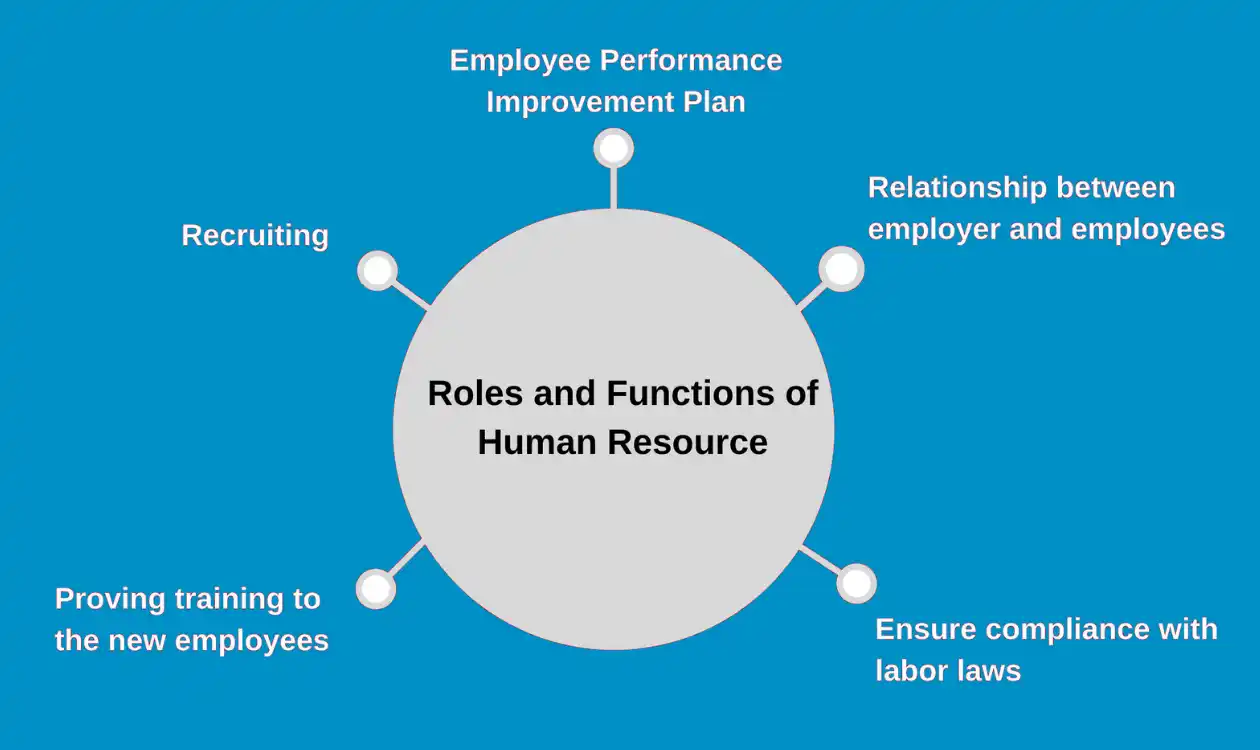
The human resource department plays a key role in every organization. Let’s see what are the key roles and functions of human resources.
-
Employee performance improvement plan
-
Responsible for forming a relationship between employer and employees
-
Ensure compliance with labor laws
-
Proving training to the new employees
-
Recruiting
Why HR Matters
1. Build and maintain the company culture
Positive company culture is the root of many crucial things like deriving employee engagement, job satisfaction, staff retention, and turnover, which also define the success of the business. Hence, the human resource department plays a pivotal role in developing, reinforcing, and transforming company culture.
2. Business communication
To become productive and to derive the business well, effective communication amongst the team is required. Often, the way of communication that should be adopted, is defined by the HR team. Effective communication reduces misunderstanding and increases employee engagement. Moreover, good communication way helps to form a strong relationship between the team members.
3. Conflict resolution
Disagreements between employees, or between employees and management, are inevitable in any organisation. HR is responsible for mediating these situations fairly, rebuilding relationships, and preventing isolated conflicts from becoming systemic cultural issues.
How Talent Acquisition, Talent Management, and HR Work Together
These three functions are most effective when they operate in close coordination rather than as independent silos.
Talent acquisition identifies and hires the right people. Talent management develops and retains them. HR ensures the environment and infrastructure that allows both to function effectively. When all three are aligned:
- Workforce plans translate directly into targeted sourcing strategies
- New hire onboarding is seamless, because HR and talent management are both involved from day one
- Development programs are built around the competencies that talent acquisition has identified as most critical to business performance
- Retention data from talent management informs future hiring criteria and candidate profile design
Organisations that invest in the coordination of these three functions consistently outperform those that treat them as separate departments with separate agendas.
Conclusion
Talent acquisition, talent management, and human resources each serve a distinct and essential role in building and sustaining a high-performing organisation. They are not competing functions or alternative names for the same thing. They are complementary disciplines that, when structured and coordinated effectively, create a people function that attracts, develops, and retains the talent an organisation needs to grow.
Understanding the boundaries and interactions between these three functions is the starting point for building a people strategy that actually delivers results.
Frequently Asked Questions (FAQs)
1. What is the main difference between talent acquisition and talent management?
Talent acquisition focuses on finding and hiring the right candidates to fill open roles. Talent management focuses on developing and retaining those employees once they are inside the organisation. Both are essential components of an effective overall people strategy.
2. How does HR relate to talent acquisition and talent management?
HR oversees the full employee lifecycle, including hiring, compliance, training, and workplace culture. Talent acquisition and talent management are specialised functions that operate within or alongside HR, each focused on a specific phase of the employee journey.
3. Why is technology important in talent acquisition?
Talent acquisition software and ATS platforms automate repetitive tasks, centralise candidate data, and improve communication across the hiring process. This saves time, reduces errors, and allows recruiters to focus on higher-value work like relationship-building and candidate evaluation.
4. Can a smaller company operate without separate teams for each function?
Yes. Smaller organisations often combine these responsibilities under a single HR function. As the business scales, separating talent acquisition and talent management into dedicated roles typically improves focus, specialisation, and outcomes across all three areas.
5. How does talent management reduce employee turnover?
By providing structured development opportunities, clear career pathways, meaningful recognition, and consistent mentoring, talent management directly addresses the most common reasons employees leave. Employees who see a future within the organisation are significantly more likely to stay.
About the Author