


Recruitment in 2026 is faster, more competitive, and more demanding than ever. Agencies can no longer depend on spreadsheets, scattered emails, and manual follow-ups to manage candidates and clients. Even a small delay can lead to a lost candidate, a missed placement, or a dissatisfied client.
TL;DR
- Staffing agency software is essential in 2026 for automating recruitment processes and enhancing efficiency.
- Manual recruitment methods lead to lost candidates, slower hiring, recruiter burnout, and revenue leakage.
- Top software solutions vary by agency size and needs, from iSmartRecruit’s all-round features to HireEZ’s AI-powered automation.
- Choosing the right software depends on agency type, budget, scalability, and user adoption.
Recruitment has never been more competitive than it is in 2026. The job market is moving quickly, talent expectations are higher, and agencies that continue to rely on outdated, manual processes risk falling behind. Traditional recruitment methods - endless spreadsheets, phone calls, and email chains - simply do not scale in a world where clients expect fast placements and candidates expect seamless experiences.
Enter staffing agency software. No longer a "nice-to-have," it has become an essential tool for agencies of all sizes. From streamlining applicant tracking to managing client relationships and automating admin-heavy tasks, the right system allows recruiters to focus on what really matters: building relationships and making successful placements.
In this guide, we will explore the best staffing agency software tools in 2026, but we will go beyond features. We will look at the real costs of not adopting software, what recruiters truly care about, mistakes to avoid, and how agencies are scaling using these platforms. Whether you are a startup agency or an established enterprise, this blog will help you choose the right platform for growth.
What Is Staffing Agency Software and Why Do You Need It?
Staffing agency software is a specialised type of recruitment technology built to automate and optimise the staffing process from end to end. At its core, it combines applicant tracking systems (ATS), Recruitment CRM, and AI-driven tools to make recruitment faster, smarter, and more efficient.
Recruitment is a multi-layered process involving job requisitions, sourcing, resume screening, interviews, compliance, onboarding, and client relationship management. Manually juggling these steps not only slows agencies down but also increases the risk of human error. That’s where staffing agency software comes in. It centralises operations in one platform, making it easier for recruiters to collaborate, track progress, and deliver consistent results.
The need for staffing agency software has grown out of the increasing complexity of hiring. Candidates expect seamless digital experiences, clients demand quick turnarounds, and recruiters must manage ever-growing data. Without the right technology, agencies struggle to keep up. But with staffing agency software, agencies gain automation for repetitive tasks, AI-powered candidate matching, integrated communication, compliance tracking, and real-time analytics that reveal exactly where improvements can be made.
For staffing firms, this isn’t just about convenience. It’s about survival. A recruiter armed with robust software can place candidates faster, nurture client relationships, and make data-backed decisions that drive growth. In short, staffing agency software isn’t optional anymore-it’s essential.
The Real Cost of Running a Staffing Agency Without Software
Many agencies underestimate the price of sticking with manual or outdated recruitment systems. On the surface, spreadsheets and email folders may feel "free," but in reality, they cost agencies far more in lost opportunities and wasted time.
Lost candidates and missed placements: Without a central system, strong candidates slip through the cracks. CVs get buried in inboxes, and recruiters lose hours searching for a profile they know exists somewhere. Every lost candidate is a missed placement and lost fee income.
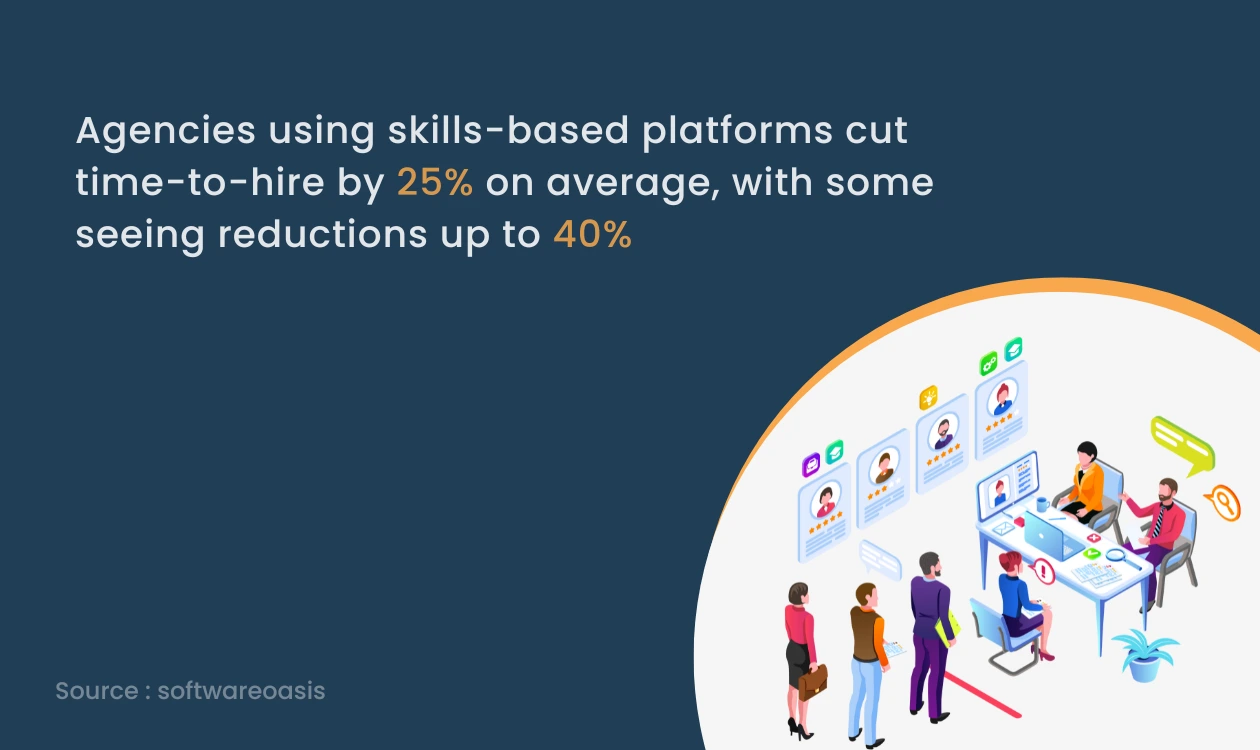
Slower hiring cycles: Clients expect speed. Without automation for job postings, resume parsing, or interview scheduling, the hiring process drags on, frustrating both clients and candidates. Clients expect speed. Without automation for job postings, resume parsing, or interview scheduling, the hiring process drags on. In fact, according to the Burning Glass Institute, agencies using skills-based platforms reduced time-to-hire by an average of 25%, with some reporting up to 40% reductions
Recruiter burnout: Admin-heavy recruitment drains productivity. Recruiters spend more time updating spreadsheets than speaking to candidates, leading to disengagement and high turnover within your team.
Revenue Leakage: Time is money in recruitment. The longer it takes to fill a role, the more potential income is lost. Agencies that implement effective staffing agency software often report cutting placement times by 30-40%.
Put simply, the cost of not adopting staffing software tends to exceed the cost of the software itself.
What Recruiters Really Want from Staffing Agency Software
While features are important, recruiters ultimately care about how the software improves their day-to-day work. Recruiters want tools that save time by automating repetitive tasks such as screening resumes, scheduling interviews, and following up with candidates.
Effective staffing agency software also enhances client communication. A centralised CRM ensures consistent updates, manages expectations, and strengthens relationships. User-friendliness is crucial; tools with a steep learning curve can frustrate recruiters and reduce adoption.
Additionally, software that reduces administrative burdens - from document management to compliance tracking and invoicing - significantly impacts productivity and job satisfaction.
In short, the best staffing agency software empowers recruiters to focus on high-value tasks, drives faster placements, and ultimately improves client satisfaction.
The 7 Best Staffing Agency Software Tools in 2026
There is no "one-size-fits-all" tool. The best choice depends on your agency's size, focus, and budget. Below, we explore seven leading platforms, each with unique strengths.
1. iSmartRecruit - Best All-Round Solution for Staffing Agencies
Overview: iSmartRecruit is an advanced yet user-friendly AI powered recruitment software built specifically for staffing agencies. It combines ATS and CRM functionality with automation tools that reduce recruiter workload and improve candidate and client experiences.
Standout Feature: AI-driven resume parsing, multilingual support, and a highly customisable recruitment workflow make iSmartRecruit a flexible choice for agencies of all sizes.
Pricing: Mid-range, with tailored pricing based on the number of recruiters and features selected.
Best For: Agencies looking for an all-in-one staffing solution that balances affordability, scalability, and advanced features.
2. Bullhorn - Best for End-to-End Recruiting
Overview: Bullhorn is one of the most trusted names in staffing software worldwide. It provides an end-to-end solution covering applicant tracking, CRM, onboarding, reporting, and even invoicing, making it a powerhouse for recruitment firms.
Standout Feature: Seamless integration of ATS + CRM, ensuring recruiters manage candidate pipelines and client relationships from a single platform.
Pricing: Custom pricing (typically mid-to-high range depending on agency size).
Best For: Mid-to-large staffing agencies seeking a proven, scalable, all-in-one system.
3. Recruit CRM - Best for Small Agencies
Overview: Recruit CRM is designed with small agencies and startups in mind. Its intuitive drag-and-drop pipelines and Chrome extension make sourcing and managing candidates simple, without needing a steep learning curve.
Standout Feature: LinkedIn sourcing extension that allows recruiters to capture and track candidate details instantly.
Pricing: Starting at around £50 per user/month.
Best For: Small and fast-growing agencies seeking affordability and simplicity.
4. HireEZ - Best for AI-Powered Automation
Overview: HireEZ (formerly Hiretual) is leading the way in AI-driven recruiting. It helps agencies find hidden talent across 45+ platforms and automates candidate engagement, saving recruiters hours of sourcing time.
Standout Feature: AI-powered sourcing and engagement campaigns that personalise outreach at scale.
Pricing: Premium, enterprise-level pricing.
Best For: Agencies looking to leverage AI for advanced sourcing and automation.
5. Avionte - Best for Large Enterprises
Overview: Avionte offers a comprehensive staffing platform for large, high-volume recruitment agencies. It covers ATS, CRM, payroll, back-office functions, and compliance, making it suitable for enterprise-level complexity.
Standout Feature: Strong payroll and compliance integrations, particularly valuable for firms handling large contractor workforces.
Pricing: Enterprise-level custom pricing.
Best For: Large staffing firms and multinational recruiters.
6. TempWorks - Best for Temporary Staffing Firms
Overview: TempWorks is purpose-built for temporary and contract staffing agencies. With workforce scheduling, timesheet tracking, and invoicing features, it handles the complexities of shift-based and hourly recruitment.
Standout Feature: Powerful scheduling tools that allow real-time updates for contractors and clients.
Pricing: Custom tiered pricing depending on agency scale.
Best For: Temp agencies, gig staffing firms, and seasonal workforce recruiters.
7. JobAdder - Best Cloud-Based Platform
Overview: JobAdder is a modern, cloud-native ATS and CRM with a sleek interface and strong integration ecosystem. Its mobile-first approach ensures recruiters can manage pipelines and communication from anywhere.
Standout Feature: Over 50 integrations with job boards, HRIS, and communication tools.
Pricing: Around £50–70 per user/month.
Best For: Agencies that value mobility, flexibility, and a secure cloud-based solution.
8. Manatal - Best Budget-Friendly AI Recruitment Software
Overview: Manatal is a cloud-based AI recruitment software platform designed for recruitment agencies, headhunters, and HR teams. It combines applicant tracking, recruitment CRM, candidate enrichment, AI recommendations, and pipeline management in a simple interface.
Standout Feature: Affordable AI-assisted candidate matching and profile enrichment, making it useful for smaller agencies that want automation without enterprise-level pricing.
Pricing: Starting from $15/user/month for its Professional plan.
Best For: Small agencies, boutique recruiters, and budget-conscious teams looking for affordable AI recruitment software.
9. Zoho Recruit - Best for Agencies
Overview: Zoho Recruit is a cloud-based recruitment platform for staffing agencies and HR teams. It includes ATS functionality, candidate management, client portals, job posting, automation, and integrations with other Zoho products.
Standout Feature: Strong value for agencies already using Zoho apps, with ATS, CRM-style recruitment workflows, automation, and agency-focused features in one platform. Zoho describes Recruit as a cloud-based hiring platform for HR teams and recruitment agencies.
Pricing: Custom tiered pricing depending on agency scale.
Best for: Small to mid-sized agencies that want affordable staffing agency software connected to the wider Zoho business ecosystem.
10. Vincere - Best for Recruitment Agencies
Overview: Vincere, now part of Access Group, is a recruitment agency software built around CRM, ATS, business development, compliance, pay and bill, marketing, and AI-powered recruitment workflows.
Standout Feature: A recruitment-agency-focused platform that connects front-office recruitment activity with back-office operations, business development, automation, and pay-and-bill workflows.
Pricing: Starting from £69/user/month, with AI add-ons available from £25/agency/month.
Best for: Recruitment and staffing agencies that need a scalable CRM, ATS, automation, compliance, and pay-and-bill solution.
Quick Comparison:
| Tool | Best For | Standout Feature | Starting Price (approx.) |
|---|---|---|---|
| iSmartRecruit | All-round staffing agency use | ATS, CRM, AI matching, automation, multilingual workflows | Mid-range, tiered |
| Bullhorn | End-to-end recruiting | Mature ATS, CRM, automation, onboarding, reporting | From $99/user/month, custom quote |
| Recruit CRM | Small agencies | Simple CRM, drag-and-drop pipelines, LinkedIn sourcing extension | From $85/user/month |
| HireEZ | AI-powered sourcing | AI sourcing, outbound engagement, automated outreach | From $169 to $250/seat/month |
| Avionté | Large enterprises | Payroll, compliance, and back-office staffing operations | Custom enterprise pricing |
| TempWorks | Temporary staffing | Scheduling, timesheets, payroll support, invoicing | Tiered, custom |
| JobAdder | Cloud-based mobility | Mobile access, job board distribution, cloud ATS/CRM | Est. $100 to $200/user/month |
| Manatal | Budget-friendly AI recruitment | AI candidate matching, enrichment, cloud ATS/CRM | From $15/user/month |
| Zoho Recruit | Zoho ecosystem users | ATS, automation, client portals, Zoho integrations | Tiered pricing |
| Vincere | Recruitment agencies needing CRM, ATS, and pay & bill | CRM, ATS, compliance, automation, pay-and-bill workflows | From £69/user/month |
Which Staffing Agency Software Fits Your Agency Type?
Choosing the right fit depends on your agency's size, focus, and workflow. Startups generally benefit from solutions that are quick to implement, affordable, and require minimal training, with intuitive dashboards and basic candidate tracking enough to get a small team moving.
Mid-sized agencies, on the other hand, prioritise scalability, automation, and analytics. They manage multiple clients and larger candidate pools, so software that integrates seamlessly with job boards, CRMs, and communication tools is vital.
Enterprise recruiters face unique challenges: complex hiring pipelines, high volumes of candidates, and multiple team members working simultaneously. For them, platforms with advanced analytics, reporting, and API integrations provide the necessary efficiency and oversight.
Temporary staffing firms need software built around scheduling, timesheets, and invoicing rather than general candidate tracking. The right fit is less about finding the "best overall" platform and more about matching software to how your agency actually operates day to day.
Mistakes Agencies Make When Choosing Software
Selecting the wrong platform can be costly, and a few patterns show up repeatedly. One is falling for "all-in-one" marketing without checking whether the included features are actually relevant to the agency's operations. Another is ignoring recruiter adoption: even capable software fails if the team struggles to use it day to day.
Focusing on price alone is another common error. Budget tools often lack the integrations, reporting depth, or scalability an agency will need within a year or two. Overlooking security and compliance is a more serious risk, particularly given strict data protection requirements such as GDPR.
To avoid these pitfalls, Agencies that run structured evaluations, take advantage of trial periods, and gather feedback directly from recruiters tend to avoid these pitfalls and end up with a platform that actually fits how they work.
Cost vs. Value: Is Staffing Agency Software Really Worth the Investment?
The cost of staffing agency software varies widely depending on features, agency size, and pricing model. Common models include subscription-based SaaS, per-user licensing, and per-placement fees. While the upfront cost may seem high, the return on investment (ROI) often outweighs the expense.
Hidden costs, such as training, onboarding, and integrations, should be considered, but agencies that implement the right software typically save significant time. Reduced time-to-hire, higher placement success rates, and improved client satisfaction translate directly into revenue.
Efficient software also reduces human error, supports compliance with data protection regulations, and allows a team to manage more clients without adding headcount. Choosing the right platform is a strategic decision that affects growth capacity, not just day-to-day convenience.
Success Stories: How Agencies Scaled With the Right Staffing Software
The impact of the right staffing agency software is evident through real-world examples.
Small Agency Example: A three-person agency implemented iSmartRecruit, automating job postings and streamlining candidate communication. Within six months, placements doubled without increasing staff.
Enterprise Example: Upman Placements, a recruitment firm, reduced its time-to-hire by 70 per cent after adopting advanced staffing software. With the help of powerful analytics, the team was able to allocate resources more effectively, leading to higher client retention and greater operational efficiency.
These success stories demonstrate that with the right staffing software, agencies of all sizes can scale operations, increase revenue, and improve recruiter satisfaction. Investing in a platform that matches the agency’s needs can transform workflow and business outcomes.
Why is iSmartRecruit the Best Staffing Agency Software?
iSmartRecruit has gained recognition in the staffing industry for its ability to balance innovation, usability, and affordability. Unlike platforms that primarily cater to either small businesses or enterprise firms, iSmartRecruit is designed to serve both ends of the spectrum.
Its AI-driven candidate matching helps recruiters find relevant talent quickly, while multilingual support makes it a practical option for agencies operating across multiple regions. Built-in compliance tooling helps firms navigate regulations such as GDPR, and customisation options let agencies tailor workflows, branding, and reporting to their own operations.
Perhaps most importantly, iSmartRecruit emphasises user experience. Recruiters don’t need weeks of training to get started, and the customer support team provides ongoing guidance to ensure agencies get the most from their investment. For agencies seeking a software partner that evolves with industry demands, iSmartRecruit stands out as the clear choice in 2026.
Conclusion: Choosing the Right Tool for Your Agency's Growth
The recruitment industry in 2026 is evolving rapidly, and agencies that leverage the right technology are the ones thriving. Staffing agency software is no longer just about tracking candidates-it’s now the backbone of efficient operations, stronger client relationships, and better candidate experiences.
The "best" platform is not defined by a universal feature list but by how well it matches an agency's actual needs. Startups tend to prioritise simplicity and affordability, while enterprises need deeper integrations and analytics. The real value lies in tools that save time, accelerate placements, and build lasting trust with both clients and candidates.
As competition grows, agencies that choose wisely will meet today’s demands and stay ready for the future of recruitment. The right platform, with a balance of automation, scalability, and user-friendly design, becomes more than a tool-it’s a strategic partner in growth and long-term success.

Frequently Asked Questions - FAQs
1. Does staffing agency software support AI candidate matching?
Yes. Leading 2026 platforms use AI to match candidates by skills and fit scores, cutting manual shortlisting time significantly.
2. Can staffing software handle temp, contract, and permanent placements?
Most full-suite platforms manage all placement types from one dashboard, including timesheet tracking for temps and contractors.
3. Is cloud-based staffing software better than on-premise systems?
Cloud-based tools offer easier access, automatic updates, and lower IT costs, making them the preferred choice for most agencies in 2026.
4. What role does a CRM play in staffing software?
The CRM manages client relationships, tracks job orders, and stores contact history so recruiters never lose a key account interaction.
5. How does staffing software improve recruiter productivity?
Automation handles job posting, resume parsing, and follow-up emails, freeing recruiters to focus on placements instead of admin tasks.
6. Can staffing software post jobs to multiple boards at once?
Yes. Most 2026 platforms support one-click job posting to LinkedIn, Indeed, and niche boards simultaneously, saving significant time.
7. Does staffing software include an onboarding module?
Many platforms offer digital onboarding with e-signatures, document collection, and compliance checks built into the candidate workflow.
8. What analytics and reporting does staffing software provide?
Standard dashboards track time-to-fill, placement rates, revenue per recruiter, and pipeline health to support better business decisions.
9. Is mobile access available in modern staffing platforms?
Yes. Most 2026 staffing tools offer mobile apps or responsive interfaces so recruiters can manage candidates and clients on the go.
10. How scalable is staffing software as an agency grows?
Cloud-based platforms typically scale by adding users or modules, so agencies can expand without switching systems or losing historical data.
About the Author