


Hiring a great software engineer is not like hiring for any other role. The talent pool is genuinely smaller, the best candidates are almost never actively looking, and the gap between a recruiter who understands the technical landscape and one who does not is immediately visible to every developer they approach. In 2026, technical recruitment has become one of the most specialised and competitive disciplines in the entire talent acquisition field and the organisations hiring the best engineers, data scientists and tech leaders are those that have built a deliberate, technology-literate approach to finding and engaging them.
The demand for skilled tech talent continues to significantly outpace supply. Software development, UX design, data engineering, cloud architecture, cybersecurity and AI-related roles are among the hardest positions to fill in any market and the competition for qualified candidates comes not just from direct industry competitors but from virtually every sector of the economy that has undergone digital transformation. A healthcare company, a logistics firm and a financial services provider are all competing for the same Python engineer your team needs to hire.
This guide covers what technical recruitment involves in practice, the specific challenges that make it harder than generalist hiring, and the ten most effective strategies for finding and hiring the right technical talent in 2026 including how the right technology stack can make each of those strategies significantly more efficient.
TL;DR
- Technical recruitment involves finding and hiring the right candidates for specialised tech roles, which is increasingly vital in today’s competitive market.
- Companies face challenges such as sourcing qualified candidates, communication gaps, poorly written job ads, and a limited local talent pool.
- Effective strategies include engaging with local and online tech communities, learning technical jargon, and creating tech-savvy career sites.
- Hiring specialised tech recruiters and using specific, clear job advertisements can improve the quality of hires.
- Employee referral programmes and online assessment tools significantly enhance the recruitment process.
- AI-powered recruitment platforms like iSmartRecruit help reduce hiring time and streamline tech recruitment workflows.
- Understanding tech roles and keeping up with industry trends are crucial for successful technical recruitment.
Indeed, The tech industry evolved exponentially in recent years. The current market is becoming highly competitive because of this rapid technological development. As a result, the demand for tech talents such as software development, UX design, and data analysis has grown like never before. Nowadays, companies are hiring tech recruiters to conduct technical recruitment and hire the best possible candidate for their growth and development.
In addition, recruiters are looking for candidates with the relevant technical skills to drive creative innovation and growth at tech firms. It includes roles like IT professional, data scientist, software developer, engineer, etc. But wait! What technical recruitment or tech recruiting is? Let’s understand.
What is Technical Recruitment?
Technical recruitment - also known as technical hiring, is a process of finding, screening, assessing, engaging, and hiring candidates who are the right fit for the technical roles. Generally, companies do outsourcing processes and hire a technical recruiter to conduct a technical recruitment process. But how do tech recruiters do technical recruitment? Let's now understand the role of technical recruiters in recruiting tech talent.
What distinguishes technical recruitment from generalist hiring is not just the specificity of the skills involved it is the depth of understanding required to source and evaluate candidates for these roles effectively. A recruiter who cannot read a job description, distinguish between different programming languages or understand why "five years of React experience" may be less relevant than it sounds will struggle to build credibility with technical candidates, attract the right applicants or make defensible shortlisting decisions.
Most organisations address this either by hiring specialist technical recruiters with relevant domain knowledge or by building strong partnerships with tech-focused recruitment agencies. In either case, the process is supported by technology from AI-powered applicant tracking systems that automate the most time-consuming screening tasks to assessment platforms that evaluate technical competence directly.
Technical Recruitment Challenges Companies Face
Indeed, technology has become an indispensable part of human lives. People rely on technology for almost everything, from communicating with their loved ones to running businesses and everything in between. As a result, the tech industry has become the fastest-growing industry in the world.
To survive in the cut-throat technology development competition, companies are under a lot of pressure to find the best tech talent. According to LinkedIn, 53% of tech recruiters face difficulty sourcing qualified candidates with the necessary tech abilities to solve tech problems. Following are some of the main problems tech recruiters face in technical hiring.
The core challenges are structural rather than cyclical:
Passive talent dominates the market. The most skilled technical candidates senior engineers, specialist data scientists, experienced architects are almost never actively looking for new roles. They are either happily employed, receiving regular inbound approaches from competitors, or selectively engaged with a handful of trusted recruiters they have worked with before. Persuading them to consider a move requires a fundamentally different approach from reviewing active applications one built on relationship, credibility and a genuinely compelling case for the specific opportunity. The cost-per-hire implications of failing to reach passive talent are significant: longer time-to-fill, higher agency fees and greater competition on compensation.
Communication gaps create friction. Technical candidates and non-technical recruiters often struggle to connect. Developers are typically more reserved, prefer substance over sales pitch, and respond to messages that demonstrate genuine understanding of their work. A recruiter who reaches out about a "Python opportunity" without understanding the specific context, stack and technical challenge of the role will lose that candidate's attention in the first message.
Poorly written technical job ads attract the wrong candidates. When job descriptions are vague, list requirements that do not reflect the actual role, or combine contradictory requirements ("5 years of experience with a framework released 3 years ago"), they either deter strong candidates or attract a high volume of unsuitable applicants both of which cost significant recruiter time.
Local talent pools have hard limits. Technology skill sets are unevenly distributed geographically. Companies in regions with smaller tech ecosystems may simply not have enough qualified candidates within a commutable distance, requiring either a shift to remote hiring, relocation packages or a rethinking of the role requirements entirely.
Top Technical Recruitment Solution For 2026
Engage in local & online communities to source talent

Recruiters must leverage the local and online platforms and communities to source the best tech candidates for tech roles. Hence, recruiters and employers need to increase their visibility locally and in the online community. They must frequently interact with the candidates to build a good relationship with the users.
Program developers spend a lot of their time on the platforms like GitHub. Hence, tech recruiters must use such a platform for researching qualified candidates here. As per the StackOverflow survey, more than 90% of developers use GitHub and agree that it is an incredibly important tool for developers.
Learn the specific technical terms
Recruiters must understand the technical jargon of the particular role they are recruiting for. They at least need to know the specific essential terms and the difference between the technical phrases. This way, they will develop an understanding of two different terms.
For example, the two words ‘memory' and 'computer storage' are often perceived as the same words. However, there is a difference between these two words. Memory is a computer component that stores data for the short term. In contrast, computer storage allows you to save data over a long duration. This kind of simple understanding is required when recruiters are hiring for coding or computer-related technical roles. Therefore, Initially, recruiters can use online tech glossary sites to learn and understand various technical terms.
The career site must be tech-savvy
The website is essential for the tech-centric company as it will bring potential job seekers and valuable customers. Thus, from a marketing perspective, it is incredibly important to design the business website precisely.
Also, nowadays, candidates search for a company profile first on the internet to check its reputation. Basically, visiting a career page is the most popular way to learn and know about the company. Candidates will learn about the value, work culture, and reviews of the firm's current employees. Therefore, it is vital to design a compelling tech website to attract tech candidates.
Understanding of tech roles is required to market
The hiring team or recruiters must thoroughly understand the tech roles they are recruiting for. It will help them to hire the most qualified talent for the position. It enables them to convey the crucial details of the open role, such as the top 3 must-have skills and day-to-day responsibilities to do the job efficiently. Such information will also help them to write and prepare an accurate job description.
Hence, technical knowledge and a brief understanding of modern technology and trends are important to engage with tech candidates. The recruitment team can read tech magazines and trade publications and exchange information to increase their tech-relevant knowledge.
Hire a tech recruiter

Nowadays, companies want to hire the best technical talent to do product enhancement in order to survive in the extremely competitive market. Hence, they hire a recruiter from outside with relevant work experience, solid technical understanding, strong people skills, and good Diplomatic Capabilities to source, engage, and hire the technical candidates within the company. In most cases, a top freelance site can help you get the job done and find the perfect candidate in just a few simple steps.
IT or tech recruiters work to make a tech talent acquisition for a company. Thus, tech recruiters have a good understanding of the technical products and brief technical knowledge. Also, they take a reference from a particular company's employee handbook to understand the company's technical requirements and convey those needs to the candidates.
Therefore, companies must think out of the box to hire and retain tech talent effectively. Hence, investing in a good tech recruiter who knows how to recruit for niche-specific and specialised roles would be great. Eventually, It would be immensely beneficial for the company too.
A job ad must be specific to the tech role
While preparing a job description, the hiring team must know the role they are hiring for the company. Determine a realistic and clear-cut requirement for the open position. Also, the Job title must reflect the job best way possible.
Mention the necessary key skills, qualifications, and day-to-day responsibilities of the tech role. Mention the Compensation, Perks, and Differentiators the candidates will get. Also, it would be a good idea to mention the technology they will be working on!
Technology can help recruiters prepare a perfect job description for each role. For example, Skillate offers the services of its AI-powered job description assistant, which could write your job descriptions to the next level!
Set a fruitful employee referral program
Employee referral is a great way to find and hire the best talent within your firm. According to Linkedin, companies can expand their talent pool by 10x by recruiting through their employees' networks.
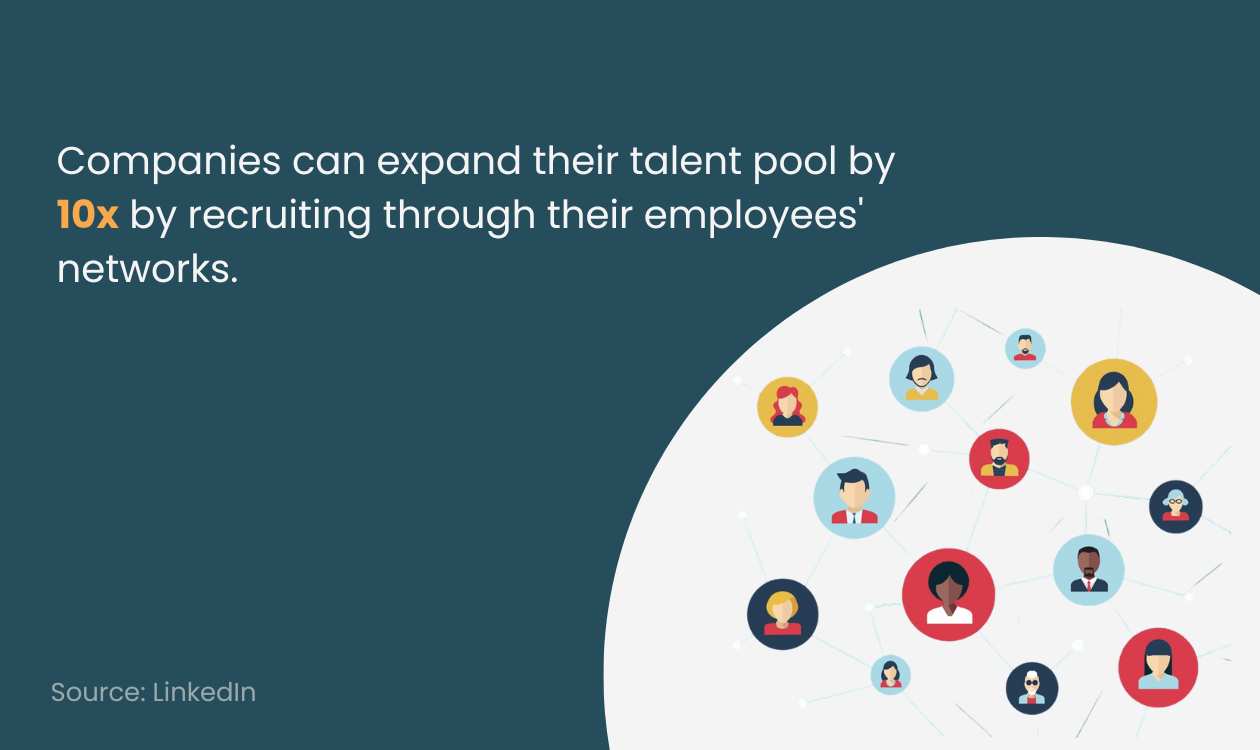
It’s true that skilled people know skilled people. So, companies must set up a cash referral program because it is a lethargic task to find potential candidates from outside. Also, as the market heats up, it becomes tougher for recruiters to find quality tech talent; at that time, employee referrals become more valuable.
As a result, many tech companies offer amazing referral programs. Where they clearly explain the requirement of the open tech role, mention the monetary and non-monetary benefits, and streamline the referral process to make it transparent. Recruiters use online software like ATS to effectively manage the tech worker referral and analyse the process and experiment more.
Also, using the company alumni network would be the best option, too, where the company ask their previous tech employees to recommend the tech talent from their network in return for monetary benefits.
Tech recruiters can be creative and request their current employees to post a story asking for tech referrals and mention the benefits the people will get. Also, recruiters can run Mass Emailing campaigns, where they send cold emails for job referrals. It will be immensely helpful for recruiters to reach many people to ask for a tech referral.
Online tech assessment tools are a lifesaver
Competence of learning is incredibly important to know whether one has truly learned a particular skill set or subject. And what could be a great way to assess a candidate's skills other than actual skill assessment tests for technical and non-technical parameters such as communication skills, behavioural skills, and situational judgment?
Tools such as Codility are used in the market to assess candidates for technical roles such as software developers. Also, HIGHMATCH assesses the candidate's cognitive capabilities, situational judgement, sales skills, and personality.
Conduct video Interviews to evaluate the candidates
In this stage, remote interviewing tools enable recruiters and HRs to shortlist candidates quickly, objectively, and efficiently. Such software feature also automatically records and sends feedback to the candidates. This way, engagement will increase, and candidate experience will improve.
Recruiters can also conduct one-way video interviews where they'll provide a set of questions, and candidates need to record themselves answering those questions. This way, recruiters can evaluate the answers at their convenient time.
Salary negotiation and offer of benefits and perks
The demand for tech talent is very high. So, recruiters must be prepared to offer excellent benefits and perks to increase the offer acceptance ratio. Also, the hirer must be willing to pay the remuneration according to the industry standard to the suitable candidates.
Brief Case Study of Tech Recruitment
Currently, many tech companies conduct tech recruitment to hire technical workers. Let’s dive deep into the following case study of a company that has succeeded in technical recruitment.
Elsner Technologies
Elsner Technologies is a fast-growing enterprise specialising in web and IT solutions, with around 400 employees and an ambition to scale to 1,000 technical staff. Like many technology firms operating at this growth rate, the company faced compounding technical recruitment challenges: sourcing qualified candidates across multiple technical disciplines simultaneously, reducing the time spent on manual resume screening, managing communication across a collaborative hiring team, and keeping pace with the speed of demand from the business.
How iSmartRecruit helps them to recruit tech talent faster?
Elsner found a tech-oriented solution which was an AI-powered hiring software by iSmartRecruit. It helps Elsner to reduce the hiring time greatly by 20 to 30% with autonomous features. Also, it enables the hiring team to streamline communication in collaborative hiring and allows the hiring managers to monitor and take crucial decisions in the tech recruitment workflow.
The social recruiting features help the team source the right technical talent faster. Also, the employee referral portal enables powerful and transparent referral programs to find technical talent. The AI-based resume parser scans numerous resumes in no time, and auto-interview scheduling features save time for their recruiters. This way, the AI-powered ATS software helps Elsener to recruit technical applicants faster and easier.
Final Thought On Technical Recruitment
Technical recruitment will only become more demanding as technology continues to evolve faster than any single training pipeline can keep pace with. The skill sets most in demand today look different from those that were scarce five years ago, and the skill sets that will be most valued in five years are already beginning to emerge. This means that the organisations building a sustainable technical hiring capability not just filling today's vacancies, but developing the sourcing relationships, employer brand and recruitment infrastructure to compete for talent consistently will have a compounding advantage over those that treat each hire as a fresh start.
The combination of specialist human judgement and the right technology is what makes that possible. AI-powered recruitment tools handle the volume, consistency and administrative elements of the technical hiring process automation that used to require entire teams of sourcers and coordinators can now be accomplished by a smaller, smarter team using the right platform. But the human elements understanding the technology landscape, building credibility with technical candidates, making the case for a specific opportunity to a passive engineer who has ten other options still require the skills, relationships and technical literacy that no algorithm replaces.
Invest in both sides of that equation and technical recruitment becomes a genuine competitive advantage. Neglect either one and the talent your competitors are finding and hiring will keep passing you by.
Happy Tech Hiring!!
Want iSmartRecruit to help you with recruiting tech talent faster than your competitors? Want to improve recruitment efficiency? Then, choose our AI Recruitment Technology to attract and acquire the right talent faster than ever. Book a Free Demo Now!

FAQs - Frequently Asked Questions
1. What is technical recruitment and why is it important?
Technical recruitment is the process of finding and hiring candidates for specialised tech roles. It’s essential because tech companies need the right skills to stay competitive and drive innovation, which makes recruiting the best talent critical.
2. What challenges do companies face in technical recruitment?
Companies often struggle with sourcing qualified tech talent, communication gaps, and writing effective job ads. Rapidly evolving technology and passive candidates also add complexity, requiring strategic solutions to overcome these hurdles.
3. How can tech recruiters improve their hiring process?
Recruiters should engage in tech communities, learn relevant technical terms, use assessment tools, and create specific job ads. Understanding the roles they recruit for helps attract the best candidates and streamlines the hiring process effectively.
4. What role does iSmartRecruit play in technical recruitment?
iSmartRecruit provides AI-powered hiring software that streamlines the recruitment workflow. It helps reduce hiring time, improves collaboration, and offers tools like resume parsing and referral portals, making technical recruitment faster and easier.
About the Author