


TL;DR
- Candidate Tracking System (CTS) is an AI-powered software that automates and streamlines recruitment processes for recruiters, hiring managers, and HR professionals.
- Key functions include candidate screening, interview scheduling, sourcing, profile matching, communication, offer management, and onboarding.
- CTS helps improve quality of hire, reduce time and cost-to-hire, streamline workflows, enable collaborative hiring, and increase retention rates.
- There are two main types of CTS: cloud-based (flexible, low IT involvement) and on-premise (more control and customisation).
- CTS eases recruitment tasks such as writing job descriptions, shortlisting applications, posting jobs to platforms, tracking applicants, and scheduling interviews.
- Many CTS pricing models exist, including flat rate, pay per user, pay per vacancy, and pay per module, tailored to business size and needs.
- Using CTS enhances candidate experience, ensures better hiring decisions, and supports company growth with efficient talent acquisition.
Candidate Tracking System is growing too fast and grabbing the attention of recruiters and hiring managers. The reason is its prominent features that serve various benefits.
If you are searching for Candidate Tracking Software or want to change the existing one, check out this blog to learn how candidate software works to align your candidates.
As a hiring manager, you want to bring the best talent to your company.
Attracting competent and professional candidates is the first step in your hiring process, which requires carefulness. From how you write your job description, the qualifications you want, and the kind of experience you would like every employee to possess.
Hiring managers often miss a step and end up hiring the wrong talent.
The Candidate Tracking Software, also called Applicant Tracking System, is created to ensure hiring managers take practical steps to engage the most competent and professional company staff members.
Understanding Candidate Tracking System
What Is a Candidate Tracking System?
Candidate Tracking System is an AI-powered recruitment software that automates hiring administrative tasks for recruiters, hiring managers, and HR professionals and streamlines the hiring workflow. It is a perfect recruitment solution for challenges recruiters are facing in the recruitment landscape.
It helps the recruitment team to source the right candidates to onboard them for growth. Some areas where Applicant Tracking System can help are:
- Candidate screening
- Automatic interview scheduling
- Candidate sourcing
- Profile Matching with Artificial Intelligence (AI)
- Effective communication between the candidate and the hiring teams
- Candidate tracking with custom workflow
- Recruitment Marketing
- Offer management
- Candidate onboarding
How Does a Candidate Tracking System Work?
The Candidate Tracking Software is a complete automation with unique features that eliminate the manual tasks of the recruitment process. With a candidate management system, the hiring manager can post the job, collect applications after conducting the pre-employment assessment test, find the best-matching candidates, and compare candidates based on different criteria.
It also handles the candidate application process, saving time for other resumes. If a candidate is not the proper fit, recruiters and hiring managers can seek the device later to find resumes that match new positions. Assume that you have been contacted some months later by an organisation to which you have already applied; apart from these, the right candidate management system permits the employer to engage with candidates and form strong candidate relationships continuously. The Applicant Tracking System plays a significant role in providing the best candidate experience and ensuring employee retention for growth.
Why Use a Candidate Tracking System?
Nowadays, recruiters and hiring managers prefer to use Candidate Tracking Software because of two major benefits.
Firstly, the applicant tracking system eliminates manual and repetitive hiring tasks and frees recruiters to focus on more important tasks that require critical thinking and a human approach.
Secondly, automated features of the Applicant Tracking System allow recruiters to provide a positive candidate experience throughout the recruitment process.
The following are some of the primary reasons that modern Talent Acquisition Software is vital in the current recruitment landscape.
- Improves quality of hire
- Reduces time-to-hire & cost-to-hire
- Streamlines the recruitment workflow
- Enables collaborative hiring
- Increases retention rate
Types of Candidate Tracking Systems
Cloud-Based CTS
A cloud-based system is hosted online and accessed through a browser. No software installation is required, updates are applied automatically by the provider, and the platform can be accessed from any location or device with an internet connection.
This makes cloud-based CTS the preferred choice for most organisations today, particularly those with remote or distributed hiring teams. Setup is faster, upfront costs are lower, and the ongoing IT overhead is minimal. Providers typically handle security, compliance updates, and infrastructure maintenance as part of the subscription.
On-Premise CTS
An on-premise system is installed directly on your organisation's own servers. This gives you complete control over your data, your security configuration, and how the system is customised to fit your internal processes.
The trade-off is higher upfront investment in hardware and implementation, and ongoing responsibility for maintenance, updates, and IT support. On-premise solutions are typically favoured by large enterprises with strict data sovereignty requirements, highly specific compliance obligations, or existing infrastructure that makes server-based deployment the more practical option.
Which Is Right for Your Organisation?
For the lowest to mid-sized organisations, and for any team that values flexibility and speed of deployment, cloud-based is the better starting point. For enterprises with complex compliance environments or a requirement for deep customisation, on-premise may be worth the additional investment. Some providers also offer hybrid models that combine elements of both.
Recruitment Tasks Performed by the Candidate Tracking System
The Candidate Tracking System helps recruiters perform the overall tasks of the hiring process. Hence, it covers each recruiting job and makes the process hassle-free. However, some recruiting tasks become challenging for recruiters and agencies, such as attracting and finding the perfect candidate for the job.
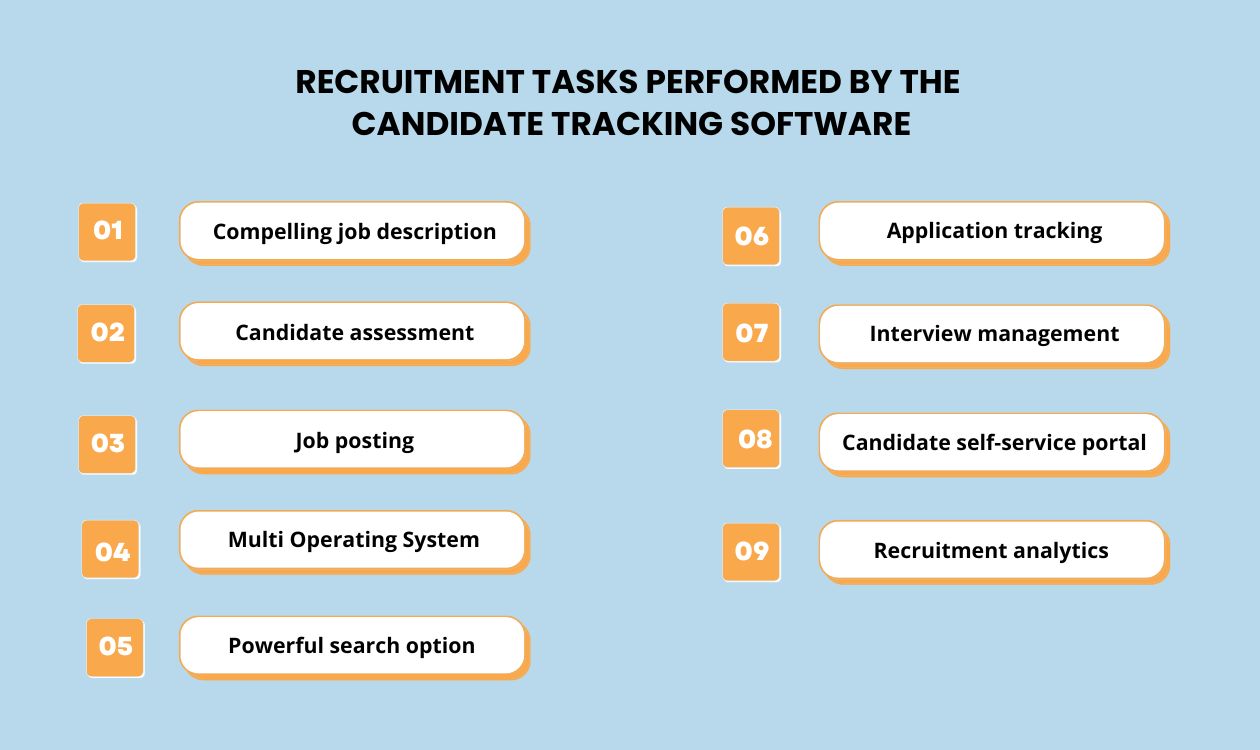
Moreover, performing these manual tasks is burdensome. Recruiting automation streamlines the recruiting process by saving maximum time and resources. Let us look at the different tasks the Candidate Tracking System can perform effortlessly.
1. Helps in Writing Proper Job Descriptions and Requirements
Sometimes, roles are confusing, and even how people grade employees matters. If you don't want such confusion, it is essential to make sure you use the right candidate recruitment software.A
Candidate Tracking System will help you outline your job requirements, from skills to academic qualifications, so applicants can quickly look at your job requirements and know whether they are qualified. Also, you can highlight the vital aspects of the job description through formatting options.
2. Evaluate and Shortlist Applications Quickly
You may receive thousands of applications to the extent that you don't know how to evaluate and shortlist candidates for interviews. The Candidate Tracking Software can perfectly scrutinise your applications by matching the job descriptions with the candidates' profiles and coming up with the best candidates.
All this matching stuff happens in a second, so it saves a great deal of time in pre-screening candidates. It also helps organise the applications that prevent you from making mistakes while shortlisting the candidates.
3. Helps in Posting your Jobs to the Right Platforms
It is true that Posting jobs on the right platforms can lead you to get potential candidates. The applicant tracking system gives you perfect exposure so qualified applicants can easily find your posts. You will have a lot of competent people to choose from, so you will not need to compromise on your requirements. Let your company be reliable by installing and utilising this software.
4. Mobile-friendly Recruitment Software
The software allows you to work it on any device that helps you reach your skilful talents. It enables you to use Windows, iOS or Android; in short, it will not limit you from trying any such devices. In addition, the software's compatibility also supports posting job openings using your mobile phone.
5. Find Best Match Candidates From the Candidate Database
Sometimes, you don't want to use job posts to display your openings to the public, but you need excellent applicants to interview from your talent pool. The AI hiring software makes your search easy to discover skilled candidates from your talent pipeline.
You will get the best candidates to invite them for interviews and hire them for your company. You can even track the CVs and job history of the applicants to know whether they can perfectly fit the role or not, which is the best way to prevent making any mistakes while hiring suitable talent.
6. Effectively Track Applicants
Overall, the recruitment process spans multiple stages like pre-screening, shortlisting, interview, negotiation, offer, and more. With the help of the Candidate Tracking system, you can configure your process workflow and manage every hiring workflow efficiently through the system.
You always want practical analysis regarding talent scrutiny. The software comes with innovative tools that collect, organise, and retrieve all your applications from your best candidates. The software will manage all documents perfectly, so you know how to approach the piles of applications.
7. Streamlines Interview Scheduling

Knowing the questions to ask a candidate is essential because, at times, an applicant might be theoretically qualified but not practically eligible. With the hiring software, you can schedule a video interview, written interview, or screening questionnaire to increase the quality of your opening job hiring. The automation in interviewing tools will find perfect candidates that match your job vacancy.
8. Candidate Self-Service portal
The Candidate Tracking System is one of the essential tools to deliver the best experience to your candidates. You can allow your applicants to self-register through the system. After registration, they can search for matching jobs, track applications, and much more stuff on their own.
9. Recruitment Analytics
The recruitment analytics feature enables hiring managers to evaluate the efficiency of the hiring process. Crucial metrics like time-to-hire, cost-per-hire, sourcing analytics, and quality-of-hire are lifesavers for recruitment managers to check the improvement areas of the recruitment process. Such recruitment KPIs help recruiters to enhance the candidate experience and employer branding throughout the hiring process.
The Three Core Stages of Candidate Tracking
The Candidate Tracking System is divided into various parts. And each element is a step. Every step achieves a particular goal, which leads you to the next step. Let us see what the three significant steps of a candidate tracking process are:
1. Candidate Sourcing
The primary purpose of candidate sourcing is to inform potential candidates about the newly open position and collect the maximum number of applications. This method involves distinguishing top ability that coordinates with your necessary skills, education, and interests for the open positions in your organisation or another organisation.
There are various ways to source the candidates, such as job board postings, social media platforms, and internal recruiting through an employee referral program. The Candidate Tracking System automates these tasks and saves time attracting and sourcing passive candidates.

2. Candidate Shortlisting
In this stage, the filtering of candidate applications comes off. The filtering might happen before reaching the system with the help of a pre-employment assessment test; otherwise, after collecting all the applications into the system and then assigning the best match candidates to the job.
This filtering process makes the recruiting process enjoyable and makes it less challenging to hire great employees for the organisation.
3. Communication
Throughout the hiring process, the CTS manages communication with candidates automatically. Status updates, interview invitations, rejection notifications, and offer letters are sent at the appropriate stage without the recruiter needing to draft each message individually. This keeps candidates informed, reduces drop-off, and reflects positively on your employer brand.
How Much Do Candidate Tracking Systems Usually Cost?
The prices of a Candidate Tracking System vary and are custom. If you are surfing on the internet to find the best Applicant Tracking System and you can’t find the accurate pricing page, that’s because most SaaS companies choose their rates according to the number of job openings, size of the businesses, integrations, modules, and many other factors. Before pricing is adapted for you, you will begin with one of the following factors:
Flat rate: This Applicant Tracking System’s pricing model basically means you pay one amount despite of user count. Usually, the flat rate is calculated as per the firm size and is best for large enterprises that can afford a multi-year-long contract at once.
Pay per user: The fee scales with the number of active users on the platform, typically recruiters, hiring managers, and HR team members. This model works well for small to mid-sized organisations where the number of people involved in hiring is limited and stable.
Pay per vacancy: Pricing is based on the number of active job openings at any one time. This suits organisations with lower or seasonal hiring volumes, where paying a flat fee year-round would be inefficient.
Pay per module: Some platforms allow organisations to start with a core package and add modules, such as a recruitment CRM, onboarding tools, or advanced analytics, as separate add-ons. This offers flexibility for teams that want to expand functionality gradually rather than committing to a full platform upfront.
When evaluating cost, factor in not just the subscription fee but also implementation costs, training requirements, integration complexity with your existing HR systems, and the expected return from reduced time-to-hire and administrative overhead.
How to Choose the Right Candidate Tracking System
The market for candidate tracking software is large and varied. Before making a decision, consider the following:
Ease of use: A platform that your team will not adopt fully is not worth the investment. Prioritise intuitive interfaces and low training requirements, particularly for hiring managers who are not recruiters by profession.
Integration capabilities: Your CTS needs to connect with your existing HR information system, job boards, calendar tools, and communication platforms. Poor integration creates data silos and manual workarounds.
Scalability: Choose a platform that can grow with your organisation. A solution that works well for 20 hires per year should also handle 200 without requiring a full platform migration.
Compliance support: Depending on your industry and operating region, your CTS may need to support GDPR compliance, equal opportunity reporting, right-to-work verification, and audit trail requirements.
Analytics depth: The more granular your data, the more precisely you can improve your process. Look for platforms that offer customisable dashboards and reporting rather than just basic metrics.
Candidate experience features: Self-service portals, mobile-friendly application processes, and automated communication tools all contribute to the candidate experience your platform delivers.
Final Thought on Candidate Tracking System
In conclusion, Candidate Tracking System is always the best for you if you experience a smooth and effective hiring process. The rapidly increasing demand for better applicant tracking systems made organisations invest more and leverage it entirely. Always make sure you do the best job posting and description so that you may successfully increase the brand value of your business. You can also enjoy the best referrals and recommendations to know the person better; you are hiring. You can make your company grow at all times from the top and most efficient talented employees.

Frequently Asked Questions (FAQs)
1. What is a Candidate Tracking System and why is it important?
A Candidate Tracking System (CTS) is recruitment software that automates hiring tasks like screening and scheduling. It improves efficiency and candidate experience, helping companies hire the best talent faster with tools like iSmartRecruit.
2. How does cloud-based CTS differ from on-premise systems?
Cloud-based CTS is accessible online with easy updates and minimal IT needs. On-premise is installed locally, giving more control but requiring IT support. Your choice depends on budget, security, and company needs.
3. Can CTS help improve the quality of new hires?
Yes, CTS uses AI to match candidate profiles with job requirements quickly. It streamlines shortlisting and supports better decision-making, which results in hiring higher quality candidates for your organisation.
4. What recruitment tasks can CTS automate?
CTS automates tasks like job postings, candidate screening, interview scheduling, communication, and offer management. This saves time and reduces errors throughout the recruitment process.
5. Is using a Candidate Tracking System cost-effective for small businesses?
Definitely. Many CTS providers offer flexible pricing models like pay per user or vacancy, which make it affordable for small businesses. Systems like iSmartRecruit scale with your needs efficiently.
About the Author