
1.webp "Inbound Recruitment: Meaning, Benefits, Drawbacks & Tips")
Inbound recruitment focuses on attracting candidates to your organisation instead of actively reaching out to them. By combining employer branding, content marketing, social media, and a positive candidate experience, companies can build long-term relationships with potential talent.
In 2026, candidates increasingly research companies before applying for jobs. This makes online visibility, company culture, and a strong employer brand important parts of the recruitment process. However, inbound recruitment may not be the right approach for every hiring situation, particularly when an organisation needs to fill a position quickly.
This guide explains what inbound recruitment is, how it differs from outbound recruitment, its key benefits and challenges, and practical strategies recruiters can use to attract better candidates.
TL;DR
- Inbound Recruitment attracts high-quality candidates by building a strong employer brand and positive company culture.
- It boosts online visibility, reduces the need for outbound outreach, and enhances the candidate experience.
- Inbound methods work well for long-term recruitment but can be less effective for urgent or short-term hiring due to waiting times.
- Successful strategies include updating websites, making them mobile-friendly, strengthening social media presence and creating engaging content.
Are you ready to revolutionise your hiring process and bring the best talent to your doorstep?
Imagine a recruitment strategy that not only flips the script but also boosts the quality of your candidates. This is where Inbound Recruitment steps in a dynamic approach that magnetically attracts top-tier professionals to your organisation.
Consider this: Traditional methods often lead to a flood of mismatched applications, making finding the perfect fit akin to searching for a needle in a haystack. But with Inbound Recruitment, the game changes.
Let's take a quick peek at the numbers – studies reveal that companies embracing this method experience a 50% increase in candidate quality, setting the stage for greater efficiency and productivity.
In today's fast-paced business landscape, it's no longer just about finding the right candidates; it's about making them find you. So, why is mastering Inbound Recruitment crucial for staying ahead?
Let's dive deep into the meaning, benefits, drawbacks, and expert tips that can reshape your approach to talent acquisition. Get ready to supercharge your recruitment game and unlock a new realm of possibilities.
Let's jump in!
What is Inbound Recruitment?
With Inbound recruitment, organisations form a positive brand image through content marketing. It highlights the environment and culture that attracts candidates to them. Rather than the organisations looking for the candidates, it is the other way around.
Inbound recruitment targets passive job seekers. They are the ones that are already employed somewhere but would want to opt for better opportunities with other employers.
Inbound recruitment can attract:
- Active job seekers looking for new opportunities.
- Passive candidates who are not actively searching but may be open to the right role.
- Professionals interested in a company's culture, values, and career opportunities.
Did you know? The market is filled with 73% of passive job seekers. They are only sometimes seeking jobs but would be interested in working with your organisation. Your Inbound recruitment strategies will connect them to your organisation, leading to a diverse talent pool.
So, what is employer branding?
It is a good name attached to an employer because of its positive value perception among job seekers. It takes years to form a brand image, yet it is fragile. One wrong step, and you bid farewell to the good books of your potential employees.
Inbound VS Outbound Recruitment
Inbound and outbound recruitment use different approaches to attract talent.
Inbound recruitment focuses on creating content, improving employer branding, and building online visibility so that candidates discover and approach the organisation. It is generally more suitable for long-term talent acquisition and building a future talent pipeline.
Outbound recruitment involves actively reaching out to candidates through direct messages, emails, calls, sourcing platforms, and other channels. This approach can be more useful when organisations need to fill roles quickly or require candidates with specific skills.
Many organisations benefit from using both approaches. Inbound recruitment helps build a long-term talent pipeline, while outbound recruitment provides a more direct way to reach candidates when immediate hiring is required.
4 Key Benefits of Inbound Recruitment
Inbound recruitment has many benefits. All it requires is smart handling. If you know the art of Inbound recruitment, things will fall in your favour. Here are some of the many benefits of Inbound recruitment.
1. Makes You More Approachable
Do you ever wonder how often you search your queries on Google? It is so many times that we all lose count.
When candidates graduate, Google is their saviour in searching for suitable jobs. When you carry Inbound recruitment, you need to increase your online visibility.
With your Search Engine Optimised content, Google ranks you higher in its search results. Why would any candidate not want to be a part of your company when all Google brings up is your webpage? Hence, Inbound recruitment marketing forms a positive brand image and makes you more reachable.
2. You Don't Need to Reach out to Candidates
Unlike outbound recruitment, you don't have to e-mail, cold-calling, or advertise jobs every time there is a vacancy in your organisation. Instead, candidates themselves visit your website regularly to stay updated. Suppose your organisation's Inbound recruitment marketing is effective.
In that case, your website traffic will increase. Gallup reported that in 2015, 51% of already employed Americans were searching for new jobs or watching for any openings. In this case, Inbound recruitment marketing helps in better talent acquisition.
3. Helps you Fill the Open Posts Quickly
Even if you are not seeking employees, Inbound recruitment engages candidates and helps build strong relationships. You make a healthy bond with strangers, so they turn up to you when you conduct a recruitment process. In effect, your vacancies fill immediately, which prevents losses from employee shortages.
Statistics show that 60% of employers worry about the cost of unfilled positions. Similarly, 79% of Australian hiring managers point out the challenge of hiring on time, as reported by Robert Half Research.
Inbound recruitment is helpful, but this is not the case. Along with so many benefits, there are some drawbacks too.
4. Elevate Positive Candidate Experience
Recruiters need to ensure a personalised candidate experience via prompt and effective communication. This way, the candidate will be informed and engaged.
It leads to a higher satisfaction ratio among candidates and helps you attract a diverse range of candidates in the future.
So, the future talent will get a positive vibe about your company and eventually boost your employer's brand reputation.
Challenges in Inbound Sourcing
As a recruiter, you must consider the drawbacks of inbound recruitment before deciding on a strategy. However, it has more benefits; pay attention to the following drawbacks for better results.
1. Unsuitable for Short-term Recruitment
According to an SHRM research report, 83% of HR professionals reported having difficulty recruiting suitable job candidates in the past 12 months.
The percentage of these HR professionals increased over time. One of the main reasons for this difficulty was a low number of applicants, as reported by 51% of hiring managers.
.webp.dat)
With a rise in recruitment difficulties, inbound recruitment methods are unfit for short-term hiring. If time is less, HR professionals can save time for suitable candidates to contact. The Inbound recruitment approach is best if Human Resource Planners forecast a vacancy in the future.
2. You Have to Wait for the Right Candidate to Get in Touch
As you know, Inbound recruitment marketing helps create awareness about your organisation's existence. When people perceive your company culture positively, they want to be a part of your team. This approach gathers many resumes. But if you depend on Inbound recruitment alone, you will have to wait for suitable candidates to get in touch.
Unless that happens, your wait will be prolonged, disturbing your recruitment functions. All are waiting, and no work risks the growth factor. Moreover, this is not the case with one position alone; with every vacancy, the same waiting process repeats, compromising the work.
3. General Targeting Widens Your Talent Pool
Inbound recruitment can attract a large and diverse range of applicants. While this can increase your talent pool, it may also result in applications from candidates who do not meet the requirements of the role.
Recruiters may therefore need to spend additional time reviewing and filtering applications.
Using clear job descriptions, specific requirements, targeted content, and an effective Applicant Tracking System (ATS) can help manage a larger candidate pool more efficiently.
Practical Tips for Inbound Recruitment in 2026
Follow the tips listed below and get things sorted!
1. Update Your Website
Updated information with relevant keywords on your website will increase your online visibility. It will also improve your employer branding. Even if your blog posts are top-ranked on Google right now, there is always someone doing a better job for a higher ranking. Important information is a few clicks away these days; hence you need to update your website regularly.
2. Make the Mobile-friendly User Interface
Your mobile-friendly user interface will further increase your talent pool. Did you know? The first quarter of 2023 generated 54.8% of global website traffic. Today, smartphones are more commonly used than laptops.
Make sure your website:
- Loads quickly.
- Is easy to navigate on mobile devices.
- Displays job descriptions clearly.
- Provides a simple application process.
- Uses mobile-friendly forms.
3. Strengthen Your Social Media Presence
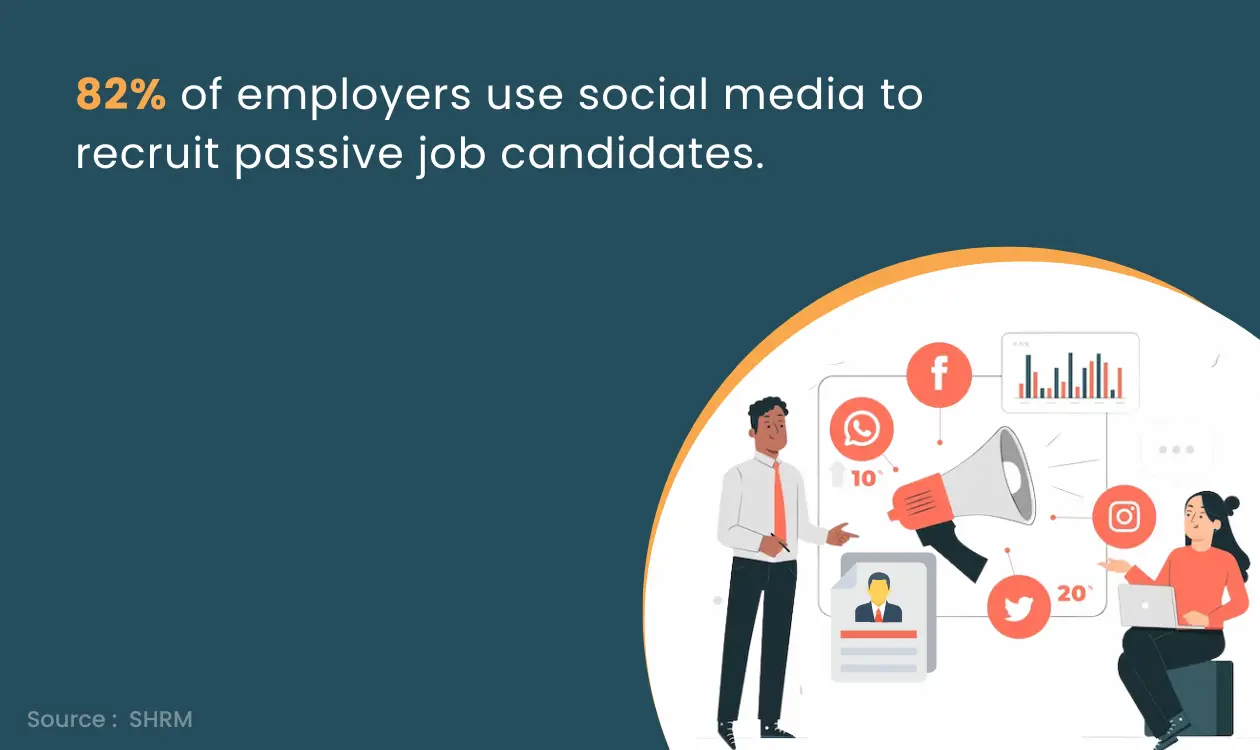
A survey found that 82% of employers use social media to recruit passive candidates. Social media is not used for entertainment purposes alone. Instead, recruiters leave no platform unturned to acquire the best talents. These recruiters are your competitors. So, it would help if you strengthen your social media presence for inbound recruitment.
Recruiters can use social platforms to share:
- Company culture content.
- Employee stories.
- Career opportunities.
- Workplace events.
- Industry insights.
- Learning and development opportunities.
Through social media, your employees will know more about your organisation, its culture, practices, etc., informally. Did you know? Top talents stay in the market for only ten days before employers hire them. So, before candidates can even reach you through your career website, they are taken down. Hence, social media is crucial for Inbound recruitment.
4. Create and Share Highly Useful Content
- What are your strong points that candidates will admire?
- How do you help them to grow?
- What is the image of your company's work environment?
Create informative and engaging content to answer the above questions. This will add value to your target audience. It will be easier for you to attract them when the position opens in the company.
Here are some tips for you to elevate your recruitment efforts via content marketing efforts.
- Apply SEO and PPC techniques
- Find the relevant keywords
- Choose the right social media channel
- Create a compelling career page
Should You Choose an Inbound Recruitment Approach?
When it comes to whether or not you should choose an Inbound recruitment approach, there are both advantages and disadvantages to consider.
While Inbound recruitment can provide you with a wider range of candidates to choose from, it's important to note that there are better solutions than this one.
To make the most of Inbound recruitment, you must work hard to establish a strong brand image that will attract suitable candidates to your company.
That being said, if you're willing to put in the effort to create a solid brand image, Inbound recruitment can be a great way to ensure that you always have a steady stream of potential employees to choose from.
By using both recruitment methods, Inbound and outbound, as needed, you can ensure that you're always selecting from the best possible pool of candidates for any given position.
So, while Inbound recruitment may not be the perfect solution for every company, it is definitely worth considering if you're looking for ways to find and attract a wider range of top applicants for your organisation.
How iSmartRecruit Can Help Your Inbound Recruitment Strategy?
Want to simplify your inbound recruitment workflow?
Did you say 'YES' out loud? Then iSmartRecruit is at your rescue.
Streamline your inbound recruitment processes and make them more efficient.
Leverage features like website integration, automated social media posting, and job board promotions to attract more candidates.
Elevate your employer brand with Recruitment Marketing features like Branded Career Pages, Social Recruiting, Email Marketing Campaigns and Mobile Recruiting.
With iSmartRecruit, you can easily manage all aspects of your inbound recruitment strategy and achieve your hiring goals more effectively.
Conclusion
Inbound recruitment helps organisations attract candidates by building a strong employer brand, creating valuable content, and improving their online presence. It can support long-term talent acquisition, strengthen candidate relationships, and improve the overall candidate experience.
However, inbound recruitment may not be suitable for urgent hiring or highly specific roles when immediate candidate outreach is required. For the best results, organisations should combine inbound and outbound recruitment strategies based on their hiring needs. By using the right mix of employer branding, recruitment marketing, social media, and recruitment technology, companies can build a stronger talent pipeline and attract the right candidates more effectively.

Frequently Asked Questions (FAQs)
1. What is inbound recruitment, and how does it differ from outbound recruitment?
Inbound recruitment focuses on attracting candidates by building a strong employer brand and positive company culture, allowing candidates to find you. Outbound recruitment involves reaching out directly to candidates, often used for urgent hiring.
2. Can inbound recruitment help attract passive job seekers?
Yes, inbound recruitment strategies effectively target passive job seekers who are currently employed but open to better opportunities. It connects them to your organisation, broadening your talent pool.
3. What are the main benefits of using inbound recruitment?
Inbound recruitment increases your online visibility, reduces the need to actively contact candidates, and helps fill open positions more quickly. It also enhances candidate experience and employer branding.
4. Are there any drawbacks to inbound recruitment?
Inbound recruitment may not be suitable for urgent, short-term hiring since you must wait for candidates to approach you. It can also lead to a broader talent pool, requiring careful filtering.
5. How can iSmartRecruit support my inbound recruitment efforts?
iSmartRecruit offers tools like website integration, automated social media posting, job board promotions, and recruitment marketing features to streamline your inbound recruitment process and attract quality candidates.
About the Author